Comparative Study
. 2019 Aug 7;20(1):482.
doi: 10.1186/s13063-019-3556-4.

NA-CONTROL: a study protocol for a randomised controlled trial to compare specific outpatient rehabilitation that targets cerebral mechanisms through relearning motor control and uses self-management strategies to improve functional capability of the upper extremity, to usual care in patients with neuralgic amyotrophy

Affiliations
Comparative Study

NA-CONTROL: a study protocol for a randomised controlled trial to compare specific outpatient rehabilitation that targets cerebral mechanisms through relearning motor control and uses self-management strategies to improve functional capability of the upper extremity, to usual care in patients with neuralgic amyotrophy

Renee Lustenhouwer et al. Trials. .

Abstract

Background: Neuralgic amyotrophy (NA) is a distinct peripheral neurological disorder of the brachial plexus with a yearly incidence of 1/1000, which is characterised by acute severe upper extremity pain. Weakness of the stabilising shoulder muscles in the acute phase leads to compensatory strategies and abnormal motor control of the shoulder - scapular dyskinesia. Despite peripheral nerve recovery, scapular dyskinesia often persists, leading to debilitating residual complaints including pain and fatigue. Evidence suggests that persistent scapular dyskinesia in NA may result from maladaptive cerebral neuroplasticity, altering motor planning. Currently there is no proven effective causative treatment for the residual symptoms in NA. Moreover, the role of cerebral mechanisms in persistent scapular dyskinesia remains unclear.

Methods: NA-CONTROL is a single-centre, randomised controlled trial comparing specific rehabilitation to usual care in NA. The rehabilitation programme combines relearning of motor control, targeting cerebral mechanisms, with self-management strategies. Fifty patients will be included. Patients are recruited through the Radboud university medical center Nijmegen, the Netherlands. Patients with a (suspected) diagnosis of NA, with lateralized symptoms and scapular dyskinesia in the right upper extremity, who are 18 years or older and not in the acute phase can be included. The primary outcome is the Shoulder Rating Questionnaire score, which measures functional capability of the upper extremity. Secondary clinical outcomes include measures of pain, fatigue, participation, reachable workspace, muscle strength and quality of life. In addition, motor planning is assessed with first-person motor imagery and functional magnetic resonance imaging. In a sub-study the patients are compared to 25 healthy participants, to determine the involvement of cerebral mechanisms. This will enable interpretation of cerebral changes associated with the rehabilitation programme and functional impairments in NA.

Discussion: NA-CONTROL is the first randomised trial to investigate the effect of specific rehabilitation on residual complaints in NA. It also is the first study into the cerebral mechanisms that might underlie persistent scapular dyskinesia in NA. It thus may aid the further development of mechanism-based interventions for disturbed motor control in NA and in other peripheral neurological disorders.

Trial registration: ClinicalTrials.gov, NCT03441347 . Registered on 20 February 2018.

Keywords: Maladaptive neuroplasticity; Motor control; Neuralgic amyotrophy; Neurorehabilitation; Occupational therapy; Parsonage Turner syndrome; Peripheral nerve dysfunction; Physical therapy; Scapular dyskinesia; Upper extremity.


Conflict of interest statement

The authors declare that they have no competing interests.

Figures

Fig. 1
Fig. 1
Cerebral reorganisation and rehabilitation after peripheral dysfunction in neuralgic amyotrophy. Schematic presentation of the concept that peripheral nerve damage leads to adaptations in motor planning that are compensatory in the acute phase, but lead to impaired motor control in the chronic phase. Neuralgic amyotrophy (NA) is an acute autoimmune inflammation of the brachial plexus, characterised by acute severe upper extremity pain and multifocal paresis. Many patients with NA develop abnormal motor control of the scapular region, scapular dyskinesia, which persists even after peripheral nerve recovery. This suggests that persistent scapular dyskinesia in NA may result from maladaptive neuroplasticity. Rehabilitation focused on relearning motor control, targeting cerebral mechanisms, can improve scapular movement and positioning, indicating that the impaired motor planning can be restored. This figure includes images that are adapted from Nervous system diagram licensed under the Creative Commons Attribution-Share Alike 4.0 International license, authored by Jordi March i Nogué and William Crochot
Fig. 2
Fig. 2
Flowchart of the study design: 50 neuralgic amyotrophy patients will be included. After the baseline measurement, participants are randomised into either the intervention group or the usual care group (1:1 ratio). After the first 17-week treatment period, both groups will undergo the first outcome measurement. The usual care group will then receive the 17-week rehabilitation program, after which they will undergo the second outcome measurement. Participants in both groups will complete a follow up from home 17 weeks after completing the rehabilitation program. Wks, weeks
Fig. 3
Fig. 3
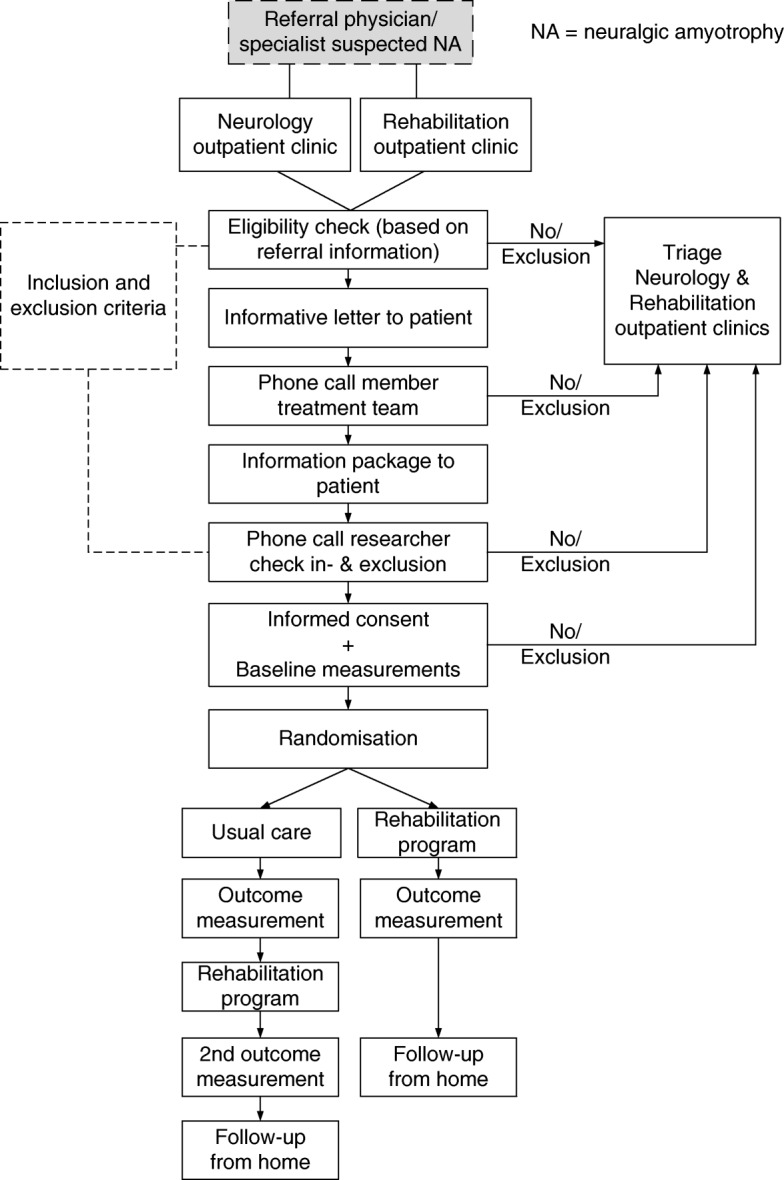
Flow-chart of patient recruitment, consent and other procedures of the study. NA, neuralgic amyotrophy
Fig. 4
Fig. 4
Overview of assessments and treatment for the intervention group (a) and the usual care group (b). A single treatment session consists of 1 h of physical therapy and 1 h of occupational therapy. BM, baseline measurement; PP, visit to out-patient plexus clinic; TS, treatment session; OM, outcome measurement; F-U, follow up
Fig. 5
Fig. 5
Treatment model with the components addressed during the rehabilitation programme. Issues in the outer two circles (External factors, Activity and Participation) form the main focus of the occupational therapy sessions. During the physical therapy sessions, the main focus is on improving body functions. All other components (i.e. disease knowledge, fatigue, pain, behaviour and self-efficacy and self-management) are addressed during occupational and physical therapy. This is accomplished through conveying knowledge of neuralgic amyotrophy and adaptation of behaviour related to functioning in daily life. Reproduced with permission from IJspeert et al. NeuroRehabilitation 2013;33:657–665 [14]

References

    1. Helmich RC, de Lange FP, Bloem BR, Toni I. Cerebral compensation during motor imagery in Parkinson's disease. Neuropsychologia. 2007;45(10):2201–2215. doi: 10.1016/j.neuropsychologia.2007.02.024. - DOI - PubMed
    1. Samuel M, CeballosBaumann AO, Blin J, Uema T, Boecker H, Passingham RE, et al. Evidence for lateral premotor and parietal overactivity in Parkinson's disease during sequential and bimanual movements - a PET study. Brain. 1997;120:963–976. doi: 10.1093/brain/120.6.963. - DOI - PubMed
    1. Simon NG, Franz CK, Gupta N, Alden T, Kliot M. Central adaptation following brachial plexus injury. World Neurosurg. 2016;85:325–332. doi: 10.1016/j.wneu.2015.09.027. - DOI - PubMed
    1. Maeda Y, Kettner N, Holden J, Lee J, Kim J, Cina S, et al. Functional deficits in carpal tunnel syndrome reflect reorganization of primary somatosensory cortex. Brain. 2014;137:1741–1752. doi: 10.1093/brain/awu096. - DOI - PMC - PubMed
    1. Comerford MJ, Mottram SL. Functional stability re-training: principles and strategies for managing mechanical dysfunction. Man Ther. 2001;6(1):3–14. doi: 10.1054/math.2000.0389. - DOI - PubMed

Publication types

MeSH terms

Associated data