Medication Errors: Is it the Hidden Part of the Submerged Iceberg in Our Health-care System?
- PMID: 31392175
- PMCID: PMC6652282
- DOI: 10.4103/ijabmr.IJABMR_96_19
Medication Errors: Is it the Hidden Part of the Submerged Iceberg in Our Health-care System?
Abstract
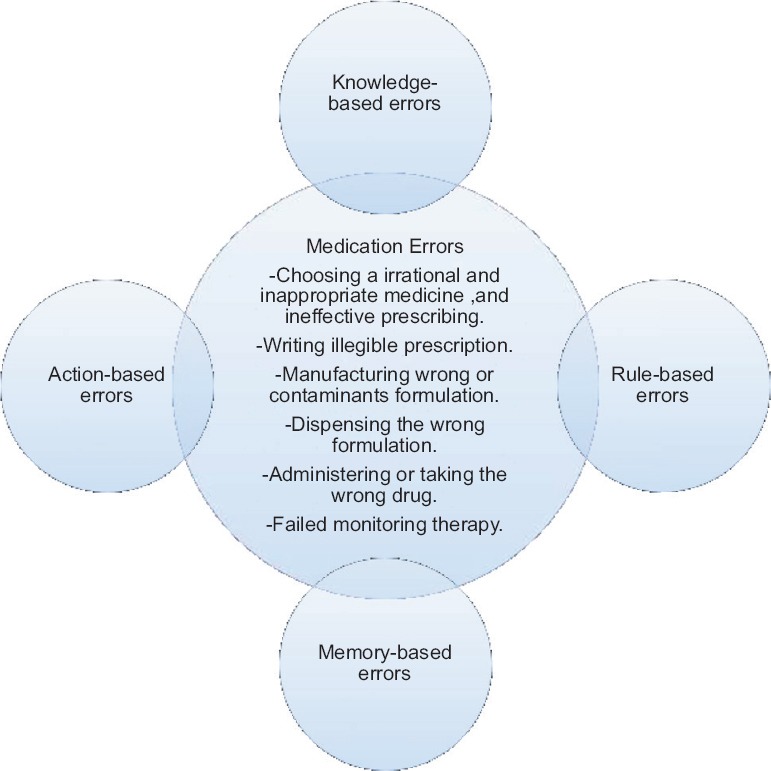
Medication error (ME) is an adverse preventable event which happens due to the inappropriate use of medication that leads to patient harm. Such events may be related to professional practice, health-care products, procedures, and systems including prescribing, communication, product labeling, packaging, and nomenclature, compounding, dispensing, distribution, administration, education, monitoring, and use. A major ME is the one, which results in either permanent harm or transfer to the intensive care units or death. When an error is identified, it shall be reported immediately. It must also be nonpunitive so that staff does not have to be afraid of repercussions. An error shall be reported to the concerned consultant immediately. Continuous monitoring and frequent assessments shall be done for the patient. A root cause analysis shall be done for all serious MEs.
Keywords: Administration; dispensing education; medication errors; monitoring.
Conflict of interest statement
There are no conflicts of interest.
Figures
References
-
- Duerden M, Avery AJ, Payne RA. Polypharmacy and Medicines Optimisation: Making it Safe and Sound. London: King's Fund; 2013.
-
- The National Coordinating Council for Medication Error and Prevention (NCCMERP) The Council: Moving into the Second Decade “Developing Recommendations and Offering Tools”. 2010
-
- ASHP guidelines on preventing medication errors in hospitals. Am J Hosp Pharm. 1993;50:305–14. - PubMed
-
- Gandhi TK, Weingart SN, Borus J, Seger AC, Peterson J, Burdick E, et al. Adverse drug events in ambulatory care. N Engl J Med. 2003;348:1556–64. - PubMed
-
- To Err is Human: Building a Safer Health System. 1st ed. Washington, DC: National Academy Press; 1999. Institute of Medicine.
Publication types
LinkOut - more resources
Full Text Sources
Miscellaneous