


Longitudinal virological outcomes and factors associated with virological failure in behaviorally HIV-infected young adults on combination antiretroviral treatment in the Netherlands, 2000 to 2015
- PMID: 31393344
- PMCID: PMC6709178
- DOI: 10.1097/MD.0000000000016357
Longitudinal virological outcomes and factors associated with virological failure in behaviorally HIV-infected young adults on combination antiretroviral treatment in the Netherlands, 2000 to 2015
Abstract
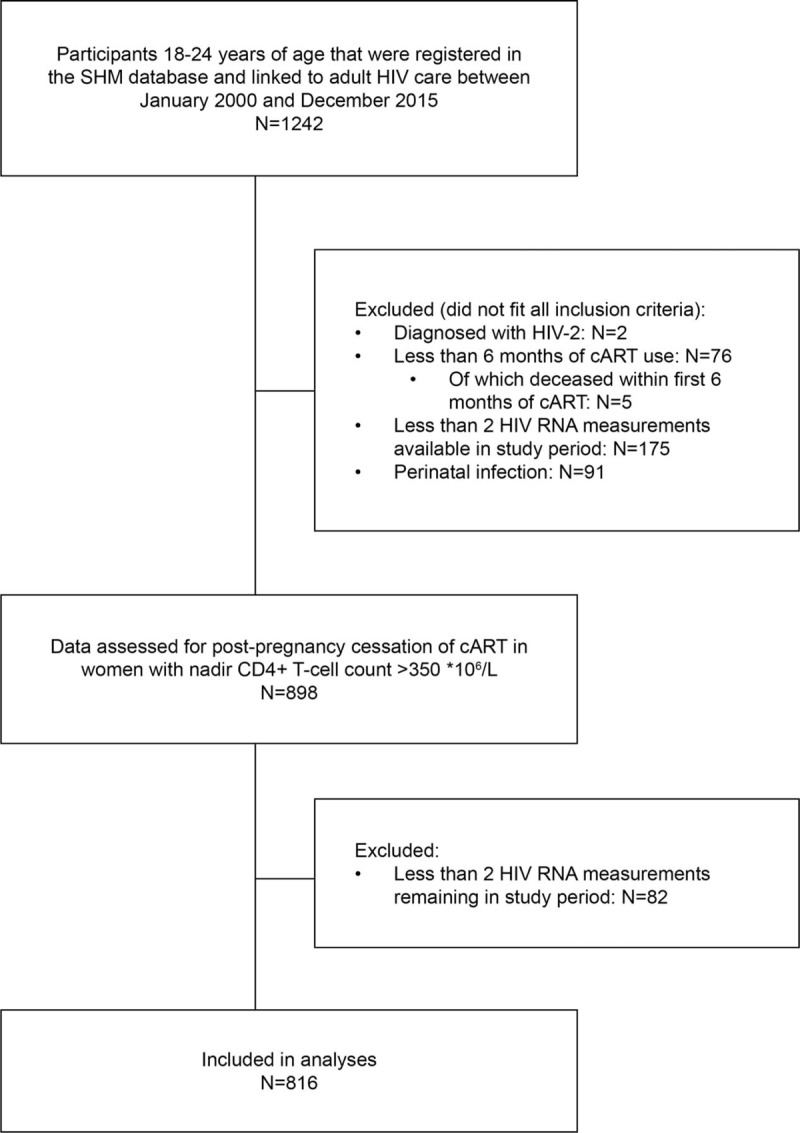
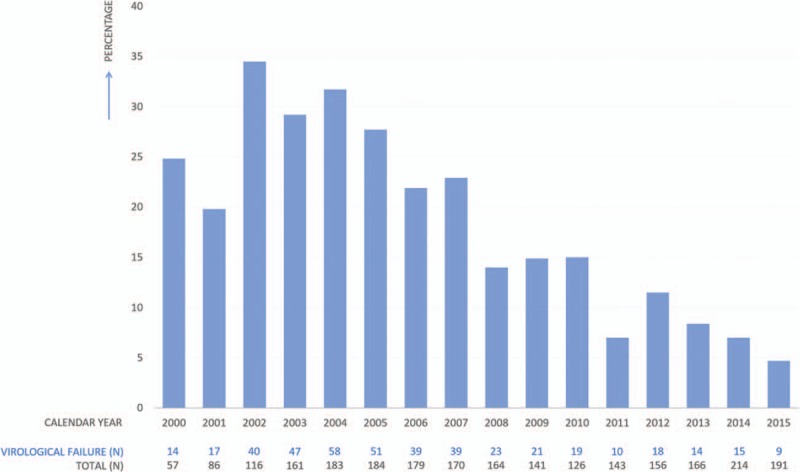
Achieving and maintaining viral suppression in young adults (18-24 years) living with HIV is challenging. Overall HIV viral suppression rates are lower in young as compared to older adults. Longitudinal data provide valuable insight on dynamics of viral suppression and variables of potential influence on HIV virological failure (VF), but is scarce in young adults living with HIV on combination antiretroviral therapy (cART). We evaluated longitudinal virological outcomes of behaviorally young adults (18-24 years) living with HIV in the Netherlands over a period of 15 years.We analyzed data from the Dutch national HIV database of 816 young adults living with HIV on cART in the Netherlands from 2000 to 2015. VF was defined as 2 consecutive detectable plasma HIV-1 viral load (VL) measurements > 200 copies/ml. Generalized linear mixed model analyses were used to assess HIV VF over time and identify risk factors associated with VF.VF during the study follow-up occurred at least once in 26% of cases. The probability of experiencing VF decreased over the study period per calendar year (OR 0.78, 95% confidence interval [CI];0.72; 0.85). Factors significantly associated with VF were being infected through heterosexual contact (OR 5.20, CI 1.39;19.38) and originating from Latin America or the Caribbean (OR 6.59, CI 2.08;20.92). Smaller, yet significant risk factors for VF were being infected through a blood transfusion or a needle accident (OR9.93, CI 1.34;73.84, and having started with cART with a nadir CD4 count >500 cells/μl (OR 11.36, CI 2.03;63.48).In our large cohort of young adults, the risk of VF has diminished over 15 years. Specific subgroups were identified to be at risk for suboptimal treatment.
Conflict of interest statement
The authors report no conflicts of interest.
Figures
References
-
- US Department of Health and Human Services. Treatment Goals | Adult and Adolescent ARV | AIDS info. https://aidsinfo.nih.gov/guidelines/html/1/adult-and-adolescent-arv/9/tr... [Accessed September 26, 2016].
-
- Rodger AJ, Cambiano V, Bruun T, et al. Sexual activity without condoms and risk of hiv transmission in serodifferent couples when the hiv-positive partner is using suppressive antiretroviral therapy. JAMA 2016;316:171. - PubMed
-
- World Health Organization. Global Report on Early Warning Indicators of Hiv Drug Resistance Hiv Drug Resistance. 2016; (July):9. http://apps.who.int/iris/bitstream/handle/10665/246219/9789241511179-eng... [accessed September 5, 2017].
-
- Spear LP. The adolescent brain and age-related behavioral manifestations. Neurosci Biobehav Rev 2000;24:417–63. - PubMed
Publication types
MeSH terms
Substances
LinkOut - more resources
Full Text Sources
Medical
Research Materials
