Review
. 2019 Aug 8;17(1):64.
doi: 10.1186/s12915-019-0685-x.

Synthetic Biology Goes Cell-Free

Affiliations
Review

Synthetic Biology Goes Cell-Free

Aidan Tinafar et al. BMC Biol. .

Abstract

Cell-free systems (CFS) have recently evolved into key platforms for synthetic biology applications. Many synthetic biology tools have traditionally relied on cell-based systems, and while their adoption has shown great progress, the constraints inherent to the use of cellular hosts have limited their reach and scope. Cell-free systems, which can be thought of as programmable liquids, have removed many of these complexities and have brought about exciting opportunities for rational design and manipulation of biological systems. Here we review how these simple and accessible enzymatic systems are poised to accelerate the rate of advancement in synthetic biology and, more broadly, biotechnology.


Conflict of interest statement

The authors declare that they have no competing interests.

Figures
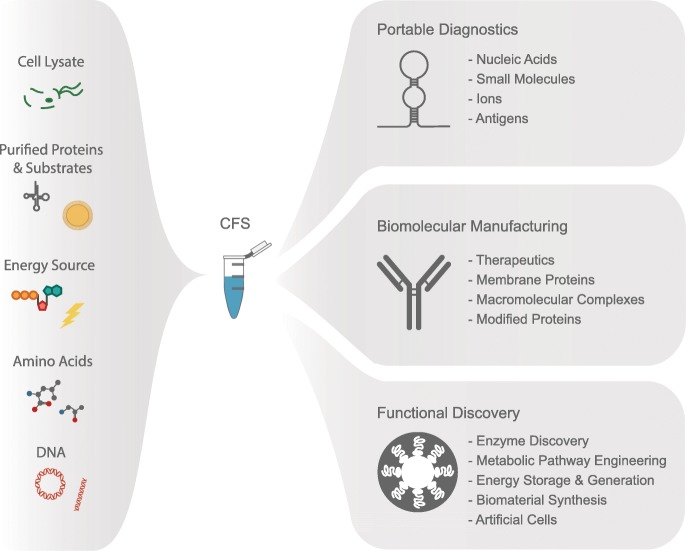
Fig. 1
Fig. 1
Cell-free protein expression systems and their applications. Capitalizing on their open nature, CFS can be rationally assembled to include cell lysates, purified proteins, energy sources (e.g., ATP), amino acids, other substrates (such as modified tRNAs and membrane mimics) and RNA or DNA (circular or linear). CFS can be applied in portable diagnostic devices [46, 50] and also hold great potential for biomolecular manufacturing [49, 51]. Additionally, CFS can enable discovery of novel enzymes (e.g., through directed evolution) [52]
Fig. 2
Fig. 2
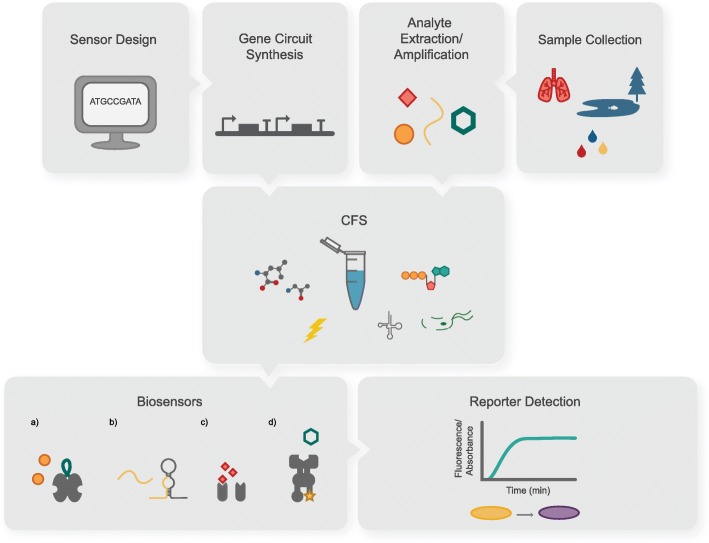
Overview of the use of biosensors in CFS. The general workflow usually involves in silico design of gene circuits encoding biosensors and reporter proteins, followed by chemical synthesis of such circuits. Meanwhile, patient or environmental samples are collected, target analytes are extracted, and, in some cases, amplified. The gene circuits and target analytes are then added to CFS. Examples of biosensors in CFS have included a) mercury (II) detection using the MerR repressor[45], b) viral and bacterial nucleic acid sensing using toehold switch-based sensors [46, 50, 59], c) identification of P. aeruginosa infection by its quorum sensing molecule, 3-oxo-C12-HSL, using the LasRV sensor [61] and d) recognition of an endocrine-disrupting compound by utilizing an allosterically activated fusion protein containing the ligand binding domain of a human estrogen receptor [62, 63]. Reporters (e.g., colorimetric or fluorescent) can then produced, contingent upon analyte detection, enabling clinical diagnosis (e.g., using standard spectrophotometers)
Fig. 3
Fig. 3
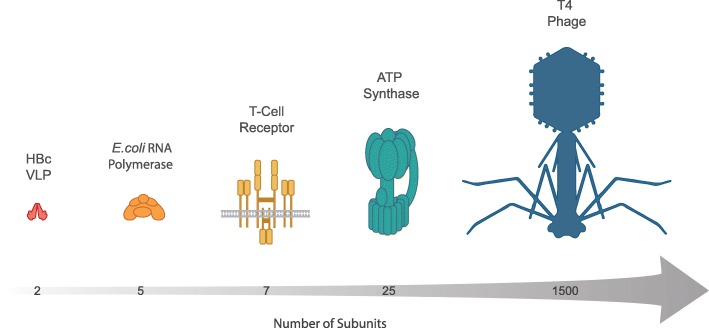
Multi-subunit protein complex synthesis in CFS. Various groups have demonstrated the production of increasingly intricate protein complexes. These have included the hepatitis B core antigen (HBc) VLP (2 subunits) [91], the E. coli RNA polymerase (5 subunits) [118], the human T-cell receptor (7 subunits) [119], an ATP synthase (25 subunits) [113], and the T4 phage (1500 subunits) [–104]
Fig. 4
Fig. 4
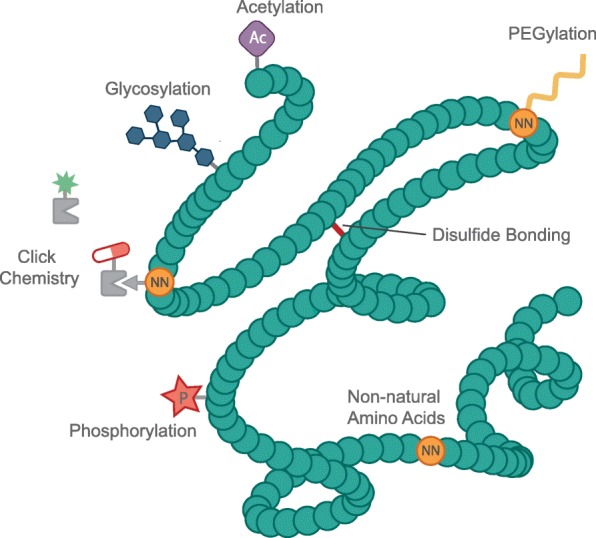
Protein modifications in CFS. Possible protein modifications include but are not limited to glycosylation, disulfide-bond formation, acetylation [140], phosphorylation [141], and PEGylation [131] (which may be accomplished through the use of non-natural amino acids). Non-natural amino acids can also be used for the conjugation of a wide range of compounds such as drugs (e.g., through click chemistry) [81] or fluorescent molecules [142]. Figure adapted from Pagel et al. [143]

References

    1. Clancy K, Voigt CA. Programming cells: towards an automated ‘Genetic Compiler’. Curr Opin Biotechnol. 2010;21(4):572–581. doi: 10.1016/j.copbio.2010.07.005. - DOI - PMC - PubMed
    1. van der Meer JR, Belkin S. Where microbiology meets microengineering: design and applications of reporter bacteria. Nat Rev Microbiol. 2010;8(7):511–522. doi: 10.1038/nrmicro2392. - DOI - PubMed
    1. Mao N, Cubillos-Ruiz A, Cameron DE, Collins JJ. Probiotic strains detect and suppress cholera in mice. Sci Transl Med. 2018;10(445):eaao2586. doi: 10.1126/scitranslmed.aao2586. - DOI - PMC - PubMed
    1. Siciliano V, DiAndreth B, Monel B, Beal J, Huh J, Clayton KL, et al. Engineering modular intracellular protein sensor-actuator devices. Nat Commun. 2018;9(1):1881. doi: 10.1038/s41467-018-03984-5. - DOI - PMC - PubMed
    1. Kotula JW, Kerns SJ, Shaket LA, Siraj L, Collins JJ, Way JC, et al. Programmable bacteria detect and record an environmental signal in the mammalian gut. Proc Natl Acad Sci U S A. 2014;111(13):4838–4843. doi: 10.1073/pnas.1321321111. - DOI - PMC - PubMed

Publication types

MeSH terms

LinkOut - more resources