. 2018 Mar:101:218-235.
doi: 10.1016/j.envsoft.2017.12.007.

A framework for uncertainty and risk analysis in Total Maximum Daily Load applications

Affiliations

A framework for uncertainty and risk analysis in Total Maximum Daily Load applications

Rene A Camacho et al. Environ Model Softw. 2018 Mar.

Abstract

In the United States, the computation of Total Maximum Daily Loads (TMDL) must include a Margin of Safety (MOS) to account for different sources of uncertainty. In practice however, TMDL studies rarely include an explicit uncertainty analysis and the estimation of the MOS is often subjective and even arbitrary. Such approaches are difficult to replicate and preclude the comparison of results between studies. To overcome these limitations, a Bayesian framework to compute TMDLs and MOSs including an explicit evaluation of uncertainty and risk is proposed in this investigation. The proposed framework uses the concept of Predictive Uncertainty to calculate a TMDL from an equation of allowable risk of non-compliance of a target water quality standard. The framework is illustrated in a synthetic example and in a real TMDL study for nutrients in Sawgrass Lake, Florida.

Keywords: Bayesian analysis; Margin of safety; Risk assessment; Total Maximum Daily Load; Uncertainty analysis.


Figures

Fig. 1.
Fig. 1.
Conceptual representation of the Streeter-Phelps model applied for an estuary with a point source (Eqs. (29) and (30)). The estuary is assumed well mixed in the vertical and lateral directions.
Fig. 2.
Fig. 2.
Solution of the model given by Eqs. (29) and (30) and synthetic data generated for the uncertainty analysis. a) Steady state profiles of BOD and DO deficit (dashed blue and red lines respectively) resulting from the solution of Eqs. (29) and (30), and synthetic BOD samples generated after incorporating an error term (green dots). b) DO concentration for saturation conditions (red solid line), steady state profile of DO resulting from the solution of the ESP model (dashed blue line) and synthetic DO samples after incorporating an error term (green dots). (For interpretation of the references to colour in this figure legend, the reader is referred to the Web version of this article.)
Fig. 3.
Fig. 3.
Frequency distribution and partial autocorrelation function of the series of residuals ε1 (BOD) and ε2 (DO). A likelihood function for normally distributed and uncorrelated errors e.g. AR(1) can be used to represent the statistical properties of ε1 and ε2.
Fig. 4.
Fig. 4.
Comparisons between synthetic profiles of BOD and DO and the Bayesian model predictions including 95% confidence limits.
Fig. 5.
Fig. 5.
Posterior marginal distributions of the ESP model parameters.
Fig. 6.
Fig. 6.
Dissolved Oxygen concentrations as a function of the BOD load for different risks of non-compliance. This figure suggests that the conventional approach is close to a risk of non-compliance of 50%.
Fig. 7.
Fig. 7.
Location of Sawgrass lake.
Fig. 8.
Fig. 8.
Observations (red dots) versus Bayesian averaged model predictions (blue line) plus 95% confidence bounds for TN and nitrogen subspecies. (For interpretation of the references to colour in this figure legend, the reader is referred to the Web version of this article.)
Fig. 9.
Fig. 9.
Observations (red dots) versus Bayesian averaged model predictions (blue line) plus 95% confidence bounds for TP, phosphorus subspecies and Chlorophyll a. (For interpretation of the references to colour in this figure legend, the reader is referred to the Web version of this article.)
Fig. 10.
Fig. 10.
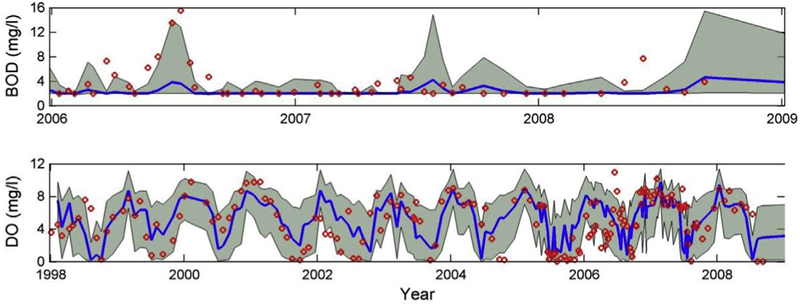
Observations (red dots) versus Bayesian averaged model predictions (blue line) plus 95% confidence bounds for BOD and Dissolved Oxygen. (For interpretation of the references to colour in this figure legend, the reader is referred to the Web version of this article.)
Fig. 11.
Fig. 11.
Expected TP¯obs and TN¯obs concentrations for different load reduction alternatives and risks of non compliance.

References

    1. Alameddine I, Cha Y, Reckhow KH, 2011. An evaluation of automated structure learning with Bayesian networks: an application to estuarine chlorophyll dynamics. Environ. Model. Software 26 (2), 163–172.
    1. Ambrose RB, Wool TA, Martin JL, 1993. The Water Quality Analysis Simulation Program, WASP5, Part a: Model Documentation. U.S. EPA Center for Exposure Assessment Modeling, Athens, GA.
    1. Ames DP, Lall U, 2008. Developing total maximum daily loads under uncertainty: decision analysis and the margin of safety. J. Contemp. Water Res. Educ. 140 (1), 37–52.
    1. Borsuk ME, Stow CA, Reckhow KH, 2002. Predicting the frequency of water quality standard Violations: a probabilistic approach for TMDL development. Environ. Sci. Technol. 36 (10), 2109–2115. - PubMed
    1. Camacho RA, Martin JL, McAnally W, Díaz-Ramirez J, Rodriguez H, Sucsy P, Zhang S, 2015. A comparison of bayesian methods for uncertainty analysis in hydraulic and hydrodynamic modeling. JAWRA J. Am. Water Res. Assoc. 51 (5), 1372–1393.

LinkOut - more resources