Review
. 2019 Jul 24:10:500.
doi: 10.3389/fendo.2019.00500. eCollection 2019.

Use of Growth Hormone in the IVF Treatment of Women With Poor Ovarian Reserve

Affiliations
Review

Use of Growth Hormone in the IVF Treatment of Women With Poor Ovarian Reserve

Roger J Hart. Front Endocrinol (Lausanne). .

Abstract

Growth hormone (GH) has been used as an adjunct in the field of female infertility treatment for more than 25 years, although, apart from treating women with GH deficiency its role has not yet been clarified. Contributing to this lack of clarity is that several underpowered studies have been performed on women undergoing IVF treatment, with a previous "poor response" to ovarian stimulation, which have suggested a favorable outcome. Meta-analysis of randomized controlled trials has demonstrated a benefit for the use of the adjunct growth hormone, in comparison to placebo; with reductions in the duration of ovarian stimulation required prior to oocyte retrieval, with a greater number of oocytes collected, and improvements in many of the early clinical parameters with the use of GH. However, no benefit of an increased chance of a live birth with the use of growth hormone for the "poor responding" patient has been determined. Consequently the role of GH to treat a woman with a poor response to ovarian stimulation cannot be supported on the basis of the available evidence. However, the place for GH in the treatment of women undergoing IVF may yet still be determined, as it is also used, without firm evidence of benefit; for women with poor embryonic development, poor endometrial development and for women who do not conceive despite multiple embryo transfers (recurrent implantation failure).

Keywords: IVF; embryo quality; growth hormone; ovarian reserve; poor responder.


Figures
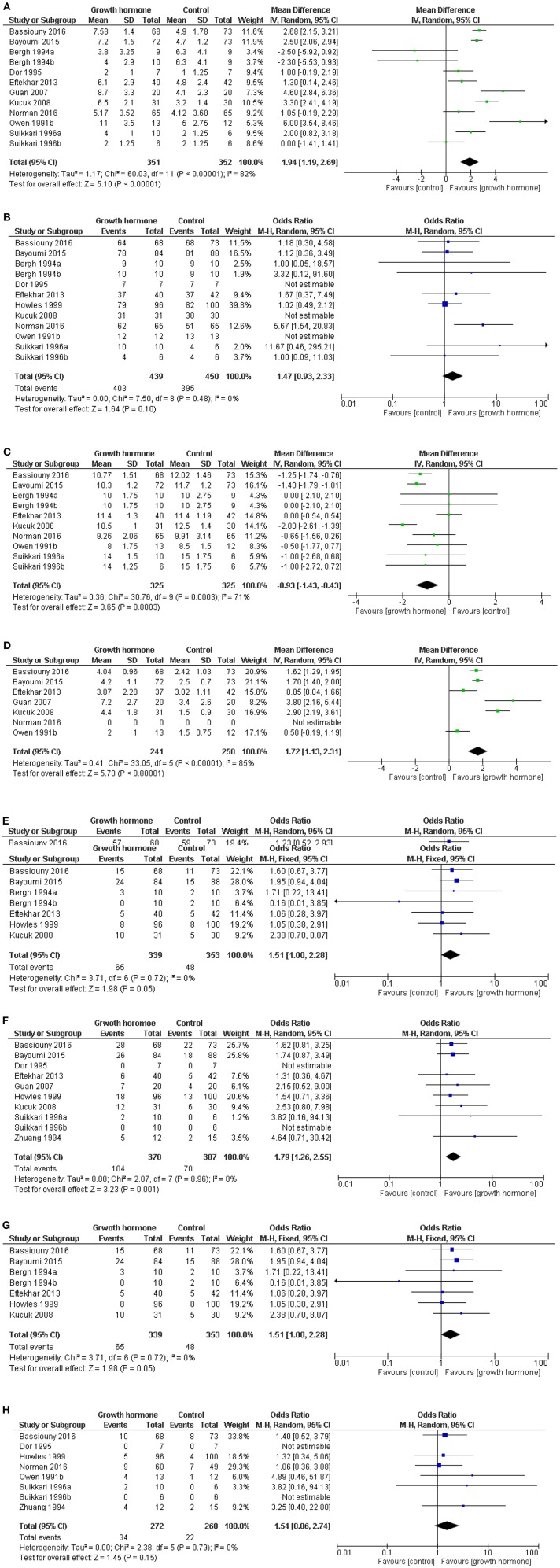
Figure 1
Figure 1
Meta-analysis of the use of GH in poor responders. Forest plots of outcomes from the use of growth hormone in “poor responders” undergoing ovarian stimulation. Where possible data presented per cycle started (median and range converted to mean and std. dev.) Software RevMan Version 5.3. Copenhagen: The Nordic Cochrane Centre, The Cochrane Collaboration, 2014. Reproduced with permission from Hart et al. (15). (A) Forest plot of comparison: oocytes collected per cycle started. Not all patients reached oocyte retrieval. (B) Patients reached oocyte retrieval and had at least one oocyte retrieved. (C) The duration of stimulation. (D) Number of fertilized oocytes for women per cycle started (some data is presented by patients who had oocytes retrieved). (E) Patients with an embryo available for transfer per cycle started. (F) Positive pregnancy test per cycle started. (G) Clinical pregnancy per cycle started. (H) Live birth per cycle started (, –41).

References

    1. Buyalos RP. Insulin-like growth factors: clinical experience in ovarian function. Am J Med. (1995) 98:55S−66S. 10.1016/S0002-9343(99)80060-6 - DOI - PubMed
    1. Zhou P, Baumgarten SC, Wu Y, Bennett J, Winston N, Hirshfeld-Cytron J, et al. IGF-I signaling is essential for FSH stimulation of AKT and steroidogenic genes in granulosa cells. Mol Endocrinol. (2013) 27:511–23. 10.1210/me.2012-1307 - DOI - PMC - PubMed
    1. Baker J, Hardy MP, Zhou J, Bondy C, Lupu F, Bellve AR, et al. Effects of an Igf1 gene null mutation on mouse reproduction. Mol Endocrinol. (1996) 10:903–18. 10.1210/mend.10.7.8813730 - DOI - PubMed
    1. Zhou J, Kumar TR, Matzuk MM, Bondy C. Insulin-like growth factor I regulates gonadotropin responsiveness in the murine ovary. Mol Endocrinol. (1997) 11:1924–33. 10.1210/mend.11.13.0032 - DOI - PubMed
    1. Bachelot A, Monget P, Imbert-Bollore P, Coshigano K, Kopchick JJ, Kelly PA, et al. Growth hormone is required for ovarian follicular growth. Endocrinology. (2002) 143:4104–12. 10.1210/en.2002-220087 - DOI - PubMed

LinkOut - more resources
