Review
. 2019 Jul 14:2019:4761427.
doi: 10.1155/2019/4761427. eCollection 2019.

Macrophages Are Key Regulators of Stem Cells during Skeletal Muscle Regeneration and Diseases

Affiliations
Review

Macrophages Are Key Regulators of Stem Cells during Skeletal Muscle Regeneration and Diseases

Junio Dort et al. Stem Cells Int. .

Abstract

Muscle regeneration is a closely regulated process that involves a variety of cell types such as satellite cells, myofibers, fibroadipogenic progenitors, endothelial cells, and inflammatory cells. Among these different cell types, macrophages emerged as a central actor coordinating the different cellular interactions and biological processes. Particularly, the transition of macrophages from their proinflammatory to their anti-inflammatory phenotype was shown to regulate inflammation, myogenesis, fibrosis, vascularization, and return to homeostasis. On the other hand, deregulation of macrophage accumulation or polarization in chronic degenerative muscle disorders was shown to impair muscle regeneration. Considering the key roles of macrophages in skeletal muscle, they represent an attractive target for new therapeutic approaches aiming at mitigating various muscle disorders. This review aims at summarizing the novel insights into macrophage heterogeneity, plasticity, and functions in skeletal muscle homeostasis, regeneration, and disease.


Conflict of interest statement

The authors declare that they have no conflict of interest.

Figures
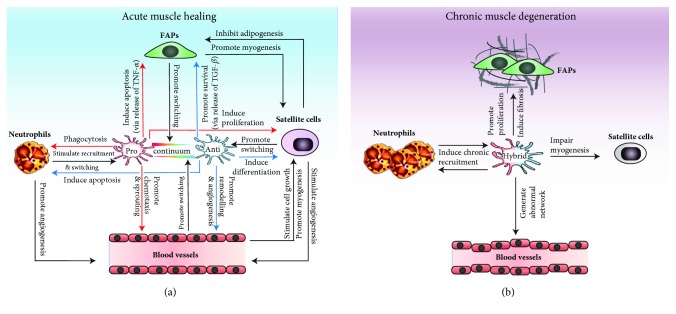
Figure 1
Figure 1
Macrophages are central regulators in skeletal muscle regeneration and diseases. In acute muscle injury (a), the inflammatory process is characterized by early accumulation of proinflammatory macrophages, which play a key role in various biological processes involved in muscle regeneration, by regulating fibrosis (FAP apoptosis), myogenesis (satellite cell proliferation), angiogenesis (sprouting), and inflammation (phagocytosis). Thereafter, macrophages switch toward the anti-inflammatory phenotype, which dampens inflammation, stimulates satellite cell/myoblast differentiation, and promotes tissue remodelling. This temporal and coordinated process is essential for optimal muscle healing. In a chronic degenerative muscle (b), the concurrent pro- and anti-inflammatory signals lead to the adoption of an abnormal hybrid phenotype by macrophages, which promote chronic inflammatory cell infiltration, excessive fibrosis, impaired myogenesis, and disorganized blood vessel network.
Figure 2
Figure 2
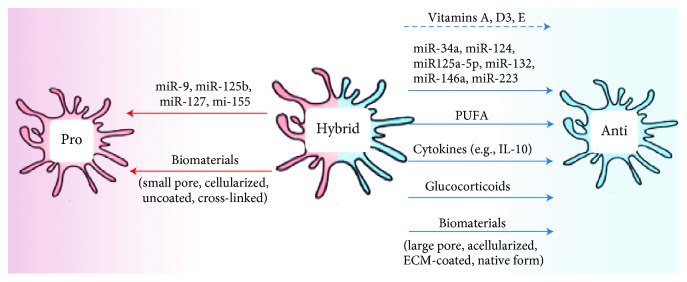
Macrophage-centered therapeutic approaches. Different strategies were developed to restore a balance in macrophage polarization in chronic degenerative muscle disorders. These strategies include cytokines (e.g., IL-10), nutritional compounds (e.g., PUFA and vitamins), RNA silencing (e.g., miRNA), pharmacological drugs (e.g., glucocorticoids), and biomaterials (synthetic, biological, or mixed). These strategies could be used to skew macrophage polarization toward their pro- or anti-inflammatory phenotype depending on the desired therapeutic effect.

References

    1. Dumont N. A., Bentzinger C. F., Sincennes M. C., Rudnicki M. A. Satellite cells and skeletal muscle regeneration. Comprehensive Physiology. 2015;5(3):1027–1059. doi: 10.1002/cphy.c140068. - DOI - PubMed
    1. Bentzinger C. F., Wang Y. X., Dumont N. A., Rudnicki M. A. Cellular dynamics in the muscle satellite cell niche. EMBO Reports. 2013;14(12):1062–1072. doi: 10.1038/embor.2013.182. - DOI - PMC - PubMed
    1. Tidball J. G. Mechanisms of muscle injury, repair, and regeneration. Comprehensive Physiology. 2011;1(4):2029–2062. doi: 10.1002/cphy.c100092. - DOI - PubMed
    1. Muñoz-Cánoves P., Serrano A. L. Macrophages decide between regeneration and fibrosis in muscle. Trends in Endocrinology & Metabolism. 2015;26(9):449–450. doi: 10.1016/j.tem.2015.07.005. - DOI - PubMed
    1. Lemos D. R., Babaeijandaghi F., Low M., et al. Nilotinib reduces muscle fibrosis in chronic muscle injury by promoting TNF-mediated apoptosis of fibro/adipogenic progenitors. Nature Medicine. 2015;21(7):786–794. doi: 10.1038/nm.3869. - DOI - PubMed