. 2020 Jan;33(1):30-40.
doi: 10.1111/pcmr.12817. Epub 2019 Aug 24.

Cutaneous pharmacologic cAMP induction induces melanization of the skin and improves recovery from ultraviolet injury in melanocortin 1 receptor-intact or heterozygous skin

Affiliations

Cutaneous pharmacologic cAMP induction induces melanization of the skin and improves recovery from ultraviolet injury in melanocortin 1 receptor-intact or heterozygous skin

Robert-Marlo Bautista et al. Pigment Cell Melanoma Res. 2020 Jan.

Erratum in

  • Corrigendum.
    [No authors listed] [No authors listed] Pigment Cell Melanoma Res. 2021 Nov;34(6):1140. doi: 10.1111/pcmr.13010. Epub 2021 Sep 13. Pigment Cell Melanoma Res. 2021. PMID: 34514742 No abstract available.

Abstract

Homozygous loss of function of the melanocortin 1 receptor (MC1R) is associated with a pheomelanotic pigment phenotype and increased melanoma risk. MC1R heterozygosity is less well studied, although individuals inheriting one loss-of-function MC1R allele are also melanoma-prone. Using the K14-Scf C57BL/6J animal model whose skin is characterized by lifelong retention of interfollicular epidermal melanocytes like that of the human, we studied pigmentary, UV responses, and DNA repair capacity in the skin of variant Mc1r background. Topical application of forskolin, a skin-permeable pharmacologic activator of cAMP induction to mimic native Mc1r signaling, increased epidermal eumelanin levels, increased the capacity of Mc1r-heterozygous skin to resist UV-mediated inflammation, and enhanced the skin's ability to clear UV photolesions from DNA. Interestingly, topical cAMP induction also promoted melanin accumulation, UV resistance, and accelerated clearance in Mc1r fully intact skin. Together, our findings suggest that heterozygous Mc1r loss is associated with an intermediately melanized and DNA repair-proficient epidermal phenotype and that topical cAMP induction enhances UV resistance in Mc1r-heterozygous or Mc1r-wild-type individuals by increasing eumelanin deposition and by improving nucleotide excision repair.

Keywords: DNA repair; UV radiation; cAMP; melanin; melanocortin 1 receptor (MC1R); melanocyte.


Figures

Figure 1.
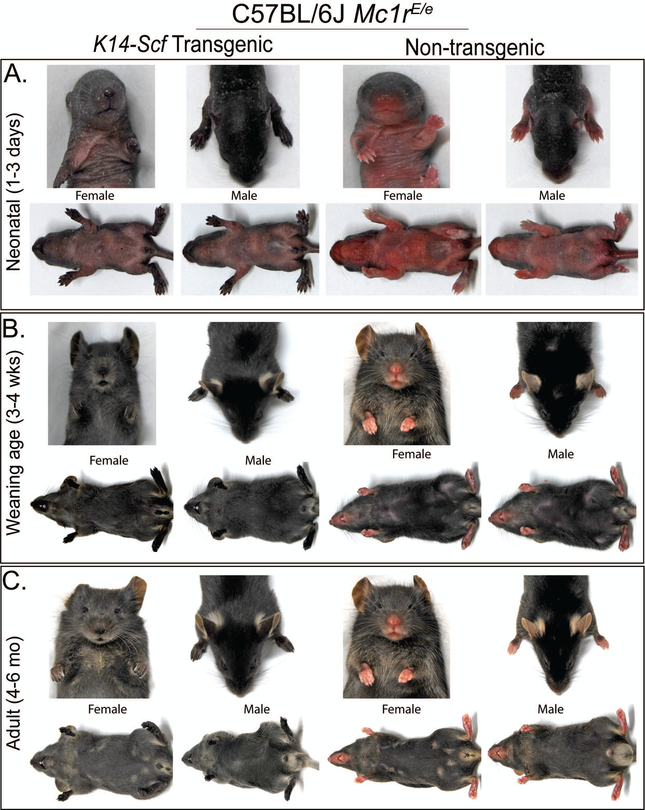
Figure 1.. Pigment phenotype of C57BL/6J Mc1rE/e K14-Scf transgenic and non-transgenic mice.
Mc1rE/e K14-Scf transgenic and non-transgenic mice were photographed at different ages of life. Neonatal animals between 3–8 days old are shown in panel A, weanling animals between 3–4 weeks of age are shown in panel B and adult mice between 4–6 months of age are shown in panel C. Male and female animals are each represented as indicated, with K14-Scf animals presented in the two left-most columns and non-transgenic animals shown in the two right-most columns. Note the pigmentary differences (interfollicular epidermal skin, particularly nose, genitals and paw pads) between K14-Scf and non-transgenic animals throughout life.
Figure 2.
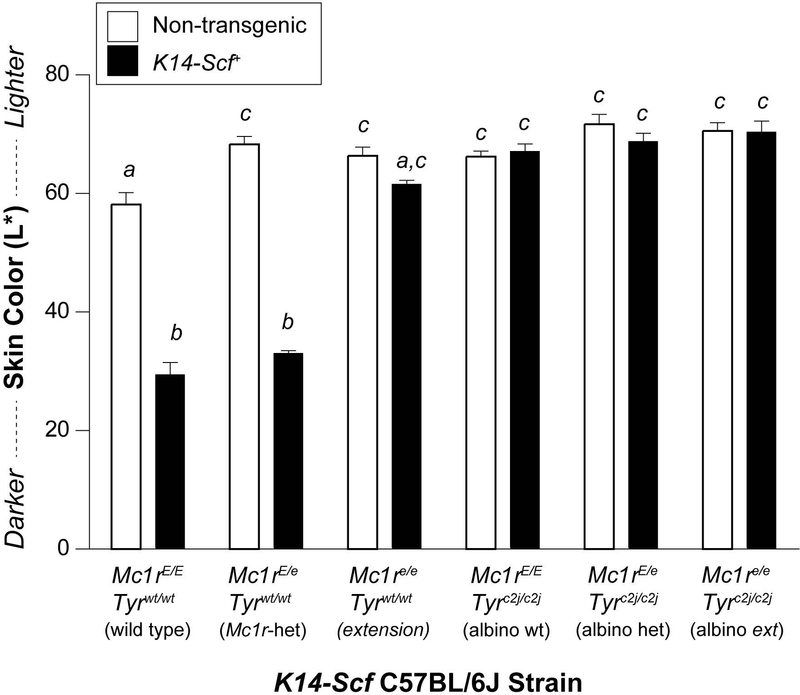
Figure 2.. Skin colorimetry of K14-Scf transgenic and non-transgenic mouse strains.
Untreated C57BL/6J mice between the ages of 6 and 12 weeks of life were depilated and the color of the dorsal depilated skin was quantified by reflective colorimetry. Areas of anagen phase hair regrowth were excluded from measurements because of the confounding influence of the growing hairs on the reflectometry of the epidermal skin. Data are reported on the black-white L* CIE color axis with darker skin having lower L* scores. Mc1r and Tyr status of the strains are indicated. Colorimetry of non-transgenic (white bars) vs. K14-Scf mice (black bars) are compared. Values not sharing a common letter were significantly different as determined by one -way ANOVA; p ≤ 0.05.
Figure 3.
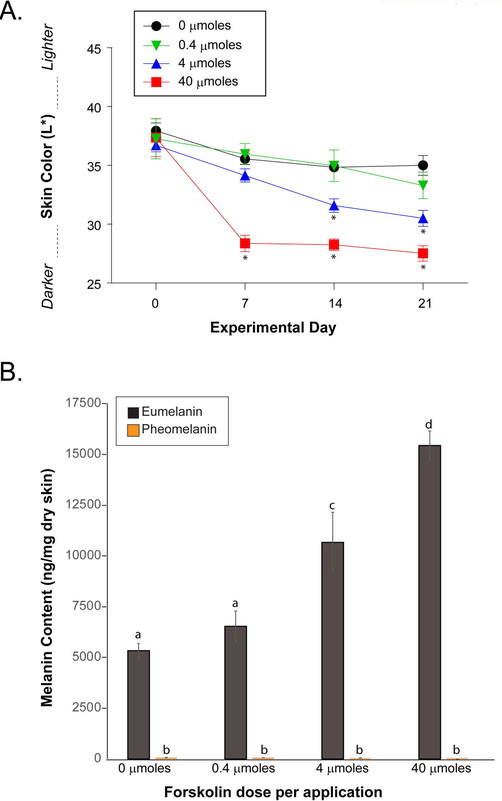
Figure 3.. Topical forskolin promotes melanization of Mc1r-heterozygous skin in a dose-dependent manner.
Mc1rE/e K14-Scf animals were depilated, and treated with increasing concentrations of forskolin as indicated once a day for five days each week (200 μL per dose; 0, 0.4, 4 or 40 μmoles of forskolin per application. A) Skin color was recorded weekly and quantified on the black-white L* CIE color axis with darker skin having lower L* scores. * indicates statistical significance (p < 0.05) as compared to control-treated animals. B) Eumelanin and pheomelanin quantification of skin biopsies at the end of the experiment (day 21). Values not sharing a common letter were significantly different as determined by one -way ANOVA; p ≤ 0.05.
Figure 4.
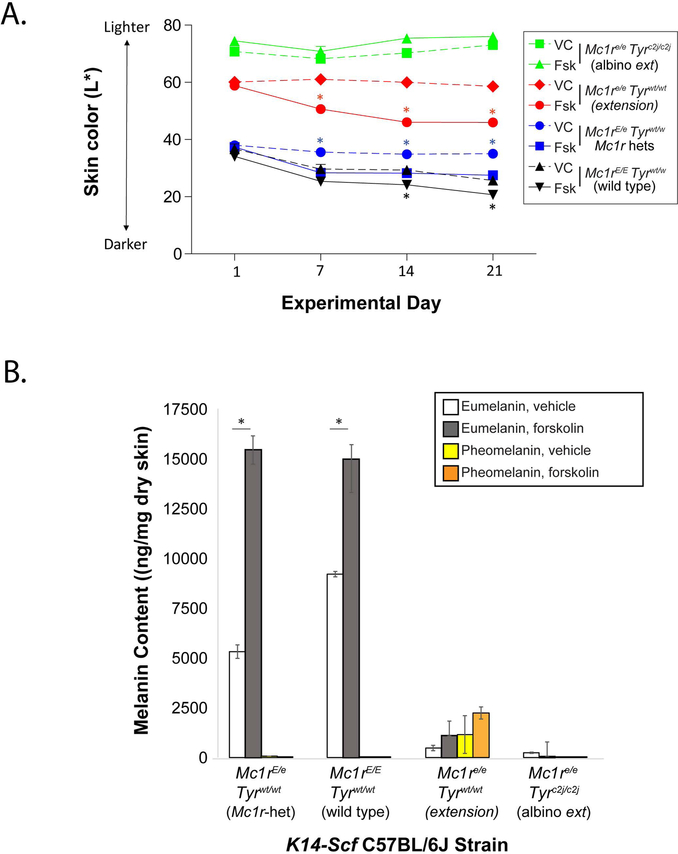
Figure 4.. Topical forskolin promotes melanization of tyrosinase-intact K14-Scf mice irrespective of Mc1r status.
A) Wild type (Mc1rE/E Tyrwt/wt), heterozygote (Mc1rE/e Tyrwt/wt), extension (Mc1re/e Tyrwt/wt), or albino extension (Mc1re/e Tyrc2j/c2j) K14-Scf animals were depilated, and treated with vehicle (dotted lines) or forskolin (solid lines) as indicated once a day for five days each week (40 μmoles of forskolin per application) through 21 days. Skin color was recorded weekly and quantified on the black-white L* CIE color axis with darker skin having lower L* scores. B) Eumelanin and pheomelanin quantification of skin biopsies at the end of the experiment (day 21). * indicates statistical significance (p < 0.05) as compared to control-treated animals within the same strain.
Figure 5.
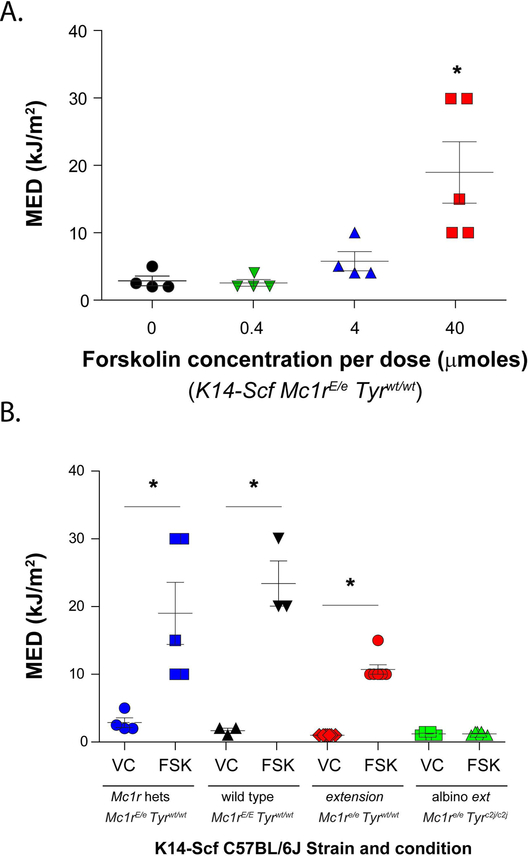
Figure 5.. Pharmacologic cutaneous cAMP induction protects against UV-mediated inflammation.
A) Mc1rE/e K14-Scf animals were depilated, and treated with increasing concentrations of forskolin as indicated once a day for five days each week (200 μL per dose; 0, 0.4, 4 or 40 μmoles of forskolin per application. Animals were then exposed to varying doses of UV-B and MED was calculated per mouse. Mean ± SEM MEDs are shown for each forskolin dose group. * indicates statistical significance (p < 0.05) as compared to the other groups. B) MED testing was extended to wild type (Mc1rE/E Tyrwt/wt), heterozygote (Mc1rE/e Tyrwt/wt), extension (Mc1re/e Tyrwt/wt), or albino extension (Mc1re/e Tyrc2j/c2j) K14-Scf animals treated (21d, vehicle vs. forskolin (40 μmoles per application) as indicated. Animals were then exposed to varying doses of UV-B and MED was calculated per mouse. Mean ± SEM MEDs are shown for each strain; values not sharing a common letter were significantly different as determined by one -way ANOVA; p ≤ 0.05.
Figure 6.
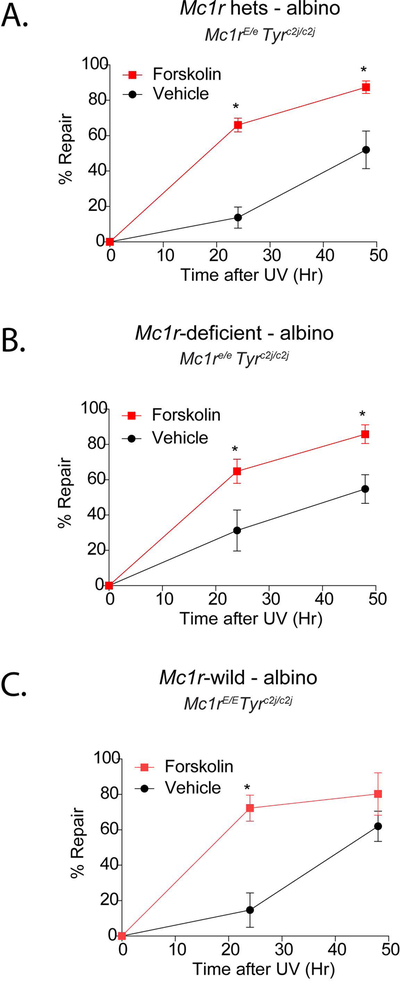
Figure 6.. Topical forskolin accelerates clearance of UV photodamage in the skin.
Mc1rE/e Tyrc2j/c2j K14-Scf (A), Mc1re/e Tyrc2j/c2j K14-Scf (B) or Mc1rE/E Tyrc2j/c2j K14-Scf (C) mice were depilated and pre-treated (twice a day × 2 days; 0 vs. 40 μmoles forskolin) before exposure to 7.5 kJ/m2 UV-B. Skin was biopsied at the indicated time points, DNA was extracted, and quantification of [6,4]-photoproducts was accomplished by Southwestern blotting. Data are expressed as relative to un-irradiated mice. * indicates statistical significance (p < 0.05) between vehicle and forskolin-treated animals at the given time point. Mean time ± SEM to repair 50% of UV damage is indicated as RT50.

References

    1. Abdel-Malek ZA, Ruwe A, Kavanagh-Starner R, Kadekaro AL, Swope V, Haskell-Luevano C, … Knittel JJ (2009). alpha-MSH tripeptide analogs activate the melanocortin 1 receptor and reduce UV-induced DNA damage in human melanocytes. Pigment Cell Melanoma Res, 22(5), 635–644. doi: 10.1111/j.1755-148X.2009.00598.x - DOI - PubMed
    1. Alewijnse AE, Smit MJ, Rodriguez Pena MS, Verzijl D, Timmerman H, & Leurs R (1997). Modulation of forskolin-mediated adenylyl cyclase activation by constitutively active G(S)-coupled receptors. FEBS Lett, 419(2–3), 171–174. - PubMed
    1. Amaro-Ortiz A, Vanover JC, Scott TL, & D’Orazio JA (2013). Pharmacologic induction of epidermal melanin and protection against sunburn in a humanized mouse model. J Vis Exp(79). doi: 10.3791/50670 - DOI - PMC - PubMed
    1. Beaumont KA, Shekar SN, Newton RA, James MR, Stow JL, Duffy DL, & Sturm RA (2007). Receptor function, dominant negative activity and phenotype correlations for MC1R variant alleles. Hum Mol Genet, 16(18), 2249–2260. doi: 10.1093/hmg/ddm177 - DOI - PubMed
    1. Castejon-Grinan M, Herraiz C, Olivares C, Jimenez-Cervantes C, & Garcia-Borron JC (2018). cAMP-independent non-pigmentary actions of variant melanocortin 1 receptor: AKT-mediated activation of protective responses to oxidative DNA damage. Oncogene, 37(27), 3631–3646. doi: 10.1038/s41388-018-0216-1 - DOI - PubMed

Publication types