


The association between cardiorespiratory fitness and the incidence of common mental health disorders: A systematic review and meta-analysis
- PMID: 31398589
- PMCID: PMC6997883
- DOI: 10.1016/j.jad.2019.07.088
The association between cardiorespiratory fitness and the incidence of common mental health disorders: A systematic review and meta-analysis
Abstract
Background: Physical activity is associated with a lower incidence of common mental health disorder, but less is known about the impact of cardiorespiratory fitness (CRF).
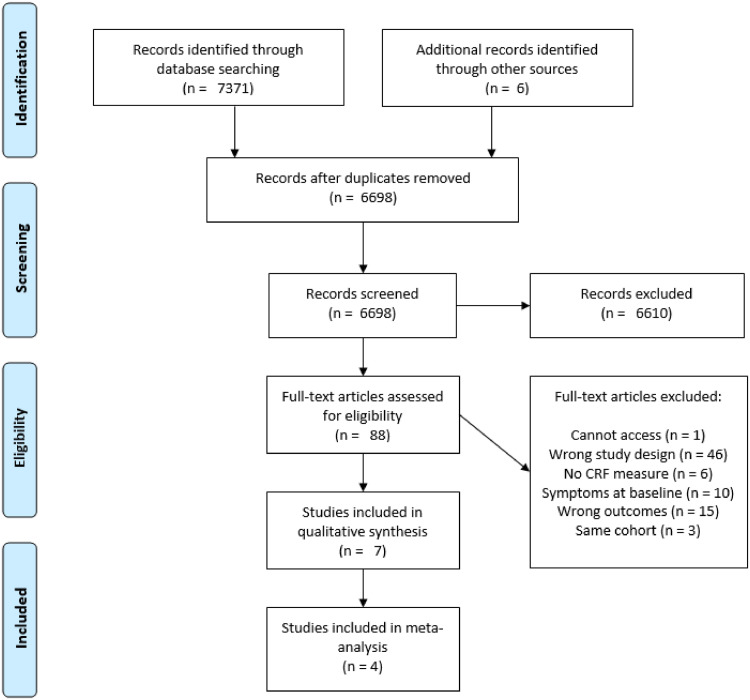
Methods: In this review, we systematically evaluated the relationship between CRF and the incidence of common mental health disorders in prospective cohort studies. We systematically searched six major electronic databases from inception to 23rd of May 2019. We assessed study quality using the Newcastle-Ottawa scale.
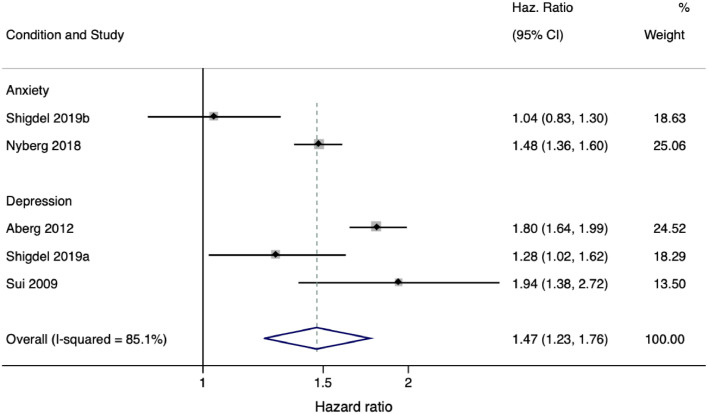
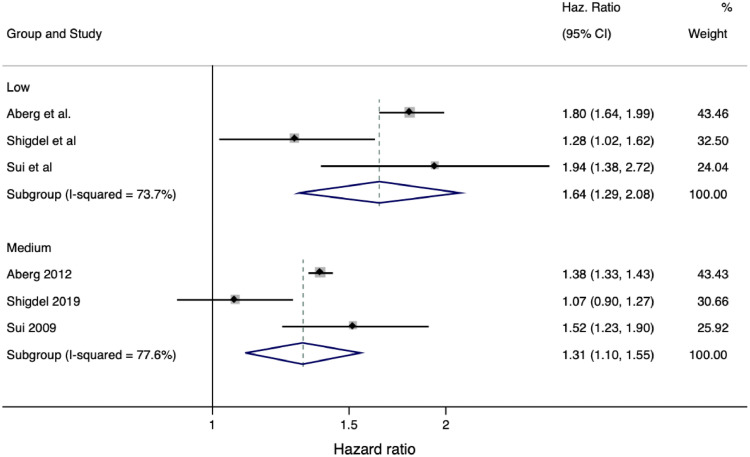
Results: We were able to pool the hazard ratios (HRs) and 95% confidence intervals (CIs) of four studies including at least 27,733,154 person-years of data. We found that low CRF (HR = 1.47, [95% CI 1.23 - 1.76] p < 0.001 I2 = 85.1) and medium CRF (HR = 1.23, [95% CI 1.09 - 1.38] p < 0.001 I2 = 87.20) CRF are associated with a 47% and 23% greater risk of a common mental health disorders respectively, compared with high CRF. We found evidence to suggest a dose-response relationship between CRF and the risk of common mental health disorders.
Limitations: We were only able to identify a small number of eligible studies from our search and heterogeneity was substantial in the subsequent meta-analysis.
Conclusions: Our findings indicate that there is a longitudinal association between CRF levels and the risk of a common mental health disorder. CRF levels could be useful for identifying and preventing common mental health disorders at a population-level.
Keywords: Anxiety; Depression; Exercise; Physical activity; Prevention; Risk factor.
Crown Copyright © 2019. Published by Elsevier B.V. All rights reserved.
Conflict of interest statement
No authors declare any conflict of interest
Figures
References
-
- Åberg M.A.I., Waern M., Nyberg J., Pedersen N.L., Bergh Y., Åberg N.D., …, Torén K. Cardiovascular fitness in males at age 18 and risk of serious depression in adulthood: Swedish prospective population-based study. British J. Psychiatry. 2012;201(5):352–359. doi: 10.1192/bjp.bp.111.103416. - DOI - PubMed
-
- Baumeister S.E., Leitzmann M.F., Bahls M., Dörr M., Schmid D., Schomerus G.…Grabe H.-J. Associations of leisure-time and occupational physical activity and cardiorespiratory fitness with incident and recurrent major depressive disorder, depressive symptoms, and incident anxiety in a general population. The Journal of Clinical Psychiatry. 2017;78(01):e41–e47. doi: 10.4088/JCP.15m10474. - DOI - PubMed
-
- Blair S.N., Kampert J.B., Kohl H.W., Barlow C.E., Macera C.A., Paffenbarger R.S., Gibbons L.W. Influences of cardiorespiratory fitness and other precursors on cardiovascular disease and all-cause mortality in men and women. JAMA. 1996;276(3):205. doi: 10.1001/jama.1996.03540030039029. - DOI - PubMed
Publication types
MeSH terms
Grants and funding
LinkOut - more resources
Full Text Sources
Medical
