


Respiratory acidosis during bronchoscopy-guided percutaneous dilatational tracheostomy: impact of ventilator settings and endotracheal tube size
- PMID: 31399057
- PMCID: PMC6689167
- DOI: 10.1186/s12871-019-0824-5
Respiratory acidosis during bronchoscopy-guided percutaneous dilatational tracheostomy: impact of ventilator settings and endotracheal tube size
Abstract
Background: The current study investigates the effect of bronchoscopy-guided percutaneous dilatational tracheostomy (PDT) on the evolution of respiratory acidosis depending on endotracheal tube (ET) sizes. In addition, the impact of increasing tidal volumes during the intervention was investigated.
Methods: Two groups of ICU-patients undergoing bronchoscopy-guided PDT with varying tidal volumes and tube sizes were consecutively investigated: 6 ml/kg (N = 29, mean age 57.4 ± 14.5 years) and 12 ml/kg predicted body weight (N = 34, mean age 59.5 ± 12.8 years).
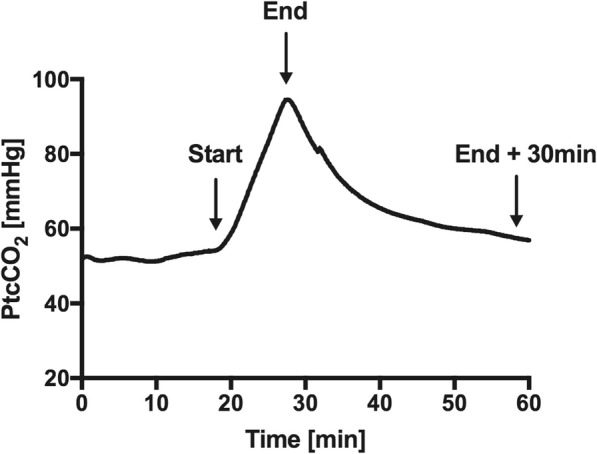
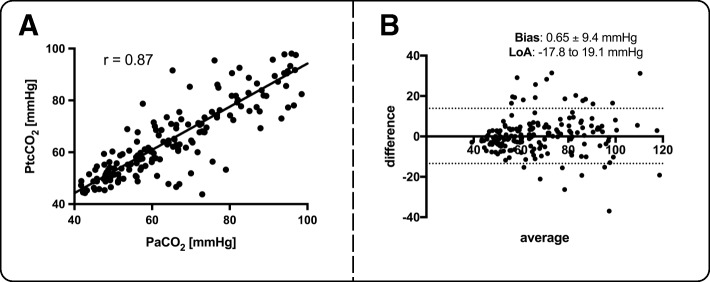
Results: The mean intervention time during all procedures was 10 ± 3 min. The combination of low tidal volumes and ETs of 7.5 mm internal diameter resulted in the most profound increase in PaCO2 (32.2 ± 11.6 mmHg) and decrease in pH-value (- 0.18 ± 0.05). In contrast, the combination of high tidal volumes and ETs of 8.5 mm internal diameter resulted in the least profound increase in PaCO2 (8.8 ± 9.0 mmHg) and decrease of pH (- 0.05 ± 0.04). The intervention-related increase in PaCO2 was significantly lower when using higher tidal volumes for larger ET: internal diameter 7.5, 8.0 and 8.5: P > 0.05, =0.006 and = 0.002, respectively. Transcutaneous PCO2 monitoring revealed steadily worsening hypercapnia during the intervention with a high correlation of 0.87 and a low bias of 0.7 ± 9.4 mmHg according to the Bland-Altman analysis when compared to PaCO2 measurements.
Conclusions: Profound respiratory acidosis following bronchoscopy-guided PDT evolves in a rapid and dynamic process. Increasing the tidal volume from 6 to 12 ml/kg PBW was capable of attenuating the evolution of respiratory acidosis, but this effect was only evident when using larger ETs.
Trial registration: DRKS00011004 . Registered 20th September 2016.
Keywords: Dilatational tracheostomy; Endotracheal tube; Hypercapnia; Respiratory acidosis; Transcutaneous PCO2.
Conflict of interest statement
C.K. received travel grants and lecture fees from Maquet, Rastatt, Germany. Si.Sc. and M.M. have no conflicts of interest. St.St. received travel grants and lecture fees from Maquet Cardiopulmonary, Rastatt, Germany. F.M. received lecture fees from SenTec AG, Therwil, Switzerland. W.W. received fees for advisory board meetings and lectures from Maquet Cardiopulmonary, Rastatt, Germany. W.W. also received lecture fees from SenTec AG, Therwil, Switzerland. The hospital of the research group C.K. and W.W. received an open research grant from Maquet Cardiopulmonary, Rastatt, Germany unrelated to this work.
Figures



References
Publication types
MeSH terms
Substances
Associated data
LinkOut - more resources
Full Text Sources
