


Early Adversity and the Neotenous Human Brain
- PMID: 31399257
- PMCID: PMC6935437
- DOI: 10.1016/j.biopsych.2019.06.018
Early Adversity and the Neotenous Human Brain
Abstract
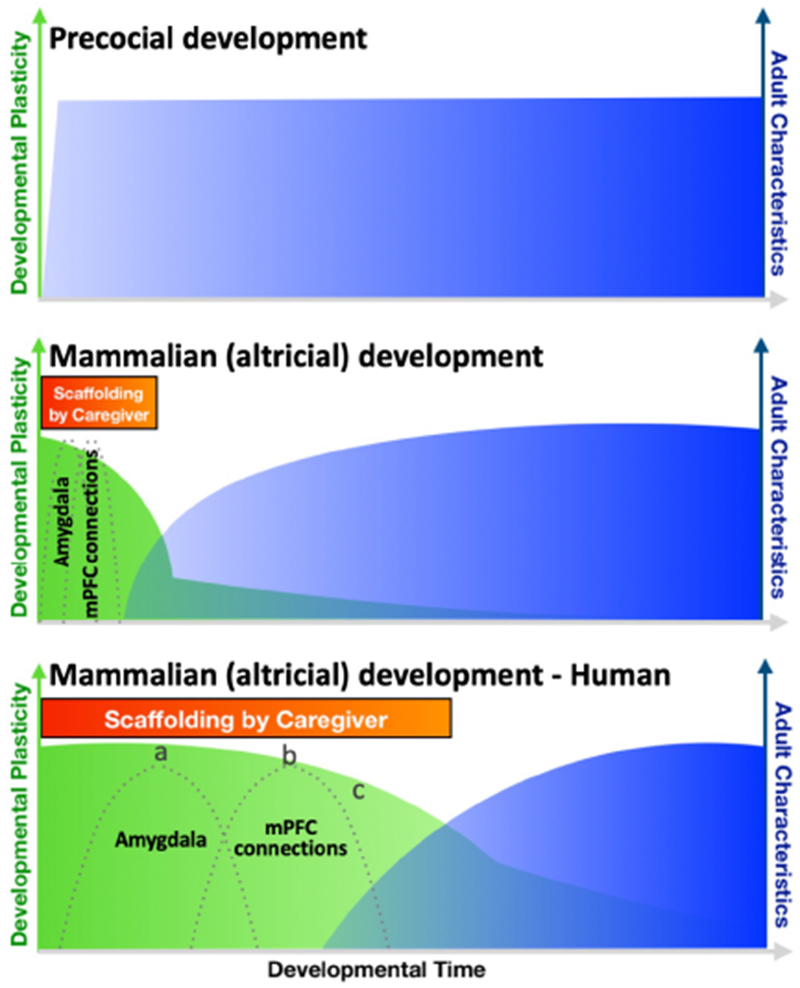
Human brain development is optimized to learn from environmental cues. The protracted development of the cortex and its connections with subcortical targets has been argued to permit more opportunity for acquiring complex behaviors. This review uses the example of amygdala-medial prefrontal cortex circuitry development to illustrate a principle of human development-namely, that the extension of the brain's developmental timeline allows for the (species-expected) collaboration between child and parent in co-construction of the human brain. The neurobiology underlying affective learning capitalizes on this protracted timeline to develop a rich affective repertoire in adulthood. Humans are afforded this luxuriously slow development in part by the extended period of caregiving provided by parents, and parents aid in scaffolding the process of maturation during childhood. Just as adequate caregiving is a potent effector of brain development, so is adverse caregiving, which is the largest environmental risk factor for adult mental illness. There are large individual differences in neurobiological outcomes following caregiving adversity, indicating that these pathways are probabilistic, rather than deterministic, and prolonged plasticity in human brain development may also allow for subsequent amelioration by positive experiences. The extant research indicates that the development of mental health cannot be considered without consideration of children in the context of their families.
Keywords: Amygdala; Brain development; Medial prefrontal cortex; Parents; Sensitive periods; Stress.
Copyright © 2019 Society of Biological Psychiatry. Published by Elsevier Inc. All rights reserved.
Conflict of interest statement
Disclosures: The authors report no biomedical financial interests or potential conflicts of interest.
Figures
Comment in
-
Transforming Psychiatry Through Novel Neuroscience: Computational and Developmental Frameworks Guided by Research Domain Criteria.Biol Psychiatry. 2020 Feb 15;87(4):314-315. doi: 10.1016/j.biopsych.2019.12.006. Biol Psychiatry. 2020. PMID: 32040419 No abstract available.
References
-
- Kernberg OF, Early ego integration and object relations. Ann N Y Acad Sci, 1972. 193: p. 233–47. - PubMed
-
- Hofer MA, Early relationships as regulators of infant physiology and behavior. Acta Pediatrica, 1994. 83(s397): p. 9–18. - PubMed
-
- Gewirtz JL, Baer DM, and Roth CH, A note on the similar effects of low social availability of an adult and brief social deprivation on young children’s behavior. Child Dev, 1958. 29(1): p. 149–52. - PubMed
-
- Bowlby J, Attachment and loss: retrospect and prospect. Am J Orthopsychiatry, 1982. 52(4): p. 664–78. - PubMed
-
- Bowen M, The use of family theory in clinical practice. Compr Psychiatry, 1966. 75(5): p. 345–374. - PubMed
Publication types
MeSH terms
Grants and funding
LinkOut - more resources
Full Text Sources
