Reliability of administrative data to identify sexually transmitted infections for population health: a systematic review
- PMID: 31399425
- PMCID: PMC7062345
- DOI: 10.1136/bmjhci-2019-100074
Reliability of administrative data to identify sexually transmitted infections for population health: a systematic review
Abstract
Introduction: International Classification of Diseases (ICD) codes in administrative health data are used to identify cases of disease, including sexually transmitted infections (STIs), for population health research. The purpose of this review is to examine the extant literature on the reliability of ICD codes to correctly identify STIs.
Methods: We conducted a systematic review of empirical articles in which ICD codes were validated with respect to their ability to identify cases of chlamydia, gonorrhoea, syphilis or pelvic inflammatory disease (PID). Articles that included sensitivity, specificity and positive predictive value of ICD codes were the target. In addition to keyword searches in PubMed and Scopus databases, we further examined bibliographies of articles selected for full review to maximise yield.
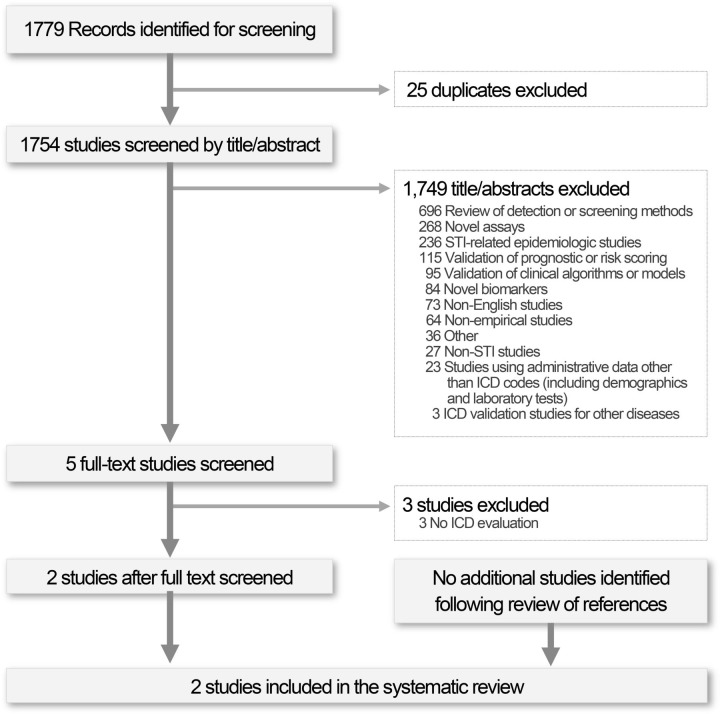
Results: From a total of 1779 articles identified, only two studies measured the reliability of ICD codes to identify cases of STIs. Both articles targeted PID, a serious complication of chlamydia and gonorrhoea. Neither article directly assessed the validity of ICD codes to identify cases of chlamydia, gonorrhoea or syphilis independent of PID. Using ICD codes alone, the positive predictive value for PID was mixed (range: 18%-79%).
Discussion and conclusion: While existing studies have used ICD codes to identify STI cases, their reliability is unclear. Further, available evidence from studies of PID suggests potentially large variation in the accuracy of ICD codes indicating the need for primary studies to evaluate ICD codes for use in STI-related public health research.
Keywords: administrative codes; international classification of diseases codes; public health informatics; sexually transmitted infections; systematic review; validation study.
© Author(s) (or their employer(s)) 2019. Re-use permitted under CC BY-NC. No commercial re-use. See rights and permissions. Published by BMJ.
Conflict of interest statement
Competing interests: None declared.
Figures
References
-
- Lee LM, Thacker SB. The cornerstone of public health practice: public health surveillance, 1961-2011. MMWR Surveill Summ 2011;60(Suppl 4):15–21. - PubMed
-
- Wang RY, Strong DM. Beyond accuracy: what data quality means to data consumers. J Manage Inform Syst 1996;12:5–33. 10.1080/07421222.1996.11518099 - DOI
-
- Dixon BE, Rosenman M, Xia Y, et al. A vision for the systematic monitoring and improvement of the quality of electronic health data. Stud Health Technol Inform 2013;192:884–8. - PubMed
Publication types
MeSH terms
Grants and funding
LinkOut - more resources
Full Text Sources
Medical