


Motivation, challenges and realities of volunteer community cardiac arrest response: a qualitative study of 'lay' community first responders
- PMID: 31399458
- PMCID: PMC6701604
- DOI: 10.1136/bmjopen-2019-029015
Motivation, challenges and realities of volunteer community cardiac arrest response: a qualitative study of 'lay' community first responders
Abstract
Objectives: To explore the reasons why lay community first responders (CFRs) volunteer to participate in out-of-hospital cardiac arrest response and the realities of their experience in providing this service to the community.
Design: A qualitative study, using in-depth semistructured interviews that were recorded and transcribed. Thematic analysis was undertaken and credibility checks conducted.
Setting: Nine geographically varied lay CFR schemes throughout Ireland.
Participants: Twelve experienced CFRs.
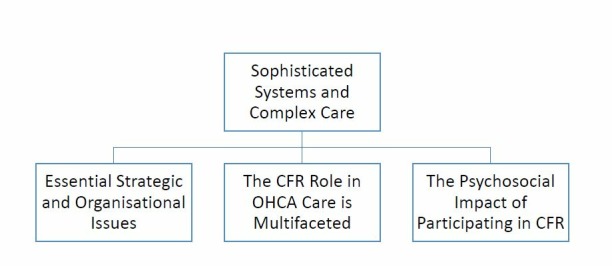
Results: CFRs were motivated to participate based on a variety of factors. These included altruistic, social and pre-existing emergency care interest. A proportion of CFRs may volunteer because of experience of cardiac arrest or illness in a relative. Sophisticated structures and complex care appear to underpin CFR involvement in out-of-hospital cardiac arrest. Strategic and organisational issues, multifaceted cardiac arrest care and the psychosocial impact of participation were considered.
Conclusions: Health systems that facilitate CFR out-of-hospital cardiac arrest response should consider a variety of relevant issues. These issues include the suitability of those that volunteer, complexities of resuscitation/end-of-life care, responder psychological welfare as well as CFRs' core role of providing early basic life support and defibrillation in the community.
Keywords: first responders; out-of-hospital cardiac arrest; public health.
© Author(s) (or their employer(s)) 2019. Re-use permitted under CC BY-NC. No commercial re-use. See rights and permissions. Published by BMJ.
Conflict of interest statement
Competing interests: TB and GB are general practitioners who participate voluntarily in out-of-hospital cardiac arrest community response and declare no other conflicts of interest. SG is an academic researcher with experience of health services research. She has no conflict of interest to declare.
Figures
References
-
- Hansen CM, Kragholm K, Granger CB, et al. The role of bystanders, first responders, and emergency medical service providers in timely defibrillation and related outcomes after out-of-hospital cardiac arrest: Results from a statewide registry. Resuscitation 2015;96:303–9. 10.1016/j.resuscitation.2015.09.002 - DOI - PubMed
Publication types
MeSH terms
LinkOut - more resources
Full Text Sources
