. 2019 Aug 9;10(1):3595.
doi: 10.1038/s41467-019-11546-6.

A modular effector with a DNase domain and a marker for T6SS substrates

Affiliations

A modular effector with a DNase domain and a marker for T6SS substrates

Biswanath Jana et al. Nat Commun. .

Abstract

Bacteria deliver toxic effectors via type VI secretion systems (T6SSs) to dominate competitors, but the identity and function of many effectors remain unknown. Here we identify a Vibrio antibacterial T6SS effector that contains a previously undescribed, widespread DNase toxin domain that we call PoNe (Polymorphic Nuclease effector). PoNe belongs to a diverse superfamily of PD-(D/E)xK phosphodiesterases, and is associated with several toxin delivery systems including type V, type VI, and type VII. PoNe toxicity is antagonized by cognate immunity proteins (PoNi) containing DUF1911 and DUF1910 domains. In addition to PoNe, the effector contains a domain of unknown function (FIX domain) that is also found N-terminal to known toxin domains and is genetically and functionally linked to T6SS. FIX sequences can be used to identify T6SS effector candidates with potentially novel toxin domains. Our findings underline the modular nature of bacterial effectors harboring delivery or marker domains, specific to a secretion system, fused to interchangeable toxins.


Conflict of interest statement

The authors declare no competing interests.

Figures
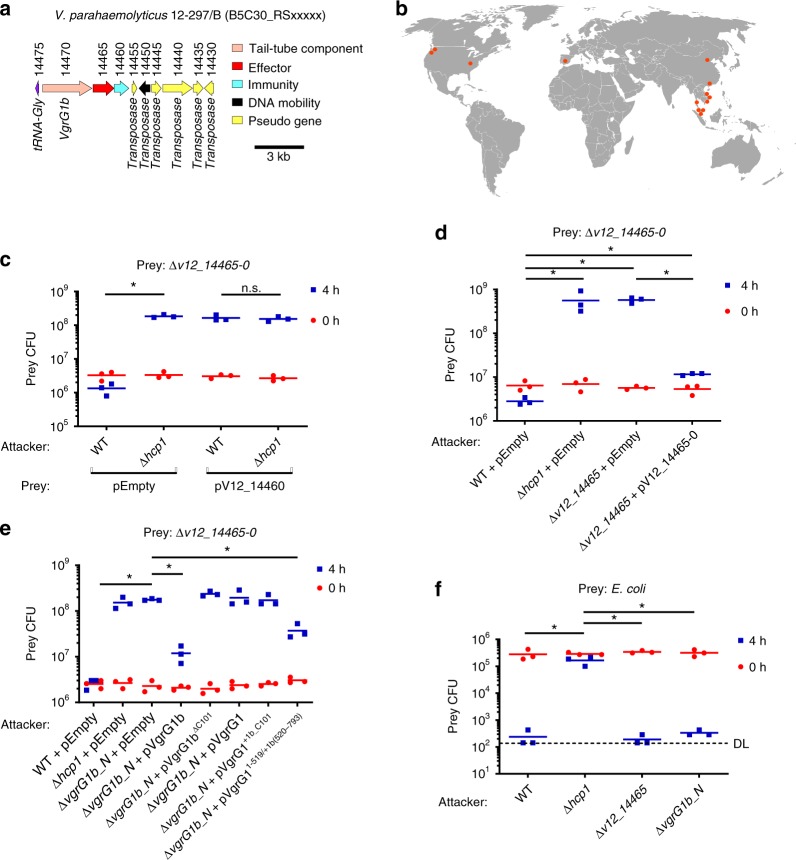
Fig. 1
Fig. 1
An auxiliary T6SS1 module in V. parahaemolyticus 12-297/B. a T6SS1 VgrG1b auxiliary module. Genes are represented by arrows indicating the direction of translation. Locus tags (B5C30_RSxxxx) are shown above. b Locations in which the V. parahaemolyticus isolates containing the VgrG1b module have been isolated are denoted by red circles. Viability counts of V. parahaemolyticus 12-297/B (ce) or E. coli (f) prey before (0 h) and after (4 h) co-incubation with the indicated V. parahaemolyticus 12-297/B attackers on media containing 3% NaCl at 30 °C. l-Arabinose was added (0.1% in c, 0.01% in e) to induce expression from the Pbad promoter. Δhcp1 is used as T6SS1 control. Asterisks denote statistical significance between samples at the 4 h timepoint by unpaired, two-tailed Student’s t test (*P < 0.05); n.s. no significant difference, WT wild-type, DL detection limit. Source data are provided as a source data file
Fig. 2
Fig. 2
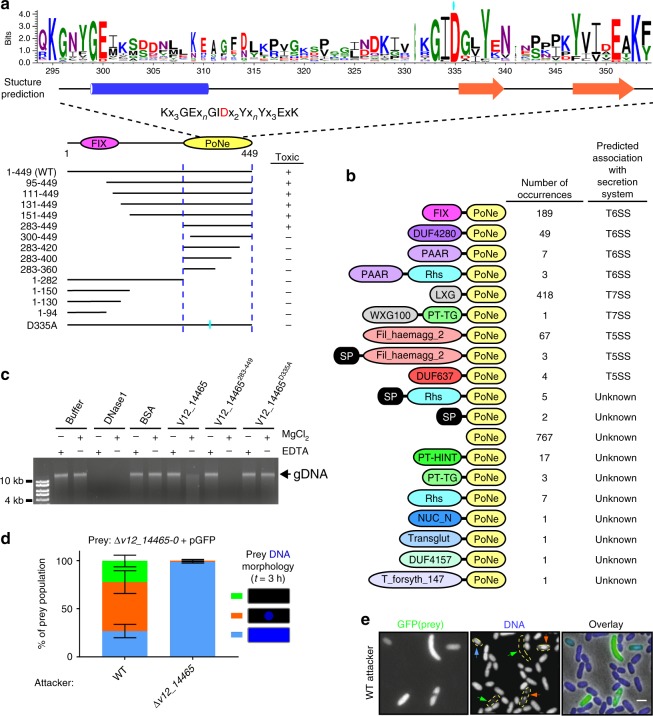
Effector V12_14465 contains a new DNase domain. a Schematic representation of full-length and truncated V12_14465 forms tested for toxicity upon expression in E. coli. The region necessary and sufficient for toxicity is denoted by dashed vertical blue lines (based on the results shown in Supplementary Fig. 5). The region of the toxic C-terminal domain (PoNe) in which a conserved motif was identified (residues 294–354) is illustrated using WebLogo 3. Secondary-structure prediction (Jpred) and the conserved motif are provided. Alpha helix is denoted as blue cylinder, and beta strands as orange arrows. A cyan oval above the WebLogo denotes the catalytic aspartic acid at position 335. b Domain architectures of PoNe-containing proteins. SP, signal peptide. c In vitro DNase activity assay. Purified E. coli genomic DNA (gDNA) was co-incubated with buffer or with the indicated purified proteins in the presence (+) or absence (−) of Mg2+ or EDTA at 37 °C for 30 min. The integrity of gDNA was visualized on 1% agarose gel. d Quantification of V. parahaemolyticus 12-297/B Δv12_14465-0 prey cells, constitutively expressing GFP from a plasmid (pGFP), that present DNA morphologies: DNA across entire cell area (cyan), DNA nucleoid or foci (orange), or no DNA (green). DNA was detected using Hoechst dye fluorescence signal after 3 h of co-incubating prey with the indicated attacker strains. Results shown are average ± S.D. of three independent biological replicates. In each experiment, 100 prey cells were evaluated per treatment. e Sample images of prey cells described in d after 3 h of co-incubation with WT attackers. Dashed yellow shapes in DNA channel encircle prey cells detected in the GFP channel. Colored arrows denote prey cells presenting each of the three DNA morphologies described in d. Bar = 2 µm. WT wild-type. Source data are provided as a source data file
Fig. 3
Fig. 3
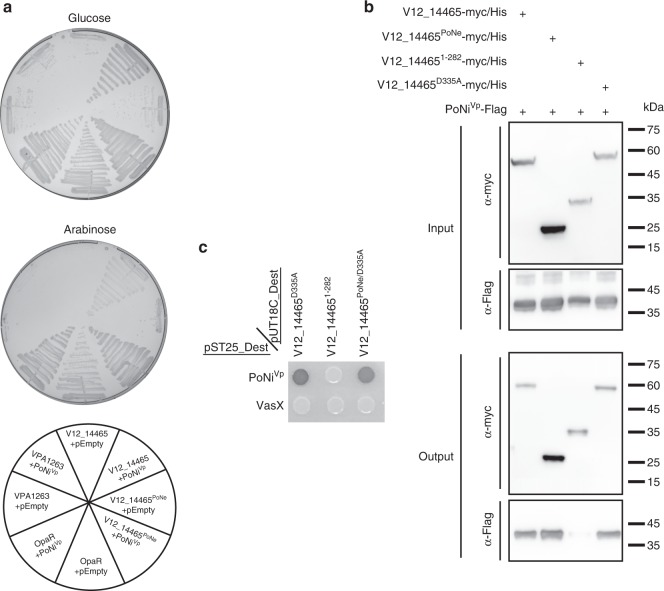
V12_14460 provides immunity against PoNe domain. a Toxicity of V12_14465 variants expressed in E. coli BL21(DE3) from arabinose-inducible expression plasmid with or without V12_14460 (PoNiVp). OpaR, the V. parahaemolyticus high cell density quorum sensing master regulator, was used as a nontoxic control. VPA1263, a T6SS1 effector with a predicted colicin DNase domain, was used as a non-PoNe toxic control. b Ni-Sepharose resin pull-down of myc/His-tagged V12_14465 forms with PoNiVp-Flag after co-expression in E. coli BL21(DE3). c Bacterial two-hybrid assay. The indicated proteins were expressed in E. coli BTH101 reporter strain fused to the T18 or T25 domain of the Bordetella adenylate cyclase. Bacteria were spotted on plates supplemented with the chromogenic substrate X-Gal. A dark-colored colony indicates protein–protein interaction. The V. cholerae T6SS effector VasX was used as a negative control. PoNiVp, V12_14460; V12_14465PoNe, V12_14465(283–449); V12_14465PoNe/D335A, V12_14465(283–449/D335A); pEmpty, empty expression vector. Source data are provided as a source data file
Fig. 4
Fig. 4
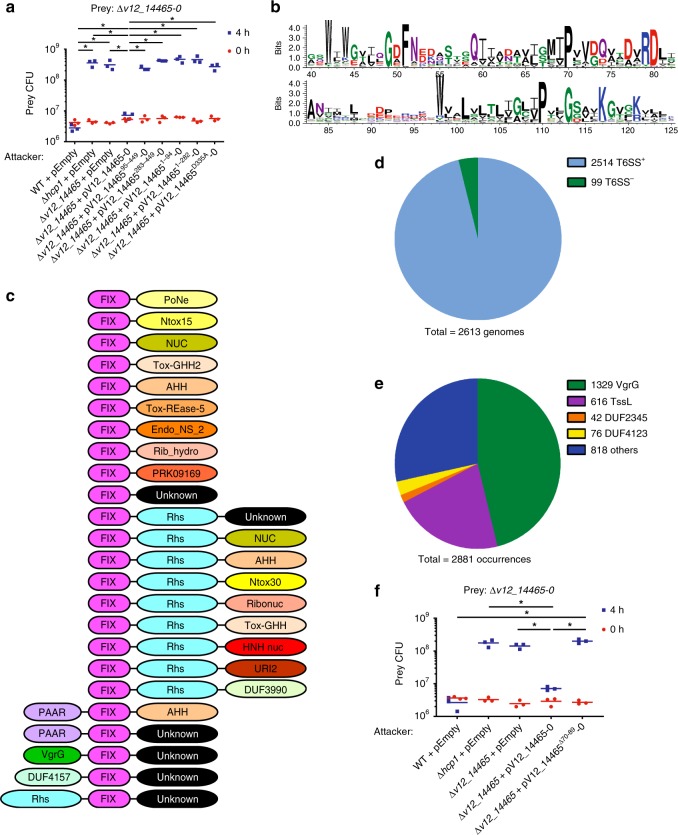
V12_14465 contains a marker for T6SS substrates. a Viability counts of V. parahaemolyticus 12-297/B prey before (0 h) and after (4 h) co-incubation with the indicated V. parahaemolyticus 12-297/B attackers at 30 °C on media containing 3% NaCl. b Conservation pattern found in FIX homologs. The region shown corresponds to positions 40–125 in V12_14465. The image was produced using WebLogo 3. c Representative domain architectures of FIX-containing proteins. d Pie chart of FIX-containing bacterial genomes that encode a T6SS (encoding at least 9 T6SS core components). e Pie chart of domains encoded by genes found immediately upstream of FIX. The number of occurrences for each domain is listed next to its name. f Viability counts of V. parahaemolyticus 12-297/B prey before (0 h) and after (4 h) co-incubation with the indicated V. parahaemolyticus 12-297/B attackers at 30 °C on media containing 3% NaCl. Asterisks denote the statistical significance between samples at the 4 h timepoint by unpaired, two-tailed Student’s t test (*P < 0.05); WT wild-type. Source data are provided as a source data file

References

    1. Pukatzki S, et al. Identification of a conserved bacterial protein secretion system in Vibrio cholerae using the Dictyostelium host model system. Proc. Natl Acad. Sci. USA. 2006;103:1528–1533. doi: 10.1073/pnas.0510322103. - DOI - PMC - PubMed
    1. Mougous JD, et al. A virulence locus of Pseudomonas aeruginosa encodes a protein secretion apparatus. Science. 2006;312:1526–1530. doi: 10.1126/science.1128393. - DOI - PMC - PubMed
    1. Boyer F, Fichant G, Berthod J, Vandenbrouck Y, Attree I. Dissecting the bacterial type VI secretion system by a genome wide in silico analysis: What can be learned from available microbial genomic resources? BMC Genom. 2009;10:104. doi: 10.1186/1471-2164-10-104. - DOI - PMC - PubMed
    1. Russell AB, et al. Type VI secretion delivers bacteriolytic effectors to target cells. Nature. 2011;475:343–349. doi: 10.1038/nature10244. - DOI - PMC - PubMed
    1. Pukatzki S, Ma AT, Revel AT, Sturtevant D, Mekalanos JJ. Type VI secretion system translocates a phage tail spike-like protein into target cells where it cross-links actin. Proc. Natl Acad. Sci. USA. 2007;104:15508–15513. doi: 10.1073/pnas.0706532104. - DOI - PMC - PubMed

Publication types

MeSH terms

LinkOut - more resources