Review
. 2019 Sep;65(3):483-493.
doi: 10.1007/s12020-019-02035-3. Epub 2019 Aug 9.

Pheochromocytoma- and paraganglioma-triggered Takotsubo syndrome

Affiliations
Review

Pheochromocytoma- and paraganglioma-triggered Takotsubo syndrome

Shams Y-Hassan et al. Endocrine. 2019 Sep.

Abstract

Takotsubo syndrome (TS), also known as neurogenic stunned myocardium or broken heart syndrome, is a recognized acute cardiac syndrome. In about 70% of cases, the syndrome is preceded by an emotional or a physical stressor. Among the innumerable physical trigger factors that may induce TS are pheochromocytomas and paragangliomas (PPGLs). PPGL-associated cardiovascular complications as "myocarditis", "myocardial infarction", "reversible cardiomyopathies", and "transient repolarization electrocardiographic changes" have been described since more than 70 years. During the last two decades, dozens of cases of PPGL-induced TS have been reported. PPGLs display increased catecholamine levels, sometimes massively elevated, which may trigger TS, most likely through hyperactivation of sympathetic nervous system including the cardiac sympathetic nerve terminal disruption with norepinephrine seethe and spillover. PPGL-induced TS is characterized by a dramatic clinical presentation with hemodynamic compromise and high complication rates. The prevalence of global and apical sparing pattern of TS in PPGL-induced TS is significantly higher than in other TS populations. In this report, the associations of PPGL-induced cardiovascular complications are analyzed, and clinical features, complications, outcome and treatment of PPGL-induced TS are reviewed.

Keywords: Broken heart; Catecholamine; Myocardial stunning; Paraganglioma; Pheochromocytoma; Takotsubo.


Conflict of interest statement

The authors declare that they have no conflict of interest.

Figures
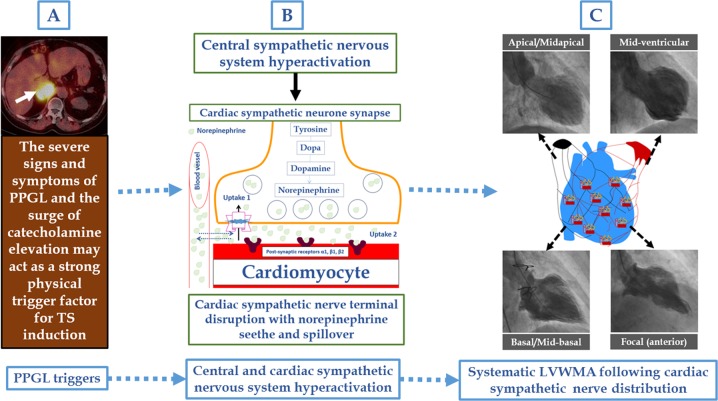
Fig. 1
Fig. 1
Pathogenesis of pheochromocytoma and paraganglioma (PPGL)-induced takotsubo syndrome (TS). PPGL is a strong physical trigger factor a and may trigger the autonomic (sympathetic) nervous system and result in sympathetic cardiac nerve terminal disruption and norepinephrine spillover b. This results in myocardial stunning, which most probably follow the cardiac sympathetic nerve distribution causing circumferential left ventricular wall motion abnormality (LVWMA) and may be localized to apical or mid-apical, midventricular, basal or rarely focal regions as illustrated in c
Fig. 2
Fig. 2
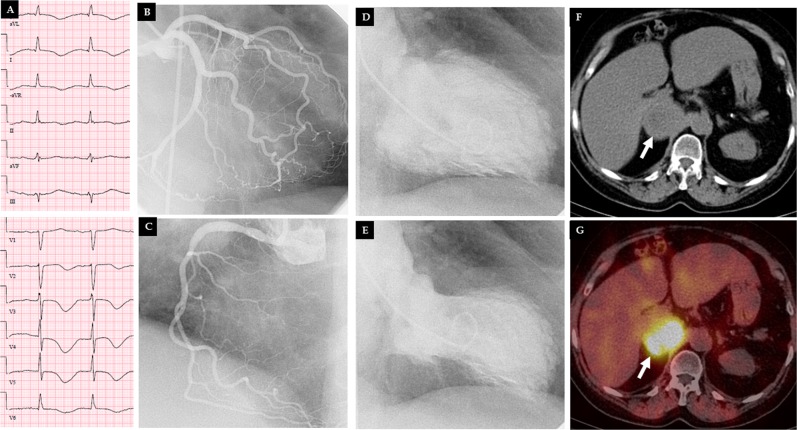
A typical case of mid-apical takotsubo syndrome (TS) pattern triggered by pheochromocytoma. The 12-lead electrocardiogram a shows T-wave inversions in the anterolateral leads with marked QTc prolongation 595 ms. Coronary angiography shows b normal left coronary artery (LCA), and c right coronary artery (RCA). Left ventriculography during diastole d and systole e shows mid-apical left ventricular ballooning consistent with TS. Abdominal computed tomography g reveals right adrenal tumor (white arrow); abdominal iodine-123 meta-iodobenzylguanidine (123I-MIBG) single-photon emission computed tomography displayed abnormal uptake of radiotracer within right adrenal pheochromocytoma (h, white arrow)
Fig. 3
Fig. 3
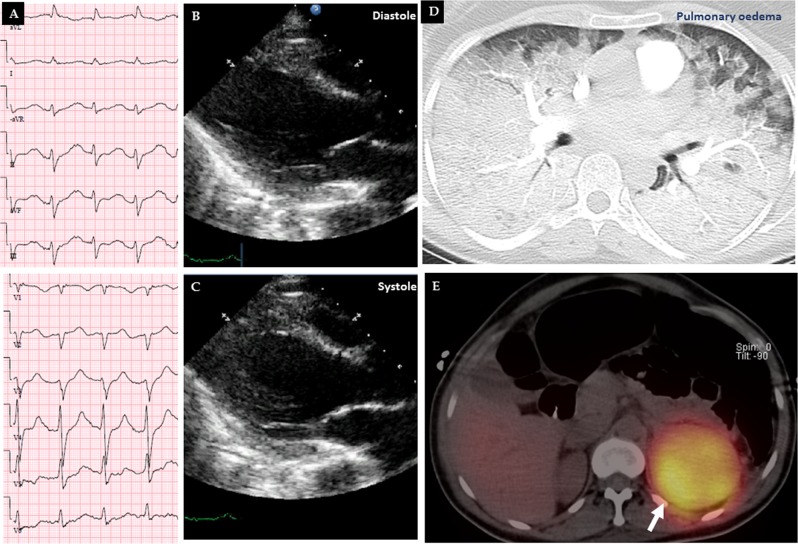
A case of mid-basal (inverted) takotsubo syndrome (TS) pattern triggered by pheochromocytoma. The 12-lead ECG reveals sinus tachycardia, ST-depressions in leads II, III, aVF, and V3–V6 a. Echocardiography during diastole b and systole c shows akinesia in the middle and basal segments of the left ventricle with normal contractions of the apical segments. Thoracic computed tomography scan with intravenous contrast showed signs suggestive of pulmonary edema d and the iodine-123 meta-iodobenzylguanidine (123I-MIBG) scan reveals a luminous left adrenal tumor mass due to high tracer uptake e

References

    1. Lenders JW, Eisenhofer G, Mannelli M, Pacak K. Phaeochromocytoma. Lancet. 2005;366(9486):665–675. doi: 10.1016/S0140-6736(05)67139-5. - DOI - PubMed
    1. Falhammar H, Kjellman M, Calissendorff J. Initial clinical presentation and spectrum of pheochromocytoma: a study of 94 cases from a single center. Endocr. Connect. 2018;7(1):186–192. doi: 10.1530/EC-17-0321. - DOI - PMC - PubMed
    1. Amar L, Servais A, Gimenez-Roqueplo AP, Zinzindohoue F, Chatellier G, Plouin PF. Year of diagnosis, features at presentation, and risk of recurrence in patients with pheochromocytoma or secreting paraganglioma. J. Clin. Endocrinol. Metab. 2005;90(4):2110–2116. doi: 10.1210/jc.2004-1398. - DOI - PubMed
    1. Gruber LM, Hartman RP, Thompson GB, McKenzie TJ, Lyden ML, Dy BM, Young WF, Bancos I. Pheochromocytoma characteristics and behavior differ depending on method of discovery. J. Clin. Endocrinol. Metab. 2019;104(5):1386–1393. doi: 10.1210/jc.2018-01707. - DOI - PubMed
    1. Yeomans H, Calissendorff J, Volpe C, Falhammar H, Mannheimer B. Limited value of long-term biochemical follow-up in patients with adrenal incidentalomas-a retrospective cohort study. BMC Endocr. Disord. 2015;15:6. doi: 10.1186/s12902-015-0001-x. - DOI - PMC - PubMed

Publication types

MeSH terms