Review
. 2019 Sep;4(9):842-850.
doi: 10.1016/j.bpsc.2019.06.003. Epub 2019 Jun 18.

Predictive Sensing: The Role of Motor Signals in Sensory Processing

Affiliations
Review

Predictive Sensing: The Role of Motor Signals in Sensory Processing

Jessica X Brooks et al. Biol Psychiatry Cogn Neurosci Neuroimaging. 2019 Sep.

Abstract

The strategy of integrating motor signals with sensory information during voluntary behavior is a general feature of sensory processing. It is required to distinguish externally applied (exafferent) from self-generated (reafferent) sensory inputs. This distinction, in turn, underlies our ability to achieve both perceptual stability and accurate motor control during everyday activities. In this review, we consider the results of recent experiments that have provided circuit-level insight into how motor-related inputs to sensory areas selectively cancel self-generated sensory inputs during active behaviors. These studies have revealed both common strategies and important differences across systems. Sensory reafference is suppressed at the earliest stages of central processing in the somatosensory, vestibular, and auditory systems, with the cerebellum and cerebellum-like structures playing key roles. Furthermore, motor-related inputs can also suppress reafferent responses at higher levels of processing such as the cortex-a strategy preferentially used in visual processing. These recent findings have important implications for understanding how the brain achieves the flexibility required to continuously calibrate relationships between motor signals and the resultant sensory feedback, a computation necessary for our subjective awareness that we control both our actions and their sensory consequences.

Keywords: Active sensing; Cerebellum; Corollary discharge; Efference copy; Internal model; Prediction.


Conflict of interest statement

Financial Disclosures: Drs. Brooks and Cullen reported no biomedical financial interests or potential conflicts of interest.

Figures

Figure1:
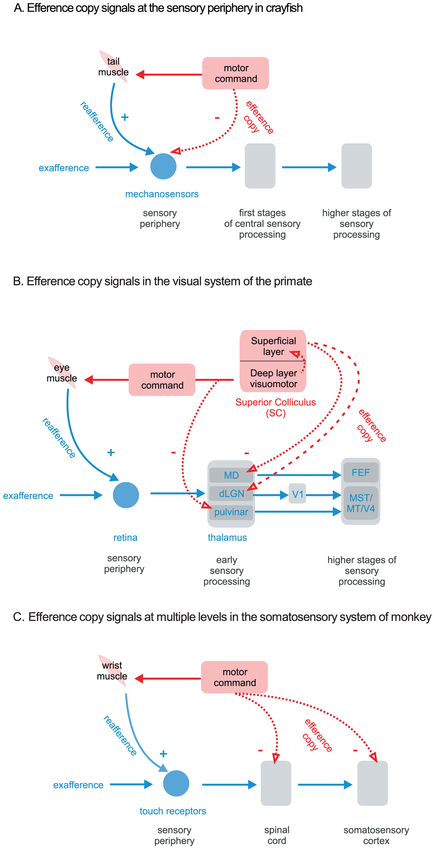
Figure1:. Motor signals can influence sensory processing at many levels for a single behavior
(a) Basic schematic of von Holst and Mittelstaedt's reafference principle illustrated for the crayfish mechanosensory system. In this model, the motor command is sent to both i) the effector muscle (in this case the tail muscle) and ii) to the sensory periphery (i.e. the mechanosensors) (dotted red arrow labeled 'efference copy'). The efference copy of motor command is then subtracted from the incoming sensory signal input, labelled ‘−' and ‘+’, respectively. In situations where sensory inputs and efference copy signals correspond, they will cancel each other out, so that in turn no sensory information relayed to higher levels for further processing. In contrast, in situations where there is a difference between sensory inputs and efference copy signals, this difference – representing externally-generated sensory information (i.e. exafference) - is processed further in higher- order sensory areas. (b) Simplified scheme illustrating sensory-motor convergence in the visual system of the primate during saccadic eye movements. In this scheme, motor signals only weakly modulate responses of neurons early visual processing (i.e., the dLGN of thalamus; (99). However, motor signals strongly influence visual responses at higher levels of processing via the superior colliculus (SC). Specifically, the SC not only sends projections to the premotor pathways to control saccades, but also to the pulvinar (red dashed arrows) where it mediates i) saccadic suppression through the SC-Pulvinar-MT pathway AND ii) shifting of visual receptive fields just before a saccade through the SC-MD thalamus FEF pathway. Together these pathways ensure perceptual stability during eye movements. (c) Simplified scheme illustrating sensory-motor convergence at multiple levels in the somatosensory system of the monkey. In this diagram, a motor signal is sent not only to the muscle controlling the wrist to move the hand but copies are also to both the spinal cord AND cerebral cortex to suppress self-generated somatosensory signals (red dashed arrows). This interaction of motor and sensory signals at multiple levels of processing (e.g. spinal cord and cerebral cortex) likely provides the flexibility required for fine-tuning and updating relationships between motor signals and the resultant sensory feedback during our everyday activities.
Figure 2:
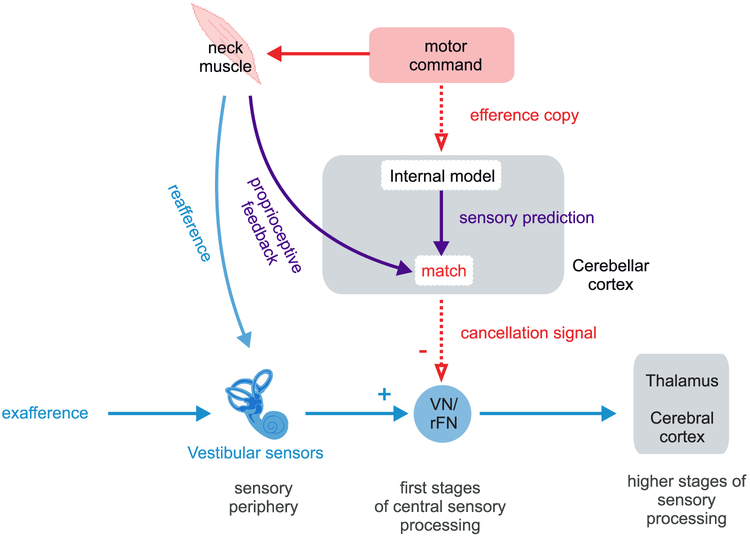
Figure 2:. Proposed model for cancellation of sensory reafference in the vestibular system.
In this model, a motor command is sent i) to the neck muscle to move the head, and also ii) to areas that generate internal models of the sensory consequences of active movements, resulting in a prediction of the sensory feedback expected as a result of the head movement command. In situations where there is a match between expected and actual proprioceptive sensory input – as would be the case during normal active head movements - a cancellation signal (negative image of the vestibular afferent signal) is sent to vestibular-only (VO) neurons in the vestibular nuclei (VN) and to the rostral fastigial nuclei (rFN) of the cerebellum to suppress the self-generated vestibular inputs. In situations where actual and predicted sensory inputs do not match, vestibular signals are not suppressed. It is notable that the brain uses a multimodal approach, combining inputs from the vestibular and proprioceptive systems, to both sense self-motion and to suppress the representation of actively generated self-motion.

References

    1. Ford JM, Mathalon DH (2005): Corollary discharge dysfunction in schizophrenia: can it explain auditory hallucinations? Int J Psychophysiol. 58:179–189. - PubMed
    1. Helmholtz HV (1925): Handbuch der Physiologischen Optik [Treatise on PhysiologicalOptics]. Southall: Edition ed.: JPC.
    1. Sperry RW (1950): Neural basis of the spontaneous optokinetic response produced by visual inversion. J Comp Physiol Psychol. 43:482–489. - PubMed
    1. von Holst E, Mittelstaedt H (1950): Das reafferenzprinzip. Naturwissenschaften. 37:464–476.
    1. Wurtz RH (2008): Neuronal mechanisms of visual stability. Vision Res. 48:2070–2089. - PMC - PubMed

Publication types