


Half-life of chlorpyrifos oxon and other organophosphorus esters in aqueous solution
- PMID: 31401088
- PMCID: PMC6732024
- DOI: 10.1016/j.cbi.2019.108788
Half-life of chlorpyrifos oxon and other organophosphorus esters in aqueous solution
Abstract
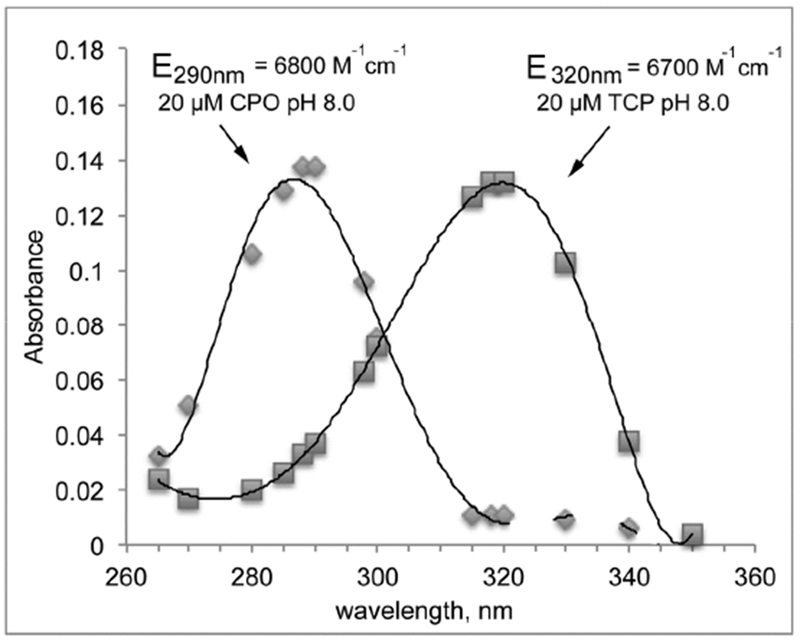
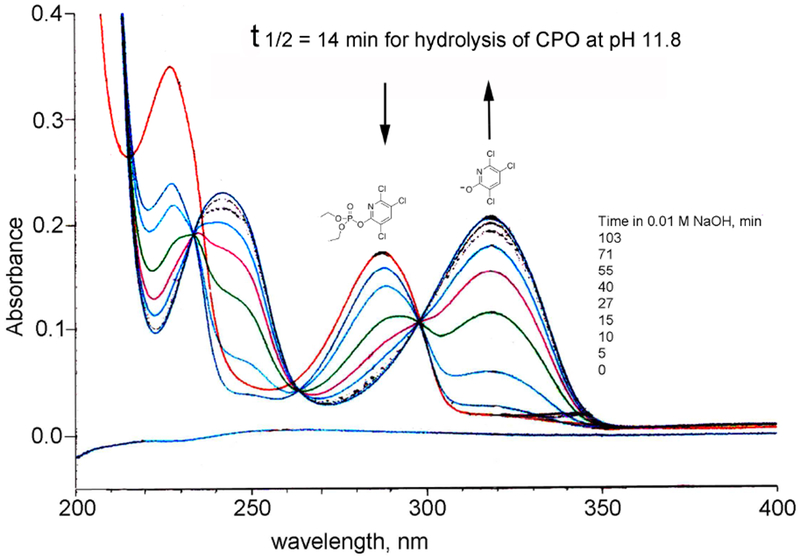
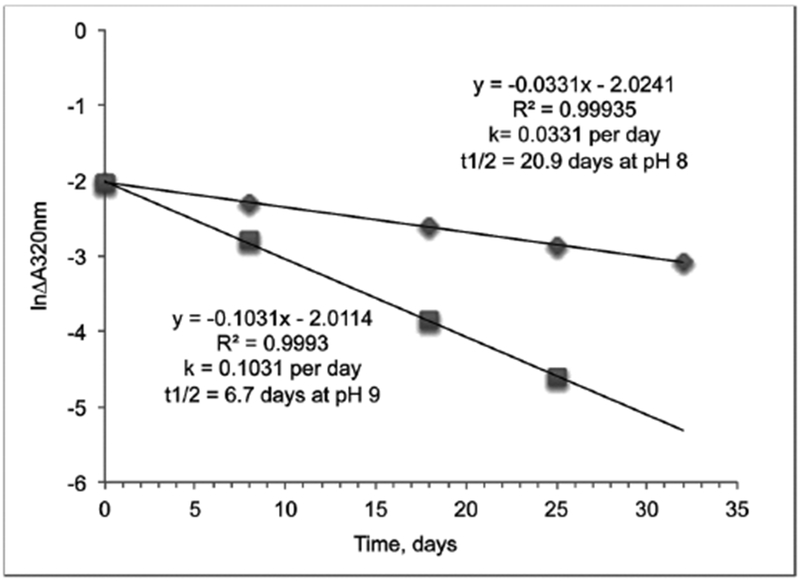
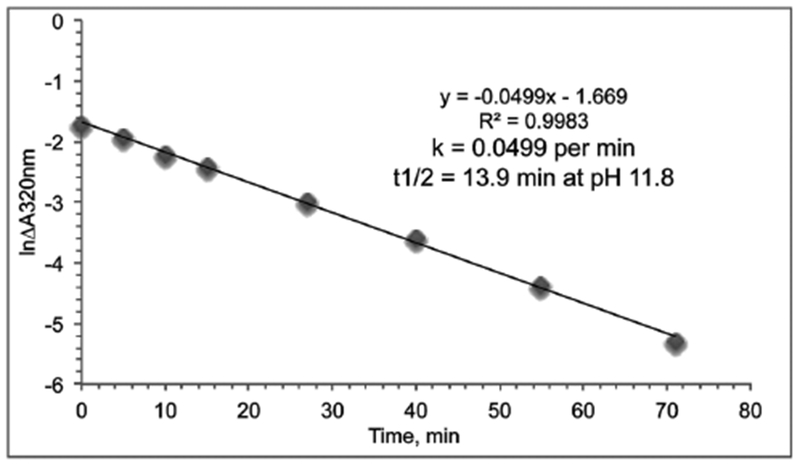
Aqueous solutions of chlorpyrifos oxon are used to study the ability of chlorpyrifos oxon to catalyze protein crosslinking. Assays for protein crosslinking can avoid artifacts by using information on the stability of chlorpyrifos oxon in solution. We undertook to determine the half-life of chlorpyrifos oxon in aqueous solution because literature values do not exist. The rate of conversion of chlorpyrifos oxon to 3,5,6-trichloro-2-pyridinol was measured at 23 °C in 20 mM TrisCl pH 8 and pH 9 by recording loss of absorbance at 290 nm for chlorpyrifos oxon and increase in absorbance at 320 nm for 3,5,6-trichloro-2-pyridinol. The half-life of chlorpyrifos oxon was 20.9 days at pH 8 and 6.7 days at pH 9. Literature reports for the stability of other organophosphorus toxicants were summarized because our current studies suggest that other organophosphorus toxicants are also crosslinking agents.
Keywords: Absorbance spectra; Chlorpyrifos oxon; Extinction coefficient; Half-life; Stability.
Copyright © 2019 The Authors. Published by Elsevier B.V. All rights reserved.
Conflict of interest statement
Conflict of interest statement
The authors have no competing interests
Declaration of interests
The authors declare that they have no known competing financial interests or personal relationships that could have appeared to influence the work reported in this paper.
Figures
References
-
- Amitai G, Moorad D, Adani R and Doctor BP (1998) Inhibition of acetylcholinesterase and butyrylcholinesterase by chlorpyrifos-oxon. Biochem Pharmacol 56:293–299. - PubMed
-
- Benoit-Marquié F, de Montety C, Gilard V, Martino R, Maurette MT and Malet-Martino M (2004) Dichlorvos degradation studied by 31P-NMR. Environ Chem Lett 2:93–97.
-
- Broomfield CA, Lenz DE and Maclver B (1986) The stability of soman and its stereoisomers in aqueous solution: toxicological considerations. Arch Toxicol 59:261–265. - PubMed
-
- Chapman RA and Cole CM (1982) Observations on the influence of water and soil pH on the persistence of insecticides. Journal of environmental science and health Part B, Pesticides, food contaminants, and agricultural wastes 17:487–504. - PubMed
-
- Clark DN (1989) Review of reactions of chemical agents in water. Defense Technical Information Center, Alexandria, VA AD-A213: 287.
MeSH terms
Substances
Grants and funding
LinkOut - more resources
Full Text Sources
