


The emergence of adaptive laboratory evolution as an efficient tool for biological discovery and industrial biotechnology
- PMID: 31401242
- PMCID: PMC6944292
- DOI: 10.1016/j.ymben.2019.08.004
The emergence of adaptive laboratory evolution as an efficient tool for biological discovery and industrial biotechnology
Abstract
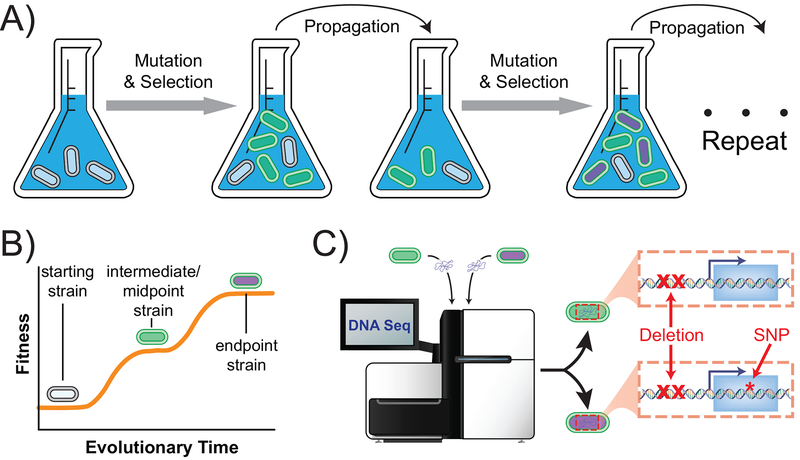
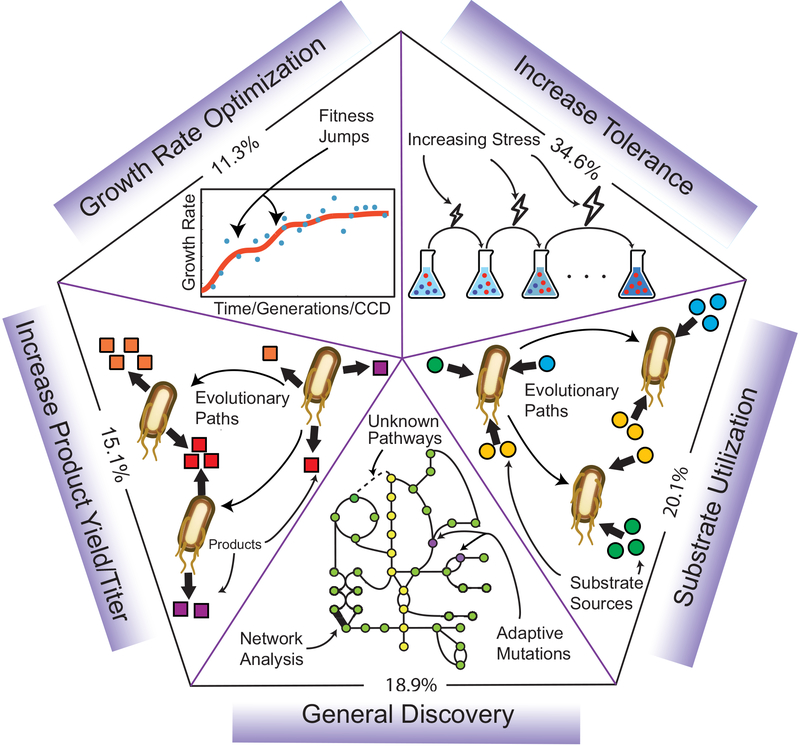
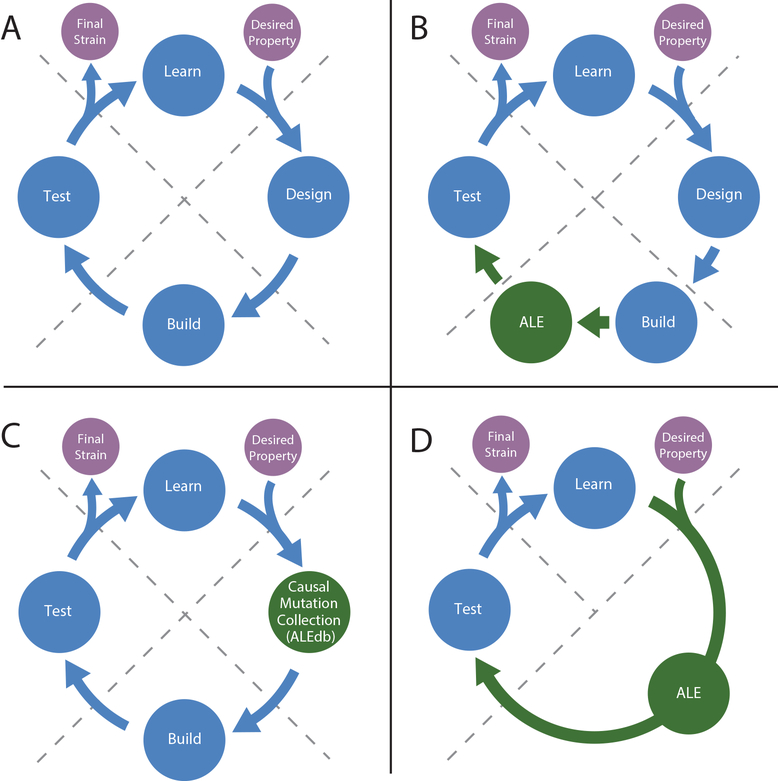
Harnessing the process of natural selection to obtain and understand new microbial phenotypes has become increasingly possible due to advances in culturing techniques, DNA sequencing, bioinformatics, and genetic engineering. Accordingly, Adaptive Laboratory Evolution (ALE) experiments represent a powerful approach both to investigate the evolutionary forces influencing strain phenotypes, performance, and stability, and to acquire production strains that contain beneficial mutations. In this review, we summarize and categorize the applications of ALE to various aspects of microbial physiology pertinent to industrial bioproduction by collecting case studies that highlight the multitude of ways in which evolution can facilitate the strain construction process. Further, we discuss principles that inform experimental design, complementary approaches such as computational modeling that help maximize utility, and the future of ALE as an efficient strain design and build tool driven by growing adoption and improvements in automation.
Copyright © 2019 International Metabolic Engineering Society. Published by Elsevier Inc. All rights reserved.
Figures
References
-
- Aguilar C, Martínez-Batallar G, Flores N, Moreno-Avitia F, Encarnación S, Escalante A, Bolívar F, 2018. Analysis of differentially upregulated proteins in ptsHIcrr- and rppH-mutants in Escherichia coli during an adaptive laboratory evolution experiment. Appl. Microbiol. Biotechnol 102, 10193–10208. 10.1007/s00253-018-9397-3 - DOI - PubMed
Publication types
MeSH terms
Grants and funding
LinkOut - more resources
Full Text Sources
Other Literature Sources
