


A practical computerized decision support system for predicting the severity of Alzheimer's disease of an individual
- PMID: 31402810
- PMCID: PMC6688646
- DOI: 10.1016/j.eswa.2019.04.022
A practical computerized decision support system for predicting the severity of Alzheimer's disease of an individual
Abstract
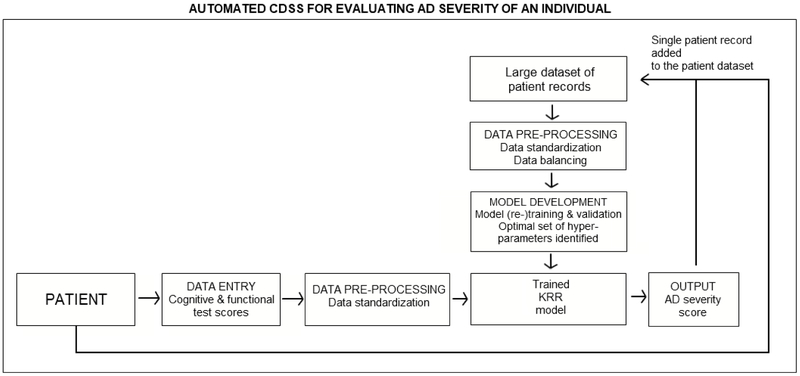
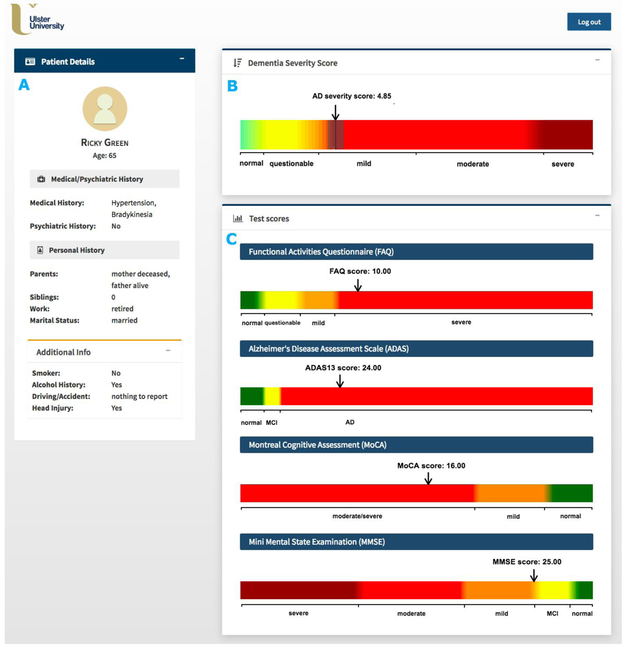
Computerized clinical decision support systems can help to provide objective, standardized, and timely dementia diagnosis. However, current computerized systems are mainly based on group analysis, discrete classification of disease stages, or expensive and not readily accessible biomarkers, while current clinical practice relies relatively heavily on cognitive and functional assessments (CFA). In this study, we developed a computational framework using a suite of machine learning tools for identifying key markers in predicting the severity of Alzheimer's disease (AD) from a large set of biological and clinical measures. Six machine learning approaches, namely Kernel Ridge Regression (KRR), Support Vector Regression, and k-Nearest Neighbor for regression and Support Vector Machine (SVM), Random Forest, and k-Nearest Neighbor for classification, were used for the development of predictive models. We demonstrated high predictive power of CFA. Predictive performance of models incorporating CFA was shown to consistently have higher accuracy than those based solely on biomarker modalities. We found that KRR and SVM were the best performing regression and classification methods respectively. The optimal SVM performance was observed for a set of four CFA test scores (FAQ, ADAS13, MoCA, MMSE) with multi-class classification accuracy of 83.0%, 95%CI = (72.1%, 93.8%) while the best performance of the KRR model was reported with combined CFA and MRI neuroimaging data, i.e., R 2 = 0.874, 95%CI = (0.827, 0.922). Given the high predictive power of CFA and their widespread use in clinical practice, we then designed a data-driven and self-adaptive computerized clinical decision support system (CDSS) prototype for evaluating the severity of AD of an individual on a continuous spectrum. The system implemented an automated computational approach for data pre-processing, modelling, and validation and used exclusively the scores of selected cognitive measures as data entries. Taken together, we have developed an objective and practical CDSS to aid AD diagnosis.
Keywords: Alzheimer’s disease; cognitive impairment; decision support system; dementia; diagnosis support; machine learning.
Conflict of interest statement
Declarations of interest None
Figures
References
-
- Abikoff H, Alvir J, Hong G, Sukoff R, Orazio J, Solomon S & Saravay S (1987). Logical memory subtest of the Wechsler Memory Scale: age and education norms and alternate-form reliability of two scoring systems. Journal of clinical and experimental neuropsychology, 9(4), 435–448. - PubMed
-
- Agosta F, Pievani M, Geroldi C, Copetti M, Frisoni GB, & Filippi M (2012). Resting state fMRI in Alzheimer's disease: beyond the default mode network. Neurobiology of aging, 33(8), 1564–1578. - PubMed
-
- Allen MP (1997). The coefficient of determination in multiple regression. Understanding Regression Analysis, 91–95.
-
- Antila K, Lotjonen J, Thurfjell L, Laine J, Massimini M, Rueckert D, Zubarev R, Oresic M, van Gils M, Mattila J, Hviid Simonsen A, Waldemar G and Soininen H (2013). The PredictAD project: development of novel biomarkers and analysis software for early diagnosis of the Alzheimer's disease. Interface Focus, 3(2), 20120072–20120072. - PMC - PubMed
-
- Awad M, & Khanna R (2015). Support vector regression In Efficient Learning Machines (pp. 67–80). Apress, Berkeley, CA.
Grants and funding
LinkOut - more resources
Full Text Sources