Prevention of lumbar reherniation by the intraoperative use of a radiofrequency bipolar device: A case-control study
- PMID: 31402829
- PMCID: PMC6652257
- DOI: 10.4103/jcvjs.JCVJS_47_19
Prevention of lumbar reherniation by the intraoperative use of a radiofrequency bipolar device: A case-control study
Abstract
Objective: The most common complication after lumbar discectomy is reherniation. Although many studies have investigated factors that may increase the reherniation risk, few are agreed upon all. It has been suggested that limited nucleus removal is associated with higher reherniation risk, while more aggressive nucleus removal can result in increased disc degeneration. Here, we assessed the efficacy of a coblation-assisted microdiscectomy in adult patients undergoing single-level disc surgery.
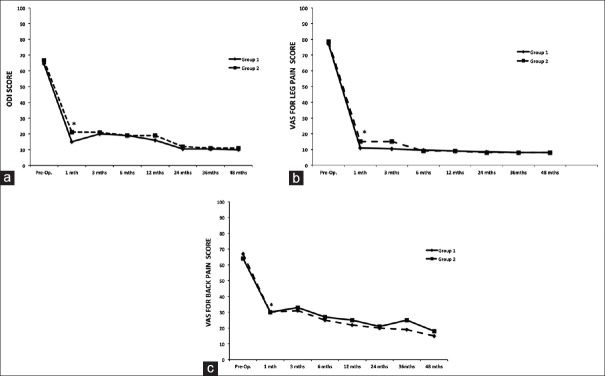
Methods: We prospectively compared the reherniation rate in 75 patients (Group 1) undergoing single-level lumbar disc surgery completed with the radiofrequency bipolar system Aquamantys® (Medtronic, Minneapolis, MN, USA) to that of a historical control group (n = 75) matched for variables related to herniation level and characteristics (Group 2). Patients were followed up to 4 years. Reherniations were assessed, pain and function were monitored throughout, and imaging was performed at annual follow-up.
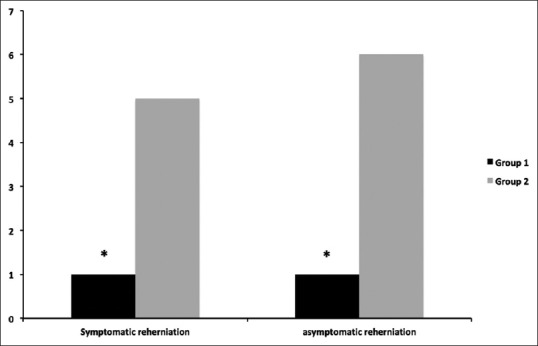
Results: The overall symptomatic reherniation rate was 4%. In particular, one case (1.3%) was observed in Group 1 and five (6.7%) in Group 2 (P < 0.05). Magnetic resonance imaging identified a total of 4 (2.7%) asymptomatic reherniations at 12 months, 6 (4%) at 24 and 36 months, and 7 (4.7%) at 48 months. Overall, Group 1 contained one (1.3%) asymptomatic reherniation case, while six (8%) were observed in Group 2 (P < 0.05).
Conclusions: The low reherniation rate in patients treated by the coblation-assisted microdiscectomy suggests that this technique may reduce the reherniation risk. Clinical outcomes for pain and function at 4 years follow-up compared favorably with literature data. Randomized controlled trial could confirm these results.
Keywords: Discectomy; radiofrequency; recurrent herniation; reherniation.
Conflict of interest statement
There are no conflicts of interest.
Figures
References
-
- Martin G. Recurrent disc prolapse as a cause of recurrent pain after laminectomy for lumbar disc lesions. N Z Med J. 1980;91:206–8. - PubMed
-
- Shamim MS, Parekh MA, Bari ME, Enam SA, Khursheed F. Microdiscectomy for lumbosacral disc herniation and frequency of failed disc surgery. World Neurosurg. 2010;74:611–6. - PubMed
-
- McGirt MJ, Eustacchio S, Varga P, Vilendecic M, Trummer M, Gorensek M, et al. A prospective cohort study of close interval computed tomography and magnetic resonance imaging after primary lumbar discectomy: Factors associated with recurrent disc herniation and disc height loss. Spine (Phila Pa 1976) 2009;34:2044–51. - PubMed
-
- Keskimäki I, Seitsalo S, Osterman H, Rissanen P. Reoperations after lumbar disc surgery: A population-based study of regional and interspecialty variations. Spine (Phila Pa 1976) 2000;25:1500–8. - PubMed