


Review
doi: 10.1200/JCO.18.02303.
Epub 2019 Aug 12.
Evidence-Based Treatment Paradigms for Management of Invasive Cervical Carcinoma
Affiliations
- PMID: 31403858
- PMCID: PMC7098831
- DOI: 10.1200/JCO.18.02303
Item in Clipboard
Review
Evidence-Based Treatment Paradigms for Management of Invasive Cervical Carcinoma
J Clin Oncol.
.
Erratum in
-
Erratum.J Clin Oncol. 2019 Nov 1;37(31):2956. doi: 10.1200/JCO.19.02423. J Clin Oncol. 2019. PMID: 31661658 Free PMC article. No abstract available.
No abstract available
Figures
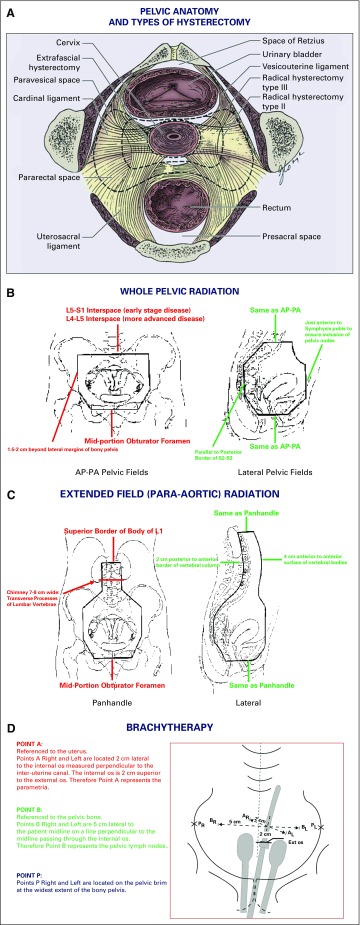
Anatomic landmarks for surgical treatment of early stage cervical cancer (Panel A) and for administration of radiation therapy for locally advanced cervical cancer (Panels B-D). (A) Anatomy of the pelvis depicting location of the paravesical and pararectal spaces and other important anatomic landmarks encountered during performance of extrafascial, modified radical, and/or radical hysterectomy. (B) Wholepelvic radiotherapy. (C) Extended-field (para-aortic) radiotherapy. (D) Intracavitary brachytherapy. Point A: referenced to the uterus. Points A right (AR) and left (AL) are located 2 cm lateral to the internal os measured perpendicular to the interuterine canal. The internal os is 2 cm superior to the external (ext) os. Therefore, point A represents the parametria. Point B: referenced to the pelvic bone. Points B right (BR) and left (BL) are 5 cm lateral to the patient’s midline on a line perpendicular to the midline passing through the internal os. Therefore, point B represents the pelvic lymph nodes. Point P: points P right (PR) and left (PL) are located on the pelvic brim at the widest extent of the bony pelvis. AP, anteroposterior; L, lumbar vertebra; PA, postero-anterior; S, sacral vertebra. Source: (A) Public domain (Berek JS, Hacker NF); (B-D) Radiation therapy manual of the Gynecologic Oncology Group. Adapted and labeled by the authors. Used with permission through open-access granted by the National Cancer Institute.
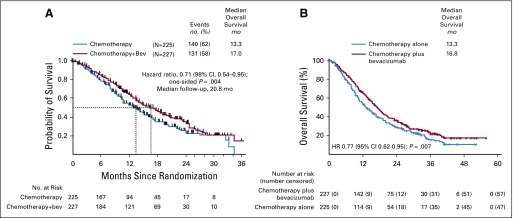
Overall survival in Gynecologic Oncology Group protocol 240. (A) Kaplan-Meier overall survival curves comparing chemotherapy alone with chemotherapy plus bevacizumab at 271 events (second interim analysis prompting closure of the trial by the National Cancer Institute’s Data Safety and Monitoring Board). (B) Kaplan-Meier overall survival curves comparing chemotherapy alone with chemotherapy plus bevacizumab at 348 events (ie, the protocol-specified intention-to-treat analysis of overall survival) Copyright 2017 Elsevier. Used with permission. HR, hazard ratio. Copyright 2014 The Massachusetts Medical Society. Used with permission.
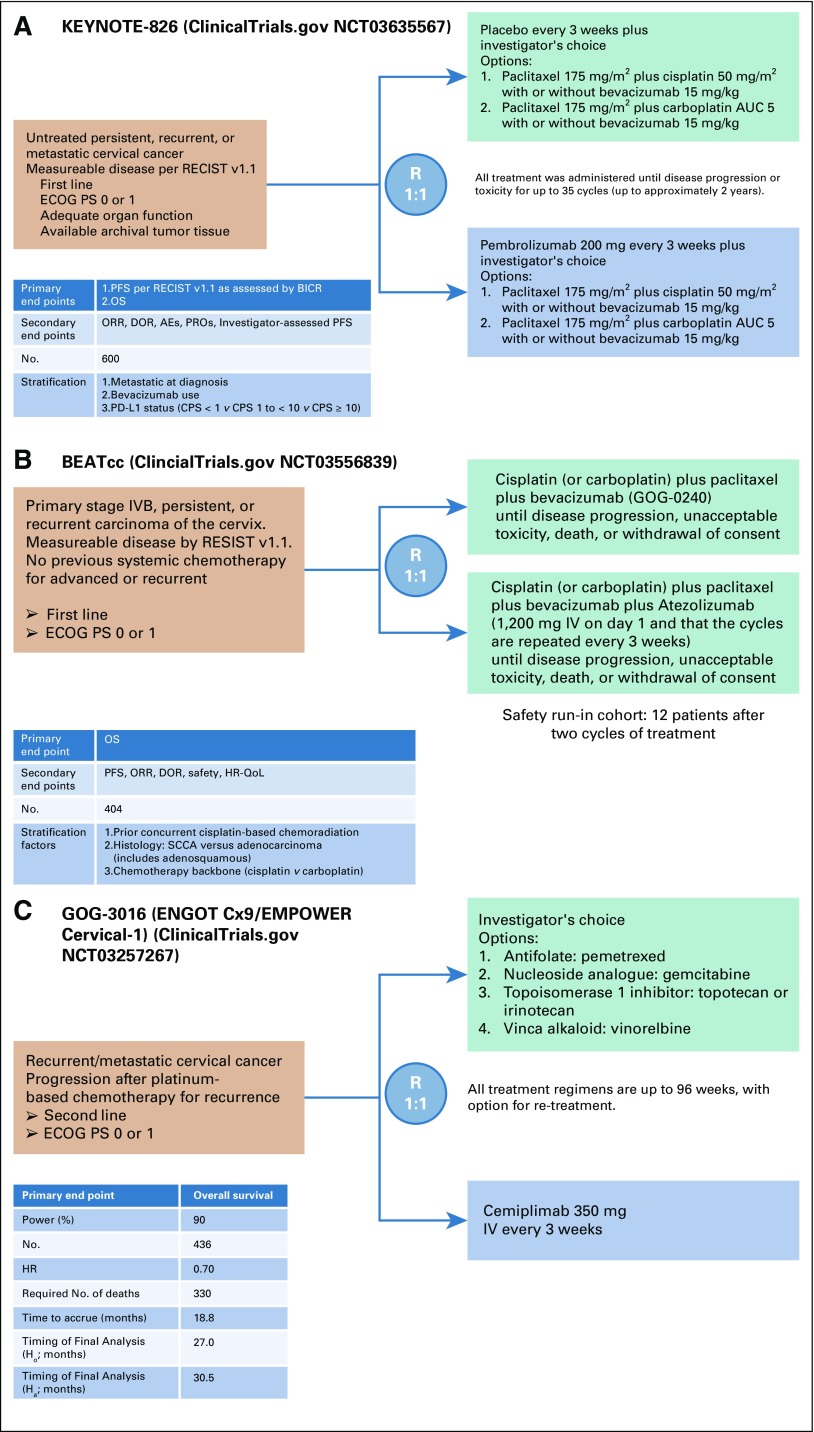
Ongoing phase III, randomized clinical trials for women with recurrent/metastatic cervical cancer. (A) KEYNOTE-826 (Keytruda Trial 826) trial schema of first-line chemotherapy with or without bevacizumab versus chemotherapy with or without bevacizumab plus pembrolizumab. (B) BEATcc (Beat Cervical Cancer trial) trial schema of first-line chemotherapy plus bevacizumab with and without atezolizumab. (C) GOG-0316 (Gynecologic Oncology Group study 3016) trial schema of cemiplimab versus physician’s choice chemotherapy after progression receiving primary platinum-based therapy. AE, adverse events; AUC, area under the concentration-time curve; BICR, blinded independent central review; CPS, combined positive score; DOR, duration of response; ECOG PS, Eastern Cooperative Oncology Group performance status; HR, hazard ratio; IV, intravenously; ORR, overall response rate; OS, overall survival; PD-L1, programmed death-ligand 1; PFS, progression-free survival; PROs, patient-reported outcomes; QoL, quality of life; R, randomize; RECIST v 1.1, Response Evaluation Criteria in Solid Tumors version 1.1; SCCA, squamous cell carcinoma.
References
-
- Bray F, Ferlay J, Soerjomataram I, et al. Global cancer statistics 2018: GLOBOCAN estimates of incidence and mortality worldwide for 36 cancers in 185 countries. CA Cancer J Clin. 2018;68:394–424. - PubMed
-
- Siegel RL, Miller KD, Jemal A. Cancer statistics, 2019. CA Cancer J Clin. 2019;69:7–34. - PubMed
-
- Tewari KS, Monk BJ: Invasive cervical cancer, in Clinical Gynecologic Oncology (ed 9). DiSaia PJ, Creasman WT (eds), Amsterdam, Elsevier 2017, pp. 38-104
-
- Tsai CS, Lai CH, Chang TC, et al. A prospective randomized trial to study the impact of pretreatment FDG-PET for cervical cancer patients with MRI-detected positive pelvic but negative para-aortic lymphadenopathy. Int J Radiat Oncol Biol Phys. 2010;76:477–484. - PubMed
