Review
. 2019 Jul 25:10:1763.
doi: 10.3389/fimmu.2019.01763. eCollection 2019.

ADAR1: "Editor-in-Chief" of Cytoplasmic Innate Immunity

Affiliations
Review

ADAR1: "Editor-in-Chief" of Cytoplasmic Innate Immunity

Mart M Lamers et al. Front Immunol. .

Abstract

Specialized receptors that recognize molecular patterns such as double stranded RNA duplexes-indicative of viral replication-are potent triggers of the innate immune system. Although their activation is beneficial during viral infection, RNA transcribed from endogenous mobile genetic elements may also act as ligands potentially causing autoimmunity. Recent advances indicate that the adenosine deaminase ADAR1 through RNA editing is involved in dampening the canonical antiviral RIG-I-like receptor-, PKR-, and OAS-RNAse L pathways to prevent autoimmunity. However, this inhibitory effect must be overcome during viral infections. In this review we discuss ADAR1's critical role in balancing immune activation and self-tolerance.

Keywords: ADAR1; MDA5; OAS; PKR; RIG-I; cytoplasmic innate immunity.


Figures
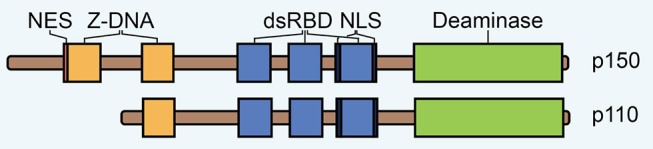
Figure 1
Figure 1
The domain architecture of ADAR1 isoforms p150 and p110. NES, nuclear export signal; dsRBD, double-stranded RNA binding domain; NLS, nuclear localization signal.
Figure 2
Figure 2
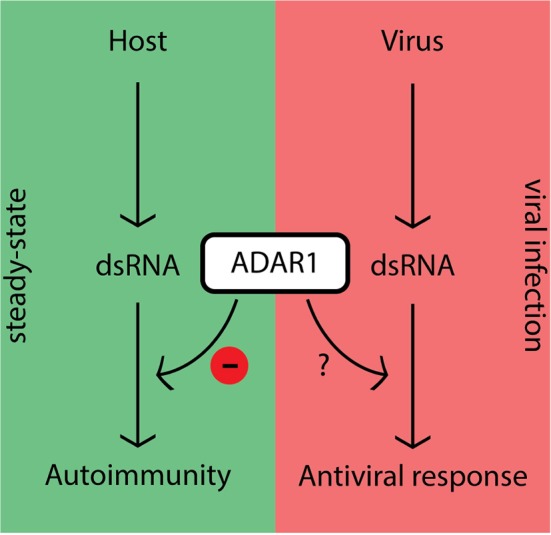
ADAR1's dampening effect on immune activity prevents autoimmunity in steady-state, but should be regulated during viral infection.
Figure 3
Figure 3
ADAR1 balances self-tolerance and immune activity by modulating canonical antiviral pathways induced by dsRNA. (A) Adenosine to inosine editing or binding of the cytoplasmic ADAR1 isoform p150 or the nuclear p110 to extended dsRNA duplexes prevents their detection by cytoplasmic antiviral signaling pathways, including RIG-I like receptor-, OAS/RNAseL-, and PKR pathways. These dsRNA duplexes can be of viral origin, but in the absence of ADAR1 (B) endogenous dsRNAs—which are likely to originate from inverted Alu repeats or other sources (e.g., mitochondrial dsRNAs)—can also serve as a substrate for antiviral signaling, leading to immune activation, and possibly autoimmunity. Blocking the activation of these pathways prevents IFN-I production, translation arrest, and apoptosis, but this must be tightly regulated in order to not create an environment that favors virus replication.

References

    1. Yoneyama M, Kikuchi M, Natsukawa T, Shinobu N, Imaizumi T, Miyagishi M, et al. The RNA helicase RIG-I has an essential function in double-stranded RNA-induced innate antiviral responses. Nat Immunol. (2004) 5:730–7. 10.1038/ni1087 - DOI - PubMed
    1. Kato H, Sato S, Yoneyama M, Yamamoto M, Uematsu S, Matsui K, et al. Cell type-specific involvement of RIG-I in antiviral response. Immunity. (2005) 23:19–28. 10.1016/j.immuni.2005.04.010 - DOI - PubMed
    1. Yoneyama M, Kikuchi M, Matsumoto K, Imaizumi T, Miyagishi M, Taira K, et al. Shared and unique functions of the DExD/H-box helicases RIG-I, MDA5, and LGP2 in antiviral innate immunity. J Immunol. (2005) 175:2851–8. 10.4049/jimmunol.175.5.2851 - DOI - PubMed
    1. Fitzgerald KA, McWhirter SM, Faia KL, Rowe DC, Latz E, Golenbock DT, et al. IKKepsilon and TBK1 are essential components of the IRF3 signaling pathway. Nat Immunol. (2003) 4:491–6. 10.1038/ni921 - DOI - PubMed
    1. Kawai T, Takahashi K, Sato S, Coban C, Kumar H, Kato H, et al. IPS-1, an adaptor triggering RIG-I- and Mda5-mediated type I interferon induction. Nat Immunol. (2005) 6:981–8. 10.1038/ni1243 - DOI - PubMed

Publication types