


Genetic risk of Parkinson disease and progression:: An analysis of 13 longitudinal cohorts
- PMID: 31404238
- PMCID: PMC6659137
- DOI: 10.1212/NXG.0000000000000348
Genetic risk of Parkinson disease and progression:: An analysis of 13 longitudinal cohorts
Erratum in
-
Erratum: Genetic risk of Parkinson disease and progression: An analysis of 13 longitudinal cohorts.Neurol Genet. 2019 Aug 15;5(4):e354. doi: 10.1212/NXG.0000000000000354. eCollection 2019 Aug. Neurol Genet. 2019. PMID: 31517058 Free PMC article.
Abstract
Objective: To determine if any association between previously identified alleles that confer risk for Parkinson disease and variables measuring disease progression.
Methods: We evaluated the association between 31 risk variants and variables measuring disease progression. A total of 23,423 visits by 4,307 patients of European ancestry from 13 longitudinal cohorts in Europe, North America, and Australia were analyzed.
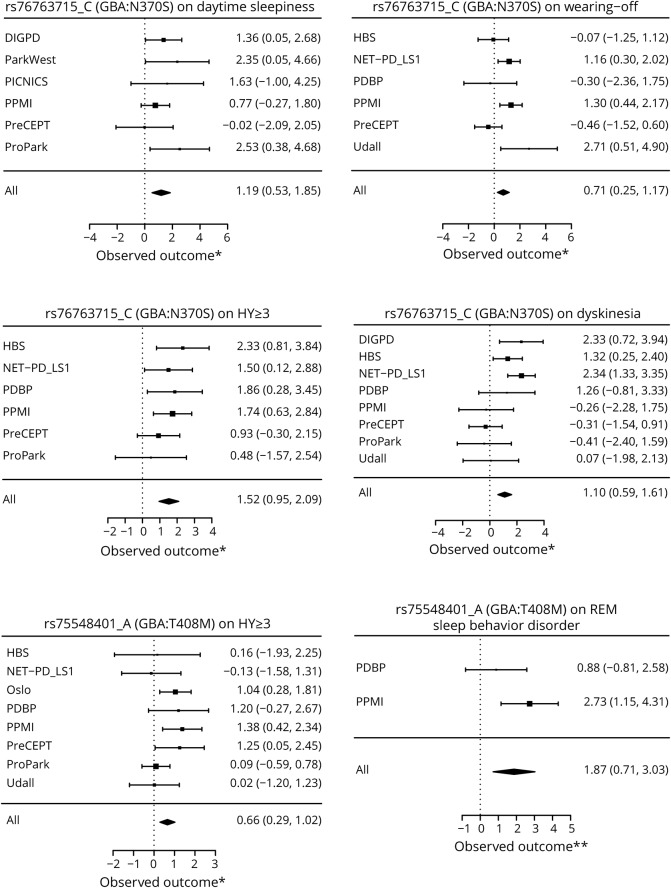
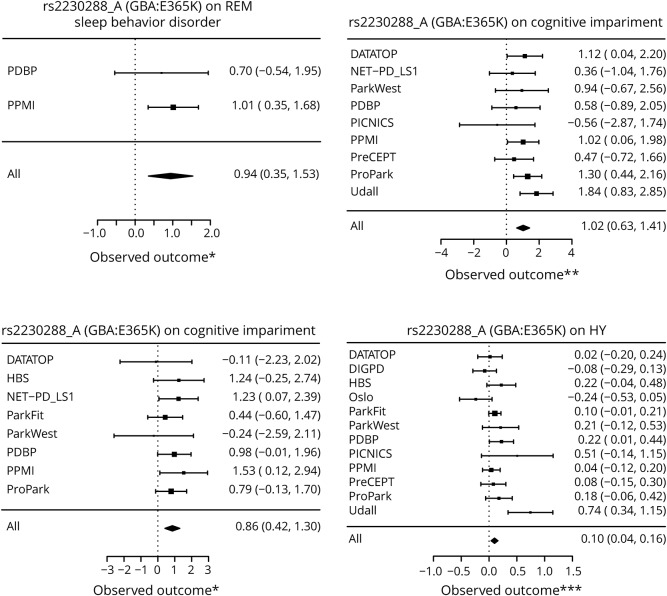
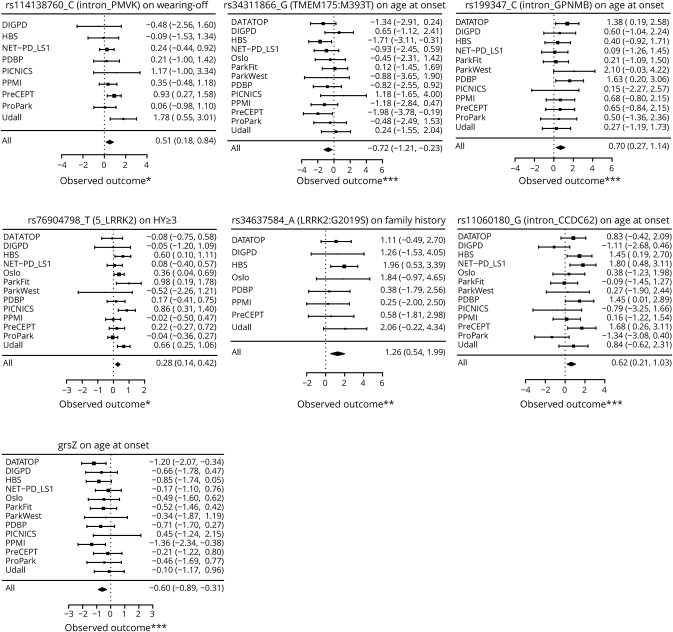
Results: We confirmed the importance of GBA on phenotypes. GBA variants were associated with the development of daytime sleepiness (p.N370S: hazard ratio [HR] 3.28 [1.69-6.34]) and possible REM sleep behavior (p.T408M: odds ratio 6.48 [2.04-20.60]). We also replicated previously reported associations of GBA variants with motor/cognitive declines. The other genotype-phenotype associations include an intergenic variant near LRRK2 and the faster development of motor symptom (Hoehn and Yahr scale 3.0 HR 1.33 [1.16-1.52] for the C allele of rs76904798) and an intronic variant in PMVK and the development of wearing-off effects (HR 1.66 [1.19-2.31] for the C allele of rs114138760). Age at onset was associated with TMEM175 variant p.M393T (-0.72 [-1.21 to -0.23] in years), the C allele of rs199347 (intronic region of GPNMB, 0.70 [0.27-1.14]), and G allele of rs1106180 (intronic region of CCDC62, 0.62 [0.21-1.03]).
Conclusions: This study provides evidence that alleles associated with Parkinson disease risk, in particular GBA variants, also contribute to the heterogeneity of multiple motor and nonmotor aspects. Accounting for genetic variability will be a useful factor in understanding disease course and in minimizing heterogeneity in clinical trials.
Figures
References
-
- Elbaz A, Bower JH, Maraganore DM, et al. Risk tables for parkinsonism and Parkinson's disease. J Clin Epidemiol 2002;55:25–31. - PubMed
-
- Chaudhuri KR, Healy DG, Schapira AHV; National Institute for Clinical Excellence. Non-motor symptoms of Parkinson's disease: diagnosis and management. Lancet Neurol 2006;5:235–245. - PubMed
-
- Satake W, Nakabayashi Y, Mizuta I, et al. Genome-wide association study identifies common variants at four loci as genetic risk factors for Parkinson's disease. Nat Genet 2009;41:1303–1307. - PubMed
Grants and funding
- M01 RR000645/RR/NCRR NIH HHS/United States
- M01 RR000034/RR/NCRR NIH HHS/United States
- U24 AG021886/AG/NIA NIH HHS/United States
- U01 NS100603/NS/NINDS NIH HHS/United States
- M01 RR000334/RR/NCRR NIH HHS/United States
- U01 NS050095/NS/NINDS NIH HHS/United States
- P50 AG005134/AG/NIA NIH HHS/United States
- U19 AG062418/AG/NIA NIH HHS/United States
- M01 RR000042/RR/NCRR NIH HHS/United States
- U01 NS043128/NS/NINDS NIH HHS/United States
- R01 NS115144/NS/NINDS NIH HHS/United States
- M01 RR000040/RR/NCRR NIH HHS/United States
- M01 RR000036/RR/NCRR NIH HHS/United States
- U24 NS095871/NS/NINDS NIH HHS/United States
- M01 RR000044/RR/NCRR NIH HHS/United States
- M01 RR000059/RR/NCRR NIH HHS/United States
- R01 NS024778/NS/NINDS NIH HHS/United States
- U01 NS082157/NS/NINDS NIH HHS/United States
- M01 RR001066/RR/NCRR NIH HHS/United States
- M01 RR000827/RR/NCRR NIH HHS/United States
- M01 RR000847/RR/NCRR NIH HHS/United States
LinkOut - more resources
Full Text Sources
Other Literature Sources