


Impact of Specialized Pediatric Palliative Care: A Systematic Review
- PMID: 31404638
- PMCID: PMC6989377
- DOI: 10.1016/j.jpainsymman.2019.08.005
Impact of Specialized Pediatric Palliative Care: A Systematic Review
Abstract
Context: Specialized pediatric palliative care (SPPC) is increasingly involved in the care of seriously ill children, yet the evidence on its impact has not been comprehensively reviewed.
Objective: The objective of this study was to assess the effects of providing SPPC to seriously ill children on patient-, caregiver-, and systems-level outcomes.
Methods: We performed a Systematic Review following Cochrane methods.
Data sources: Medline, Embase, PsycINFO, Global Health, The Cochrane Central Register of Controlled Trials, LILACS, and Web of Science were searched from January 1996 to June 2018.
Study selection/data extraction: We included randomized controlled, cohort, case-control, and before-after studies in which exposure to SPPC services was the intervention of interest. All outcomes reported in these studies were included. Two investigators independently selected articles, extracted data, and assessed risk of bias of included studies using standardized criteria.
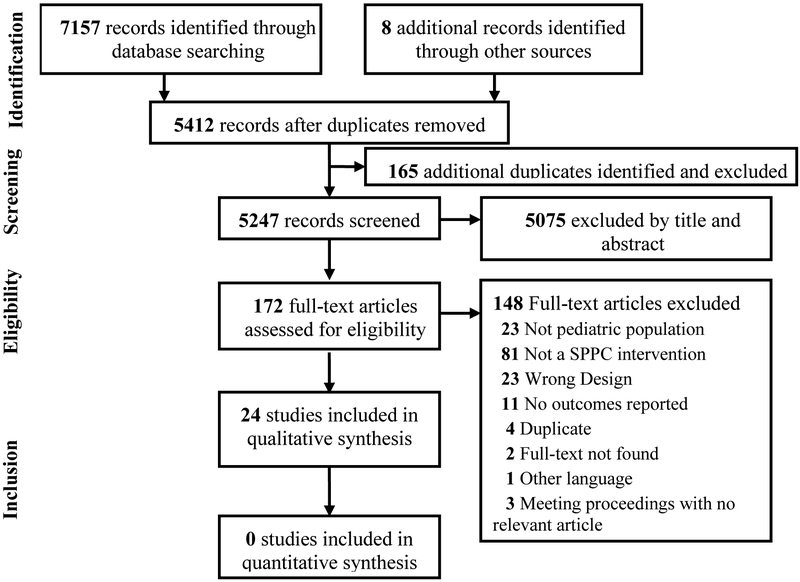
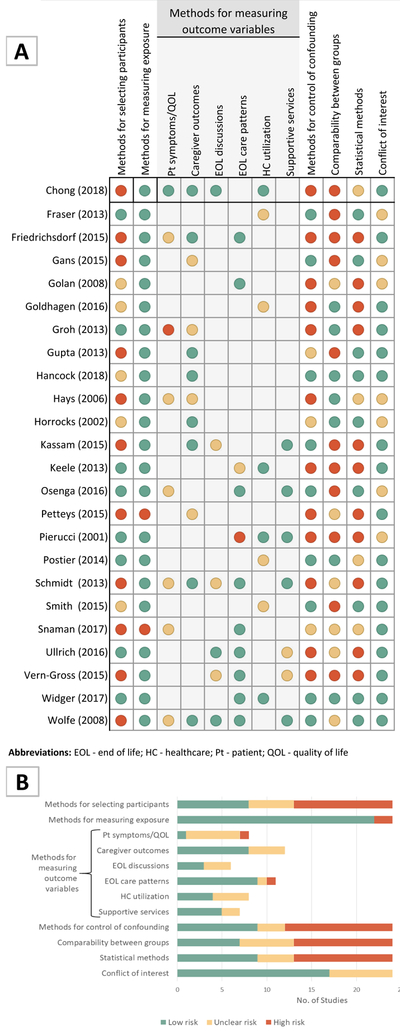
Results: Twenty-four studies were included in qualitative synthesis: one nonrandomized controlled trial, 16 cohort studies, and seven before-after studies. Evidence certainty was low. Twenty-one studies had one or more area with high risk of bias, most commonly selection bias, low group comparability, risk for confounding, and inadequate statistical reporting. Studies analyzed 46 domains, operationalized as 136 distinct outcomes. SPPC was associated with better child quality of life scores in all four studies that assessed this outcome. No other outcome showed this consistency.
Conclusion: Receiving SPPC was associated with better child quality of life. However, the paucity and low certainty of the evidence precluded any firm recommendations about SPPC practice. Larger collaborative networks and greater consensus regarding SPPC research standards are needed.
Keywords: Palliative care; end of life; outcome assessment; patient-reported outcomes; pediatrics; systematic review.
Copyright © 2019 American Academy of Hospice and Palliative Medicine. Published by Elsevier Inc. All rights reserved.
Conflict of interest statement
Authors’ Disclosures of Potential Conflicts of Interest:
All authors have completed and submitted the Disclosure of Potential Conflict of Interests forms. KM, GS, DC, and AC indicated no potential conflicts of interest, whereas JW and VD indicated potential academic conflict of interest as they are authors of four and one of the included articles respectively. Of note, they did not participate in data extraction of papers where authorship involved potential conflict.
Figures
References
-
- World Health Organization: WHO Definition of Palliative Care [Internet]. [cited 2017 Jun 30]. Available from: http://www.who.int/cancer/palliative/definition/en/
-
- Field MJ, Behrman RE, Institute of Medicine (U.S.). Committee on Palliative and End-of-Life Care for Children and Their Families When children die: improving palliative and end-of-life care for children and their families. Washington, D.C.: National Academy Press; 2003. xx, 690 p. - PubMed
-
- American Academy of Pediatrics. Committee on Bioethics and Committee on Hospital Care. Palliative care for children. Pediatrics. 2000. August; 106(2 Pt 1):351–7. - PubMed
-
- ABMS BOARD CERTIFICATION REPORT 2015–2016. American Board of Medical Specialties. [Internet]. [cited 2018 Mar 15]. Available from: http://www.abms.org/media/131568/2015-16-abmscertreport.pdf
-
- Feudtner C, Womer J, Augustin R, Remke S, Wolfe J, Friebert S, et al. Pediatric palliative care programs in children’s hospitals: a cross-sectional national survey. Pediatrics. 2013. December;132(6): 1063–70. - PubMed
Publication types
MeSH terms
Grants and funding
LinkOut - more resources
Full Text Sources
Medical
