. 2019 Aug 10;9(8):165.
doi: 10.3390/metabo9080165.

Microbial Transformations of Organically Fermented Foods

Affiliations

Microbial Transformations of Organically Fermented Foods

Ruma Raghuvanshi et al. Metabolites. .

Abstract

Fermenting food is an ancient form of preservation ingrained many in human societies around the world. Westernized diets have moved away from such practices, but even in these cultures, fermented foods are seeing a resurgent interested due to their believed health benefits. Here, we analyze the microbiome and metabolome of organically fermented vegetables, using a salt brine, which is a common 'at-home' method of food fermentation. We found that the natural microbial fermentation had a strong effect on the food metabolites, where all four foods (beet, carrot, peppers and radishes) changed through time, with a peak in molecular diversity after 2-3 days and a decrease in diversity during the final stages of the 4-day process. The microbiome of all foods showed a stark transition from one that resembled a soil community to one dominated by Enterobacteriaceae, such as Erwinia spp., within a single day of fermentation and increasing amounts of Lactobacillales through the fermentation process. With particular attention to plant natural products, we observed significant transformations of polyphenols, triterpenoids and anthocyanins, but the degree of this metabolism depended on the food type. Beets, radishes and peppers saw an increase in the abundance of these compounds as the fermentation proceeded, but carrots saw a decrease through time. This study showed that organically fermenting vegetables markedly changed their chemistry and microbiology but resulted in high abundance of Enterobacteriaceae which are not normally considered as probiotics. The release of beneficial plant specialized metabolites was observed, but this depended on the fermented vegetable.

Keywords: Fermented Food; GNPS; metabolomics; microbiome; molecular networking.


Conflict of interest statement

The authors declare no conflicts interest.

Figures
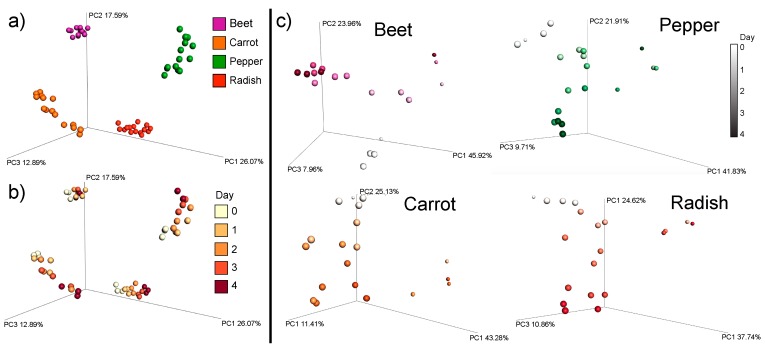
Figure 1
Figure 1
Principle coordinate analysis of a Bray-Curtis distance matrix of metabolomic data relationships among fermented food samples through time. The overall data relationship based on (a) different fermented food type and (b) days of fermentation. (c) The isolated analysis of each food as it is fermented for the 4-day time frame. Samples are colored as a spectrum from white to dark color corresponding to time for each vegetable. The autoclaved samples in this panel are smaller spheres.
Figure 2
Figure 2
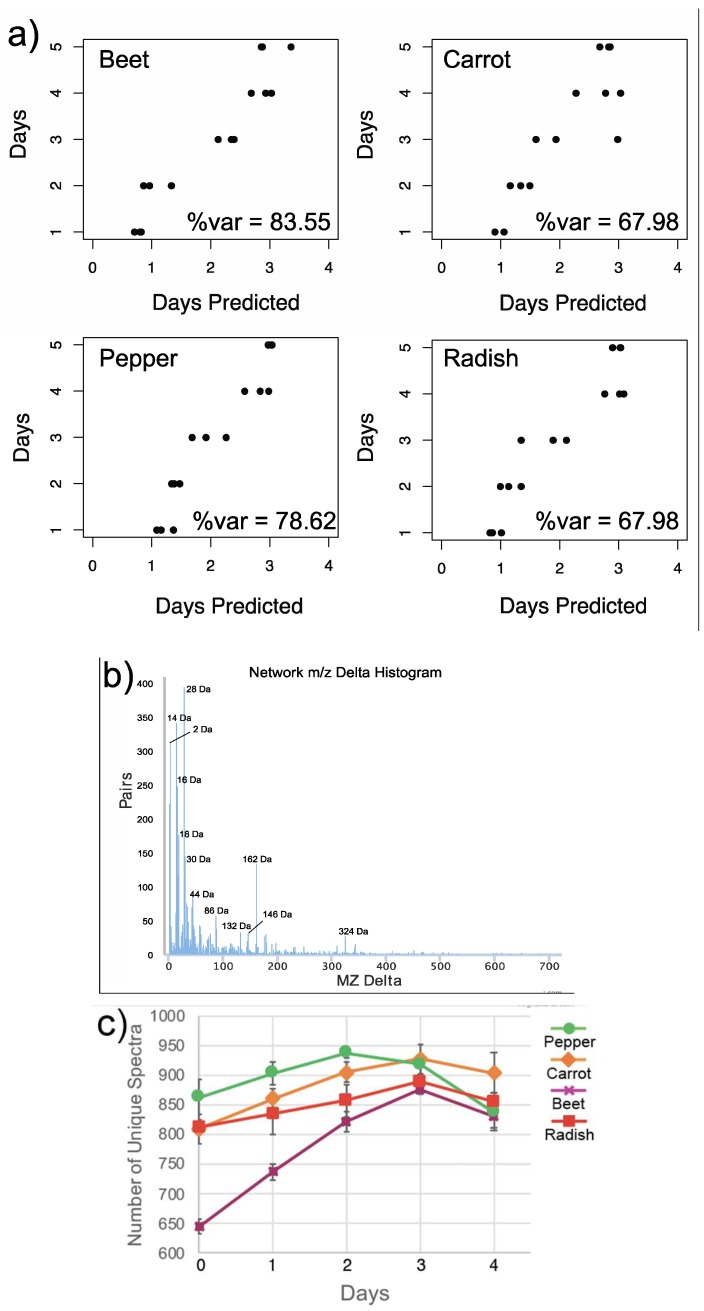
(a) Scatterplot of actual vs. predicted days of fermentation from RF regression for each food type. The RF machine learning algorithm predicts the assignment of the sample in days based on the trend in the metabolomic data. The percent variance explained by days in the metabolomic data is also shown. (b) The most common transformations across dataset based on molecular networking in GNPS plotted as the pairs (represented by one networking edge and difference in m/z of each pair. The abundance of each edge represents its occurrence in the network between two MS/MS pairs). (c) Unique MS/MS spectral richness through the fermentation based on molecular networking in GNPS and the standard deviations of the replicates.
Figure 3
Figure 3
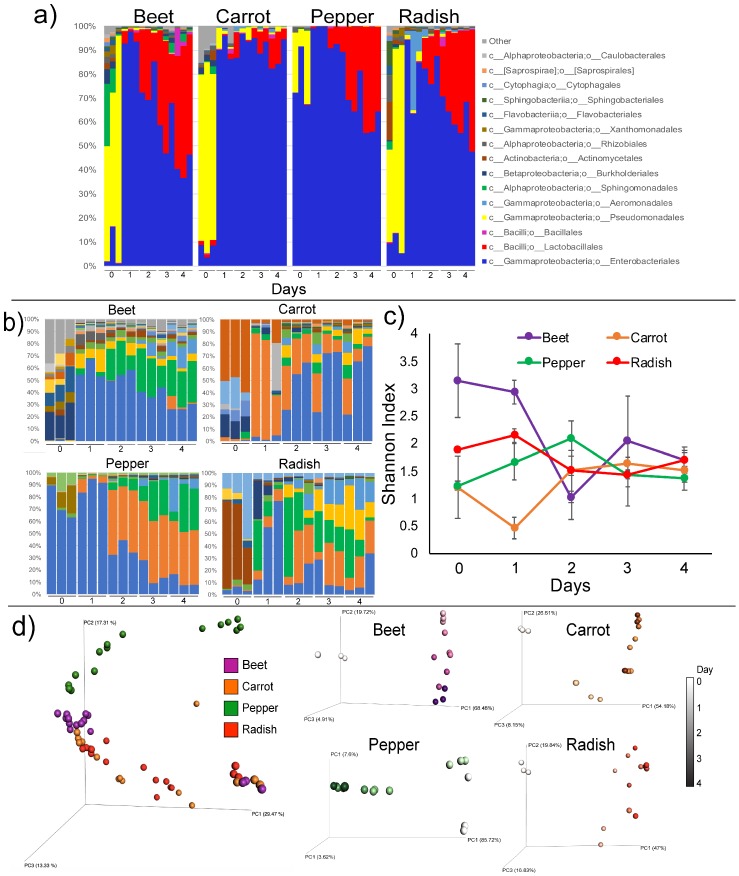
Microbiome changes in the organically fermented foods. (a) Taxa changes at the Order level in all fermented food through time, each of the three replicates is shown as its own bar in the bar graph. (b) Taxa changes at the OTU level in different fermented foods through time. (c) Shannon index of microbial diversity changes in each fermented food through time. (d) Principle coordinate analysis of the weighted UniFrac [16] distance of the Deblurred data for the whole microbiome dataset and each individual vegetable. In the PCoA plots of each individual vegetable, time is denoted as darkening of color for each representative vegetable according to their representative color scale.
Figure 4
Figure 4
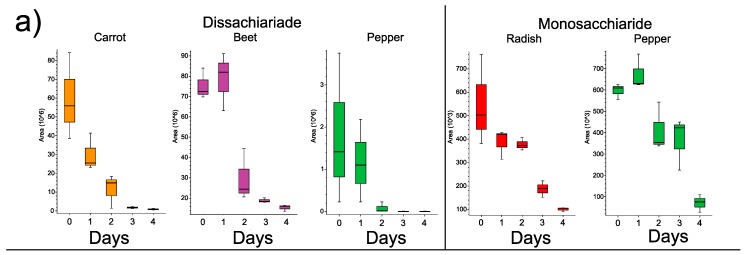
Changes of unique metabolites through the organic food fermentations. (a) Boxplots of changes in sugar abundance through the five-day fermentation in different vegetables. (b) Boxplots of changes in plant natural products detected through GNPS and Compound Discoverer library searching in the four vegetables fermented in this study. Putative structures of the compounds are also shown and the plots are ordered left to right as triterpenoids, flavonoids and other compounds for each specific vegetable.
Figure 4
Figure 4
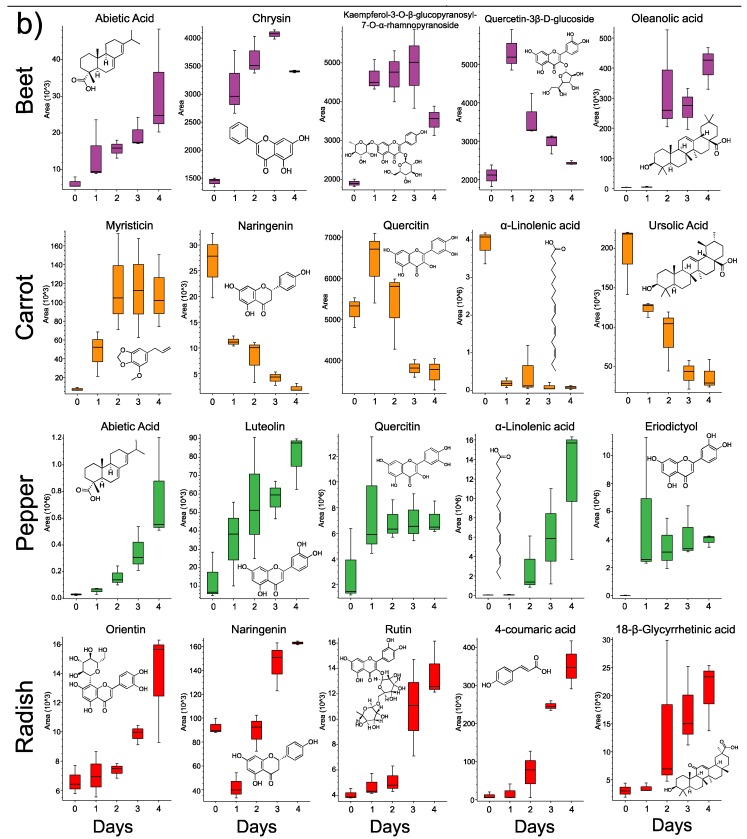
Changes of unique metabolites through the organic food fermentations. (a) Boxplots of changes in sugar abundance through the five-day fermentation in different vegetables. (b) Boxplots of changes in plant natural products detected through GNPS and Compound Discoverer library searching in the four vegetables fermented in this study. Putative structures of the compounds are also shown and the plots are ordered left to right as triterpenoids, flavonoids and other compounds for each specific vegetable.
Figure 5
Figure 5
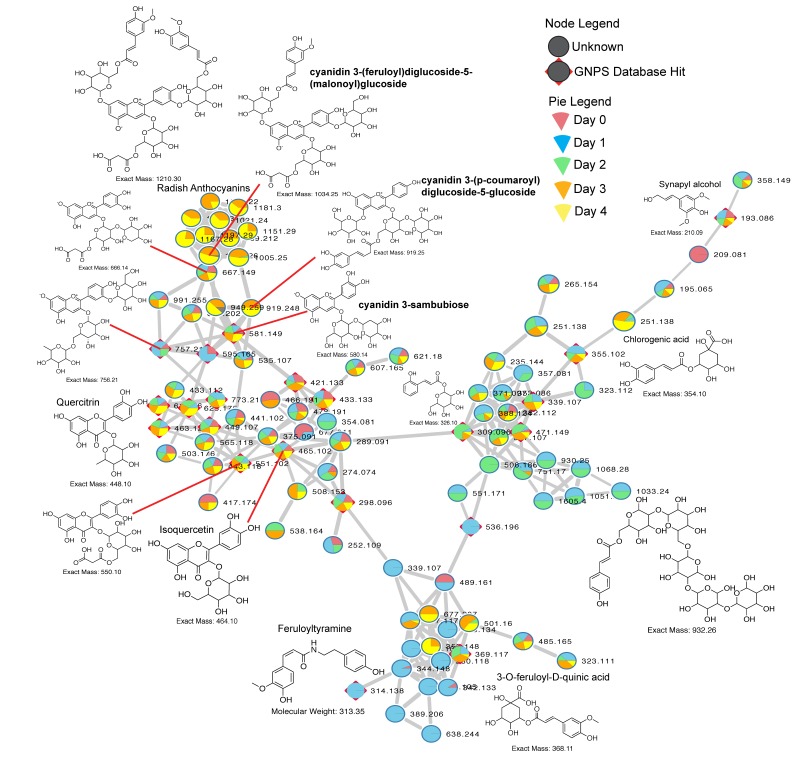
Molecular network of anthocyanins, flavonoids, ferulic acids and related molecules from the fermented food LC-MS/MS dataset (anthocyanins found only in radishes). Each node represents a uniquely clustered MS/MS spectrum and putative metabolite. Nodes are colored using pie charts which correspond to the spectral count in the different fermentation days according to the legend. Related metabolites are connected by edges according to their MS/MS cosine score and the width of the edge is determined by the score. Compounds with a GNPS database hit are highlighted using a red square behind the node. Putative structures and compounds names are shown when discernable through the literature or library matches.

References

    1. Campbell-Platt G. Fermented foods—A world perspective. Food Res. Int. 1994;27:253–257. doi: 10.1016/0963-9969(94)90093-0. - DOI
    1. Selhub E.M., Logan A.C., Bested A.C. Fermented foods, microbiota, and mental health: Ancient practice meets nutritional psychiatry. J. Physiol. Anthropol. 2014;33:2. doi: 10.1186/1880-6805-33-2. - DOI - PMC - PubMed
    1. Wolfe B.E., Dutton R.J. Fermented foods as experimentally tractable microbial ecosystems. Cell. 2015;161:49–55. doi: 10.1016/j.cell.2015.02.034. - DOI - PubMed
    1. Daniel M., Embriette H., Justine W. D., James T. M., Antonio G., Gail A., Alexander A. A., Bahar B., Caitriona B., Yingfeng C., et al. American Gut: An Open Platform for Citizen Science Microbiome Research. mSystems. 2018;3:e00031-18. - PMC - PubMed
    1. David L.A., Maurice C.F., Carmody R.N., Gootenberg D.B., Button J.E., Wolfe B.E., Ling A.V., Devlin A.S., Varma Y., Fischbach M.A., et al. Diet rapidly and reproducibly alters the human gut microbiome. Nature. 2013;505:559–563. doi: 10.1038/nature12820. - DOI - PMC - PubMed

LinkOut - more resources