


Ancient pigs reveal a near-complete genomic turnover following their introduction to Europe
- PMID: 31405970
- PMCID: PMC6717267
- DOI: 10.1073/pnas.1901169116
Ancient pigs reveal a near-complete genomic turnover following their introduction to Europe
Erratum in
-
Correction for Frantz et al., Ancient pigs reveal a near-complete genomic turnover following their introduction to Europe.Proc Natl Acad Sci U S A. 2020 Jun 23;117(25):14610-14611. doi: 10.1073/pnas.2008793117. Epub 2020 Jun 15. Proc Natl Acad Sci U S A. 2020. PMID: 32541041 Free PMC article. No abstract available.
Abstract
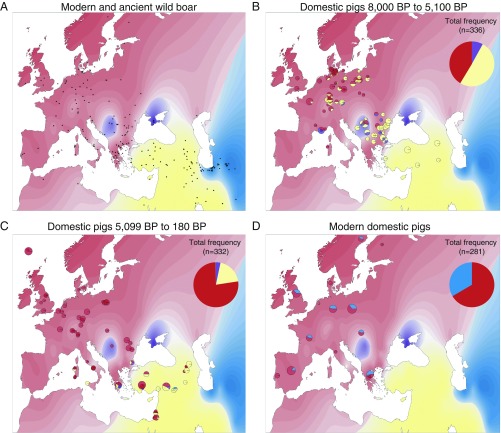
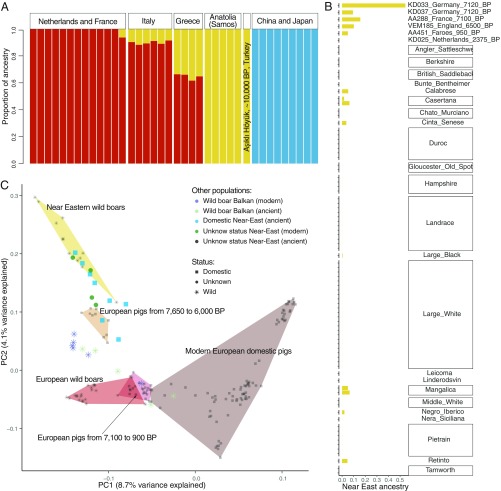
Archaeological evidence indicates that pig domestication had begun by ∼10,500 y before the present (BP) in the Near East, and mitochondrial DNA (mtDNA) suggests that pigs arrived in Europe alongside farmers ∼8,500 y BP. A few thousand years after the introduction of Near Eastern pigs into Europe, however, their characteristic mtDNA signature disappeared and was replaced by haplotypes associated with European wild boars. This turnover could be accounted for by substantial gene flow from local European wild boars, although it is also possible that European wild boars were domesticated independently without any genetic contribution from the Near East. To test these hypotheses, we obtained mtDNA sequences from 2,099 modern and ancient pig samples and 63 nuclear ancient genomes from Near Eastern and European pigs. Our analyses revealed that European domestic pigs dating from 7,100 to 6,000 y BP possessed both Near Eastern and European nuclear ancestry, while later pigs possessed no more than 4% Near Eastern ancestry, indicating that gene flow from European wild boars resulted in a near-complete disappearance of Near East ancestry. In addition, we demonstrate that a variant at a locus encoding black coat color likely originated in the Near East and persisted in European pigs. Altogether, our results indicate that while pigs were not independently domesticated in Europe, the vast majority of human-mediated selection over the past 5,000 y focused on the genomic fraction derived from the European wild boars, and not on the fraction that was selected by early Neolithic farmers over the first 2,500 y of the domestication process.
Keywords: Neolithic; domestication; evolution; gene flow.
Copyright © 2019 the Author(s). Published by PNAS.
Conflict of interest statement
The authors declare no conflict of interest.
Figures
References
-
- Zeder M. A., “Out of the fertile crescent: The dispersal of domestic livestock through Europe and Africa” in Human Dispersal and Species Movement: From Prehistory to the Present, Boivin N., Crassard R., Petraglia M., Eds. (Cambridge University Press, 2017), pp. 261–303.
-
- Conolly J., et al. , Meta-analysis of zooarchaeological data from SW Asia and SE Europe provides insight into the origins and spread of animal husbandry. J. Archaeol. Sci. 38, 538–545 (2011).
-
- Peters J., von den Driesch A., Helmer D., “The Upper Euphrates-Tigris Basin: Cradle of agro-pastoralism?” in The First Steps of Animal Domestication: New Archaeozoological Approaches. Proceedings of the Ninth International Council of Archeozoology, Vigne J.D., Peters J., Helmer D., Eds. (Oxbow Books, Oxford, 2005), pp. 96–123.
-
- Daly K. G., et al. , Ancient goat genomes reveal mosaic domestication in the Fertile Crescent. Science 361, 85–88 (2018). - PubMed
Publication types
MeSH terms
Substances
Grants and funding
LinkOut - more resources
Full Text Sources
Miscellaneous
