


Parechovirus A Infections in Healthy Australian Children During the First 2 Years of Life: A Community-based Longitudinal Birth Cohort Study
- PMID: 31406985
- PMCID: PMC7108192
- DOI: 10.1093/cid/ciz761
Parechovirus A Infections in Healthy Australian Children During the First 2 Years of Life: A Community-based Longitudinal Birth Cohort Study
Abstract
Background: Hospital-based studies identify parechovirus (PeV), primarily PeV-A3, as an important cause of severe infections in young children. However, few community-based studies have been published and the true PeV infection burden is unknown. We investigated PeV epidemiology in healthy children participating in a community-based, longitudinal birth cohort study.
Methods: Australian children (n = 158) enrolled in the Observational Research in Childhood Infectious Diseases (ORChID) study were followed from birth until their second birthday. Weekly stool and nasal swabs and daily symptom diaries were collected. Swabs were tested for PeV by reverse-transcription polymerase chain reaction and genotypes determined by subgenomic sequencing. Incidence rate, infection characteristics, clinical associations, and virus codetections were investigated.
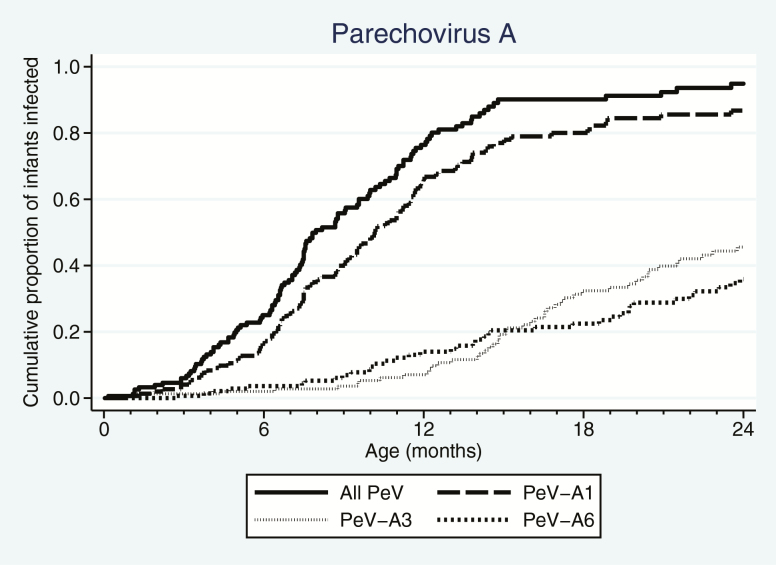
Results: PeV was detected in 1423 of 11 124 (12.8%) and 17 of 8100 (0.2%) stool and nasal swabs, respectively. Major genotypes among the 306 infection episodes identified were PeV-A1 (47.9%), PeV-A6 (20.1%), and PeV-A3 (18.3%). The incidence rate was 144 episodes (95% confidence interval, 128-160) per 100 child-years. First infections appeared at a median age of 8 (interquartile range, 6.0-11.7) months. Annual seasonal peaks changing from PeV-A1 to PeV-A3 were observed. Infection was positively associated with age ≥6 months, summer season, nonexclusive breastfeeding at age <3 months, and formal childcare attendance before age 12 months. Sole PeV infections were either asymptomatic (38.4%) or mild (32.7%), while codetection with other viruses in stool swabs was common (64.4%).
Conclusions: In contrast with hospital-based studies, this study showed that diverse and dynamically changing PeV genotypes circulate in the community causing mild or subclinical infections in children.Parechovirus can cause severe illnesses in children. However, studies focus mainly on hospitalized populations. True disease burden in the community remains largely unknown. From our community-based cohort, we found diverse parechovirus genotypes in the community, causing mild or subclinical infections in children.
Clinical trials registration: NCT01304914.
Keywords: clinical epidemiology; healthy children; longitudinal study; parechovirus; viral infection.
© The Author(s) 2019. Published by Oxford University Press for the Infectious Diseases Society of America. All rights reserved. For permissions, e-mail: journals.permissions@oup.com.
Figures



References
-
- Esposito S, Rahamat-Langendoen J, Ascolese B, Senatore L, Castellazzi L, Niesters HG. Pediatric parechovirus infections. J Clin Virol 2014; 60:84–9. - PubMed
-
- Kadambari S, Harvala H, Simmonds P, Pollard AJ, Sadarangani M. Strategies to improve detection and management of human parechovirus infection in young infants. Lancet Infect Dis 2019; 19:e51–8. - PubMed
-
- Harvala H, Robertson I, Chieochansin T, McWilliam Leitch EC, Templeton K, Simmonds P. Specific association of human parechovirus type 3 with sepsis and fever in young infants, as identified by direct typing of cerebrospinal fluid samples. J Infect Dis 2009; 199:1753–60. - PubMed
Publication types
MeSH terms
Associated data
LinkOut - more resources
Full Text Sources
Medical
