Five-Year Impact of Different Multi-Year Mass Drug Administration Strategies on Childhood Schistosoma mansoni-Associated Morbidity: A Combined Analysis from the Schistosomiasis Consortium for Operational Research and Evaluation Cohort Studies in the Lake Victoria Regions of Kenya and Tanzania
- PMID: 31407653
- PMCID: PMC6896894
- DOI: 10.4269/ajtmh.19-0273
Five-Year Impact of Different Multi-Year Mass Drug Administration Strategies on Childhood Schistosoma mansoni-Associated Morbidity: A Combined Analysis from the Schistosomiasis Consortium for Operational Research and Evaluation Cohort Studies in the Lake Victoria Regions of Kenya and Tanzania
Abstract
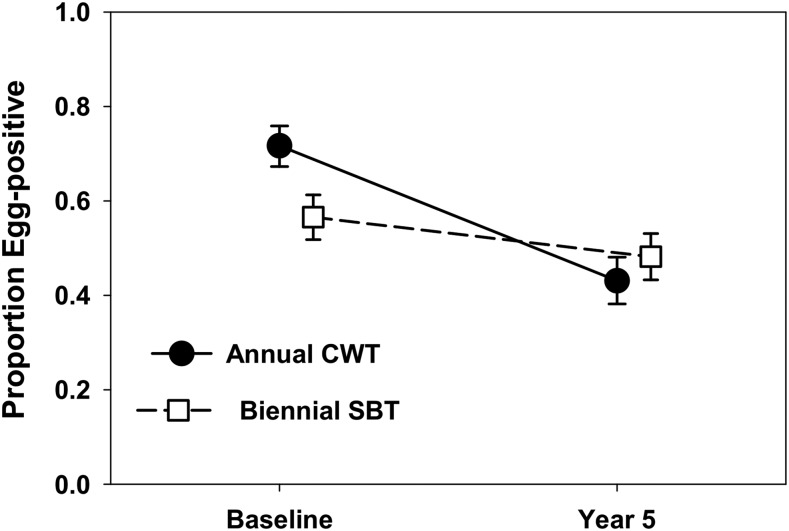
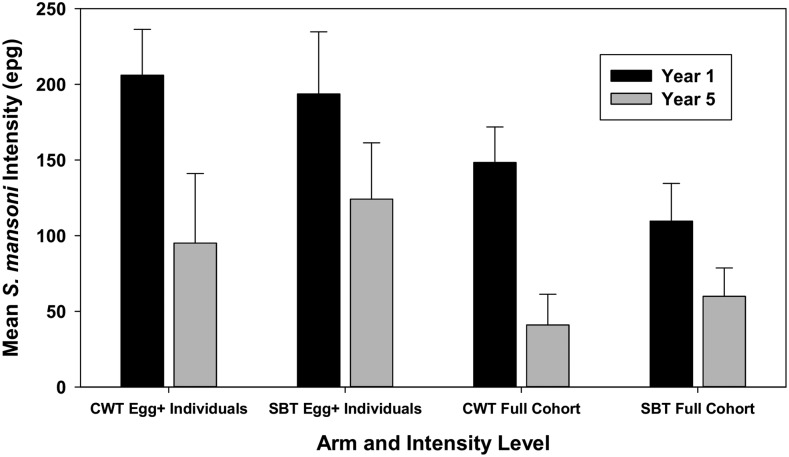
The WHO recommends mass treatment with praziquantel as the primary approach for Schistosoma mansoni-related morbidity control in endemic populations. The Schistosomiasis Consortium for Operational Research and Evaluation implemented multi-country, cluster-randomized trials to compare effectiveness of community-wide and school-based treatment (SBT) regimens on prevalence and intensity of schistosomiasis. To assess the impact of two different treatment schedules on S. mansoni-associated morbidity in children, cohort studies were nested within the randomized trials conducted in villages in Kenya and Tanzania having baseline prevalence ≥ 25%. Children aged 7-8 years were enrolled at baseline and followed to ages 11-12 years. Infection intensity and odds of infection were reduced both in villages receiving four years of annual community-wide treatment (CWT) and those who received biennial SBT over 4 years. These regimens were also associated with reduced odds of undernutrition and reduced odds of portal vein dilation at follow-up. However, neither hemoglobin levels nor the prevalence of the rare abnormal pattern C liver scores on ultrasound improved. For the combined cohorts, growth stunting worsened in the areas receiving biennial SBT, and maximal oxygen uptake as estimated by fitness testing scores declined under both regimens. After adjusting for imbalance in starting prevalence between study arms, children in villages receiving annual CWT had significantly greater decreases in infection prevalence and intensity than those villages receiving biennial SBT. Although health-related quality-of-life scores improved in both study arms, children in the CWT villages gained significantly more. We conclude that programs using annual CWT are likely to achieve better overall S. mansoni morbidity control than those implementing only biennial SBT.
Conflict of interest statement
Disclosures: The authors declare that the research was conducted in the absence of any commercial or financial relationships that could be construed as a potential conflict of interest.
Disclaimer: The findings and conclusions in this report are those of the authors and do not necessarily represent the views of the CDC.
Figures

Comment in
-
Optimizing Delivery of Mass Drug Administration for Schistosomiasis.Am J Trop Med Hyg. 2019 Dec;101(6):1191-1192. doi: 10.4269/ajtmh.19-0762. Am J Trop Med Hyg. 2019. PMID: 31674294 Free PMC article. No abstract available.
References
-
- Bustinduy AL, King CH, 2014. Schistosomiasis. Farrar J, Hotez PJ, Junghanns T, Kang G, Lalloo DG, White NJ, eds. Manson’s Tropical Diseases, 23rd edition Philadelphia, PA: Elsevier Saunders, 698–725.
-
- World Health Organization , 2002. Prevention and Control of Schistosomiasis and Soil-Transmitted Helminthiasis: Report of a WHO Expert Committee. Technical Report Series 912. Geneva, Switzerland: WHO, 1–57. - PubMed
-
- World Health Organization , 2006. Preventive Chemotherapy in Human Helminthiasis: Coordinated Use of Anthelminthic Drugs in Control Interventions: A Manual for Health Professionals and Programme Managers. Geneva, Switzerland: WHO.
Publication types
MeSH terms
Substances
LinkOut - more resources
Full Text Sources
Molecular Biology Databases