


Associations of Physical Activity With Survival and Progression in Metastatic Colorectal Cancer: Results From Cancer and Leukemia Group B (Alliance)/SWOG 80405
- PMID: 31408415
- PMCID: PMC6900834
- DOI: 10.1200/JCO.19.01019
Associations of Physical Activity With Survival and Progression in Metastatic Colorectal Cancer: Results From Cancer and Leukemia Group B (Alliance)/SWOG 80405
Abstract
Purpose: Regular physical activity is associated with reduced risk of recurrence and mortality in patients with nonmetastatic colorectal cancer. Its influence on patients with advanced/metastatic colorectal cancer (mCRC) has been largely unexplored.
Patients and methods: We conducted a prospective cohort study nested in Cancer and Leukemia Group B (Alliance)/SWOG 80405 (ClinicalTrials.gov identifier: NCT00265850), a National Cancer Institute-sponsored phase III trial of systemic therapy for mCRC. Within 1 month after therapy initiation, patients were invited to complete a validated questionnaire that reported average physical activity over the previous 2 months. On the basis of responses, we calculated metabolic equivalent task (MET) hours per week to quantify physical activity. The primary end point of the clinical trial and this companion study was overall survival (OS). Secondary end points included progression-free survival (PFS) and first grade 3 or greater treatment-related adverse events. To minimize confounding by poor and declining health, we excluded patients who experienced progression or died within 60 days of activity assessment and used Cox proportional hazards regression analysis to adjust for known prognostic factors, comorbidities, and weight loss.
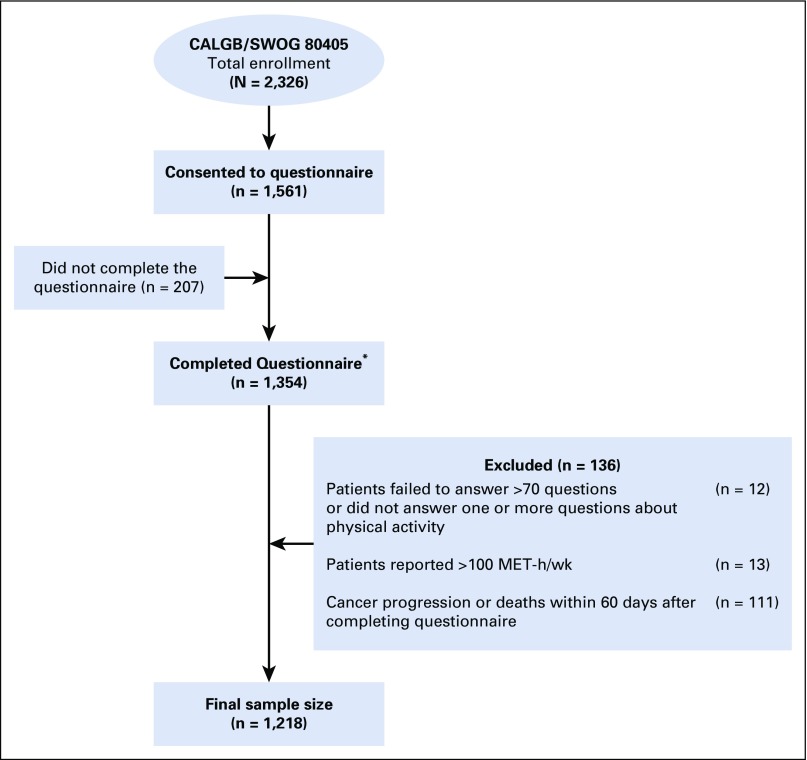
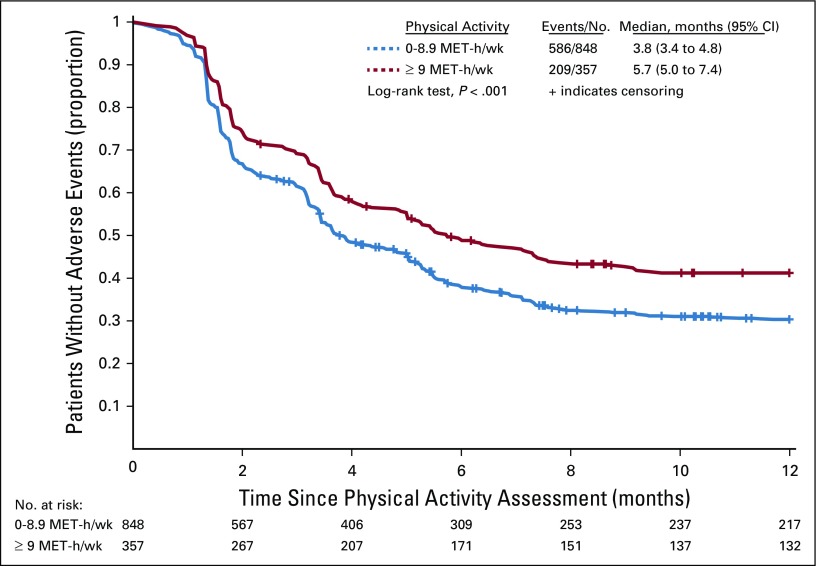
Results: The final cohort included 1,218 patients. Compared with patients engaged in less than 3 MET hours per week of physical activity, patients engaged in 18 or more MET hours per week experienced an adjusted hazard ratio for OS of 0.85 (95% CI, 0.71 to 1.02; PTrend = .06) and for PFS of 0.83 (95% CI, 0.70 to 0.99; PTrend = .01). Compared with patients engaging in less than 9 MET hours per week, patients engaging in 9 or more MET hours per week experienced an adjusted hazard ratio for grade 3 or greater treatment-related adverse events of 0.73 (95% CI, 0.62 to 0.86; PTrend < .001).
Conclusion: Among patients with mCRC in Cancer and Leukemia Group B (Alliance)/SWOG 80405, association of physical activity with OS was not statistically significant. Greater physical activity was associated with longer PFS and lower adjusted risk for first grade 3 or greater treatment-related adverse events.
Figures
References
-
- Martínez ME, Giovannucci E, Spiegelman D, et al. Leisure-time physical activity, body size, and colon cancer in women. Nurses’ Health Study Research Group. J Natl Cancer Inst. 1997;89:948–955. - PubMed
-
- Larsson SC, Wolk A. Obesity and colon and rectal cancer risk: A meta-analysis of prospective studies. Am J Clin Nutr. 2007;86:556–565. - PubMed
-
- Giovannucci E, Ascherio A, Rimm EB, et al. Physical activity, obesity, and risk for colon cancer and adenoma in men. Ann Intern Med. 1995;122:327–334. - PubMed
-
- Murphy TK, Calle EE, Rodriguez C, et al. Body mass index and colon cancer mortality in a large prospective study. Am J Epidemiol. 2000;152:847–854. - PubMed
Publication types
MeSH terms
Associated data
Grants and funding
- U10 CA180826/CA/NCI NIH HHS/United States
- R01 CA118553/CA/NCI NIH HHS/United States
- R01 CA149222/CA/NCI NIH HHS/United States
- UL1 TR001863/TR/NCATS NIH HHS/United States
- U10 CA180821/CA/NCI NIH HHS/United States
- K07 CA197077/CA/NCI NIH HHS/United States
- U10 CA180795/CA/NCI NIH HHS/United States
- R01 CA205406/CA/NCI NIH HHS/United States
- U54 GM104942/GM/NIGMS NIH HHS/United States
- U10 CA180882/CA/NCI NIH HHS/United States
- U10 CA180820/CA/NCI NIH HHS/United States
- U10 CA180888/CA/NCI NIH HHS/United States
- U10 CA180830/CA/NCI NIH HHS/United States
- UG1 CA233290/CA/NCI NIH HHS/United States
- UG1 CA233331/CA/NCI NIH HHS/United States
- UG1 CA189869/CA/NCI NIH HHS/United States
- UG1 CA189974/CA/NCI NIH HHS/United States
- U10 CA180836/CA/NCI NIH HHS/United States
- UG1 CA180830/CA/NCI NIH HHS/United States
- UG1 CA189858/CA/NCI NIH HHS/United States
- P30 CA008748/CA/NCI NIH HHS/United States
- U10 CA180791/CA/NCI NIH HHS/United States
- U10 CA180850/CA/NCI NIH HHS/United States
- R01 CA169141/CA/NCI NIH HHS/United States
- UG1 CA233180/CA/NCI NIH HHS/United States
- U10 CA180867/CA/NCI NIH HHS/United States
- U10 CA180838/CA/NCI NIH HHS/United States
