Review
. 2019 Aug 12;20(16):3916.
doi: 10.3390/ijms20163916.

Multitasking Rab Proteins in Autophagy and Membrane Trafficking: A Focus on Rab33b

Affiliations
Review

Multitasking Rab Proteins in Autophagy and Membrane Trafficking: A Focus on Rab33b

Niamh E Morgan et al. Int J Mol Sci. .

Abstract

Autophagy (particularly macroautophagy) is a bulk degradation process used by eukaryotic cells in order to maintain adequate energy levels and cellular homeostasis through the delivery of long-lived proteins and organelles to the lysosome, resulting in their degradation. It is becoming increasingly clear that many of the molecular requirements to fulfil autophagy intersect with those of conventional and unconventional membrane trafficking pathways. Of particular interest is the dependence of these processes on multiple members of the Rab family of small GTP binding proteins. Rab33b is a protein that localises to the Golgi apparatus and has suggested functions in both membrane trafficking and autophagic processes. Interestingly, mutations in the RAB33B gene have been reported to cause the severe skeletal disorder, Smith-McCort Dysplasia; however, the molecular basis for Rab33b in this disorder remains to be determined. In this review, we focus on the current knowledge of the participation of Rab33b and its interacting partners in membrane trafficking and macroautophagy, and speculate on how its function, and dysfunction, may contribute to human disease.

Keywords: Rab GTPase; Rab33b; autophagy; membrane traffic.


Conflict of interest statement

The authors declare no conflict of interest.

Figures
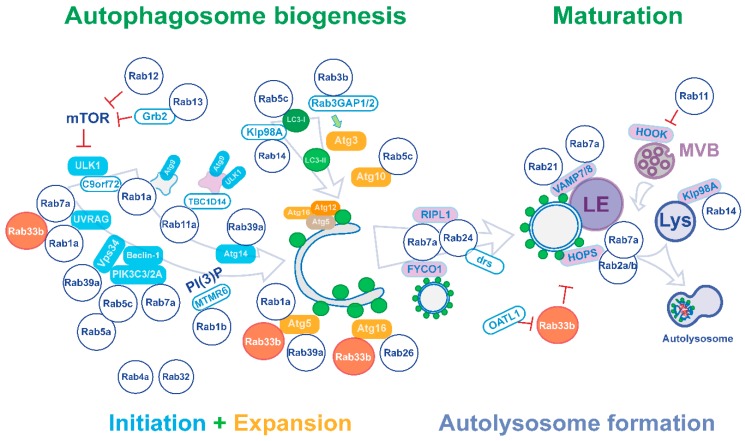
Figure 1
Figure 1
Regulation of the autophagy pathway by Rab proteins. Sequential steps of autophagy (from left to right) involve members of the Rab GTPase protein family that regulate this pathway through their effectors. Biogenesis of autophagosomes is driven by autophagy proteins that promote initiation of isolation membrane (IM) formation (light blue) and subsequently sustain expansion of IM structures (orange). Maturation steps occur following transport and ultimate fusion of mature autophagosomes with membranes of the endo-lysosomal system (light violet) including multivesicular bodies (MVBs), late endosomes (LEs) and mature lysosomes (Lys). The involvement of Rab proteins at different stages of the autophagy pathway is represented as direct interaction of a given Rab with proteins that control the autophagy pathway (solid colour rectangles), indirect interaction with autophagy proteins through a Rab effector (white rectangles) or as a means of functional regulation (inhibition or stimulation arrows). Rab33b (indicated in red) contributes to multiple steps of the autophagy pathway through distinct effectors (i.e., UVRAG, Atg5, Atg16L, OATL1), which supports IM initiation and expansion at early stages, and is eventually involved in later stages of autophagosome maturation via modulation of the fusion of autophagosomes with lysosomes.
Figure 2
Figure 2
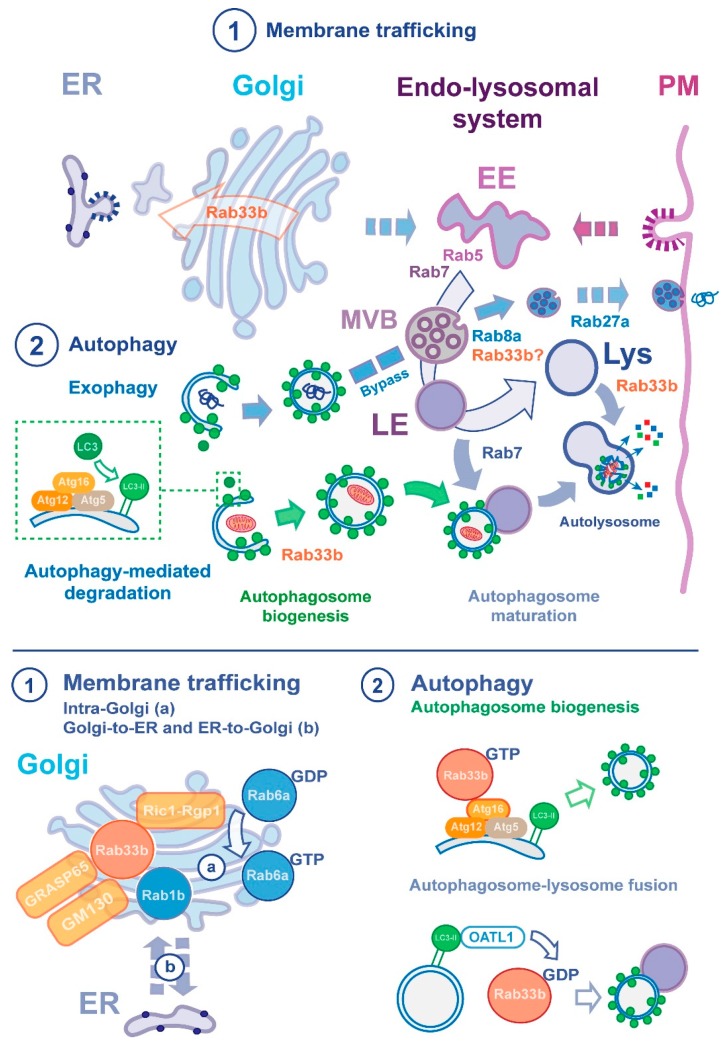
Rab33b at the intersection of membrane trafficking and autophagy. Key vesicle trafficking and autophagy pathways (upper panel). Compartmentalisation and establishment of stations along the endo-lysosomal system occur through a maturation process from early endosomes (EEs), multivesicular bodies (MVBs) and late endosomes (LEs) to mature lysosomes (Lys). A Rab cascade, that involves recruitment of Rab7 to Rab5 domains, leads to formation of a stable LE compartment before delivery to lysosomes. Autophagy-mediated degradation converges with this pathway. Biogenesis of autophagosomes at dedicated foci, culminates with recruitment of lipidated LC3 (green boxed inset) to pre-autophagosomal membranes. Next, autophagosome maturation results from the transport of autophagosomes towards EEs and LEs, and fusogenic events at distinct stages of the endosomal maturation pathway. Rabs participating in endocytic transport (i.e., Rab7) sustain the autophagic flux. Degradation of cytosolic components engulfed by autophagosomes occurs by fusion of autophagosomes or amphisomes that result from the fusion between autophagosomes and LEs with lysosomes. The resulting autolysosomes mediate the breakdown of autophagic cargo. A secondary arm of the autophagic pathway, also known as exophagy, plays a role in unconventional protein secretion. Rab proteins provide a regulatory role that avoids stages that result in autolysosomal formation for autophagosomes carrying unconventional secretory cargo. Autophagosomal secretion relies on fusion of autophagosomes with MVBs and subsequent fusion of these intermediates with the plasma membrane (PM). Blue arrows, biosynthetic transport; purple arrows, fusiogenic autolysosomal maturation steps. Rab33b, initially described to reside in the Golgi apparatus, contributes to multiple pathways through distinct effectors. Specific roles in vesicular trafficking and autophagy are indicated in the figure (lower panel, left and right side respectively). Rab33b localises to the medial Golgi cisternae and works alongside Rab6a and has an established role in (a) the structural organisation of the Golgi apparatus, and (b) retrograde Golgi-to-ER transport. Rab33b is the first Rab protein reported to interact with Atg16L for regulation of autophagosome formation. The function of a regulator of Rab33b, OATL, suggests a functional involvement of this GTPase in later stages of autophagy-mediated degradation.

References

    1. Viotti C. ER to Golgi-Dependent Protein Secretion: The Conventional Pathway. Methods Mol. Biol. 2016;1459:3–29. doi: 10.1007/978-1-4939-3804-9_1. - DOI - PubMed
    1. Nickel W., Rabouille C. Mechanisms of Regulated Unconventional Protein Secretion. Nat. Rev. Mol. Cell Biol. 2009;10:148–155. doi: 10.1038/nrm2617. - DOI - PubMed
    1. Ponpuak M., Mandell M.A., Kimura T., Chauhan S., Cleyrat C., Deretic V. Secretory Autophagy. Curr. Opin. Cell Biol. 2015;35:106–116. doi: 10.1016/j.ceb.2015.04.016. - DOI - PMC - PubMed
    1. Rabouille C. Pathways of Unconventional Protein Secretion. Trends Cell Biol. 2017;27:230–240. doi: 10.1016/j.tcb.2016.11.007. - DOI - PubMed
    1. Pfeffer S.R. Rab GTPases: Master Regulators That Establish the Secretory and Endocytic Pathways. Mol. Biol. Cell. 2017;28:712–715. doi: 10.1091/mbc.e16-10-0737. - DOI - PMC - PubMed

Substances

Supplementary concepts

LinkOut - more resources