


Bounded rationality in C. elegans is explained by circuit-specific normalization in chemosensory pathways
- PMID: 31409788
- PMCID: PMC6692327
- DOI: 10.1038/s41467-019-11715-7
Bounded rationality in C. elegans is explained by circuit-specific normalization in chemosensory pathways
Abstract
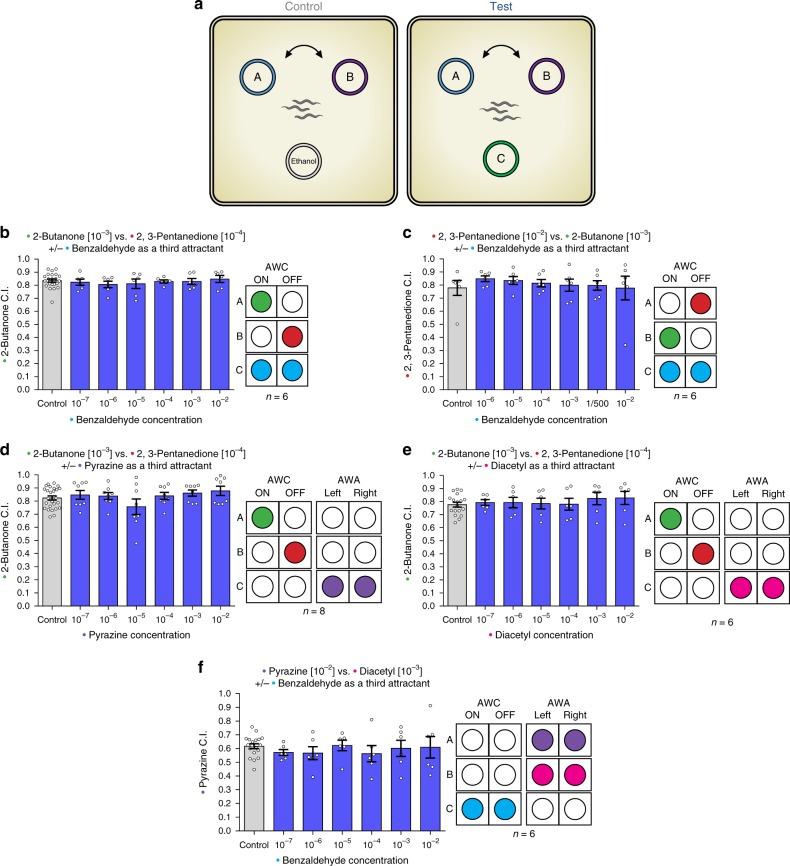
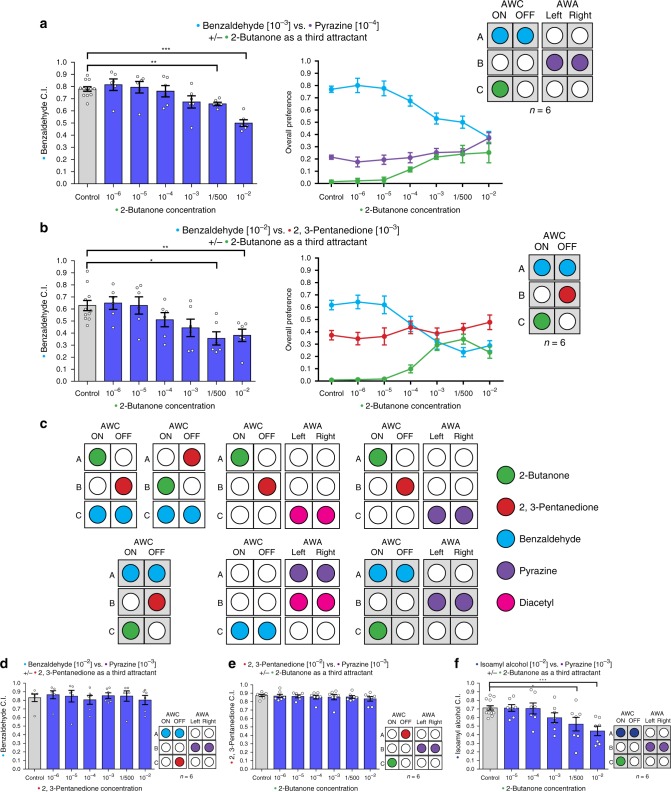
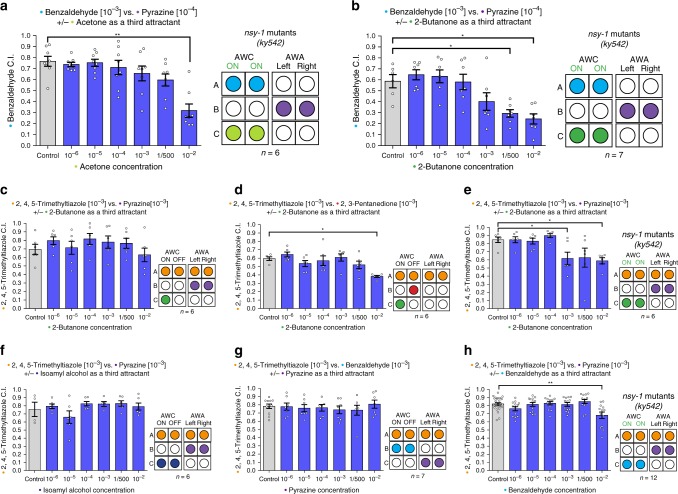
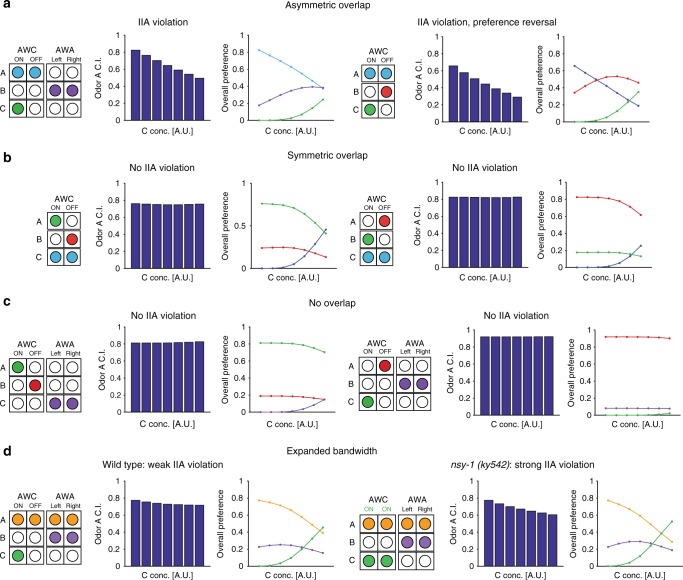
Rational choice theory assumes optimality in decision-making. Violations of a basic axiom of economic rationality known as "Independence of Irrelevant Alternatives" (IIA) have been demonstrated in both humans and animals and could stem from common neuronal constraints. Here we develop tests for IIA in the nematode Caenorhabditis elegans, an animal with only 302 neurons, using olfactory chemotaxis assays. We find that in most cases C. elegans make rational decisions. However, by probing multiple neuronal architectures using various choice sets, we show that violations of rationality arise when the circuit of olfactory sensory neurons is asymmetric. We further show that genetic manipulations of the asymmetry between the AWC neurons can make the worm irrational. Last, a context-dependent normalization-based model of value coding and gain control explains how particular neuronal constraints on information coding give rise to irrationality. Thus, we demonstrate that bounded rationality could arise due to basic neuronal constraints.
Conflict of interest statement
The authors declare no competing interests.
Figures
References
-
- Afriat S. N. The Construction of Utility Functions from Expenditure Data. International Economic Review. 1967;8(1):67. doi: 10.2307/2525382. - DOI
-
- Kahneman D, Tversky A. Prospect theory—analysis of decision under. Risk. 1979;47:263–292.
-
- Tversky A, Kahneman D. Advances in prospect theory: cumulative representation of uncertainty. J. Risk Uncertain. 1992;5:297–323. doi: 10.1007/BF00122574. - DOI
Publication types
MeSH terms
Substances
Grants and funding
LinkOut - more resources
Full Text Sources
Other Literature Sources
