


Risk factors for shedding of Salmonella enterica among hospitalized large animals over a 10-year period in a veterinary teaching hospital
- PMID: 31410902
- PMCID: PMC6766568
- DOI: 10.1111/jvim.15579
Risk factors for shedding of Salmonella enterica among hospitalized large animals over a 10-year period in a veterinary teaching hospital
Abstract
Background: Transmission of Salmonella in veterinary hospitals is typically associated with environmental contamination. Links between isolates recovered from hospitalized large animals and environment suggest animals as the likely source. Therefore, understanding factors influencing shedding is key in control. Shedding in hospitalized animals has been investigated, but many studies focused on subsets of animals limiting generalizability.
Objective: (1) Investigate factors associated with fecal shedding of Salmonella among hospitalized large animals at a veterinary hospital. (2) Compare results obtained using 2 comparison groups for risk factor analysis-large animals with high confidence in negative shedding status and those with potential for misclassification of shedding status.
Animals: Large animals admitted from March 2002 through December 2012.
Methods: A case-control study was conducted among all hospitalized large animals that were routinely cultured as part of infection control efforts. Animal and hospital factors were evaluated. Data on factors of interest were collected retrospectively from electronic medical records. Multivariable conditional logistic regression was used to evaluate associations between animal factors and fecal shedding of Salmonella enterica.
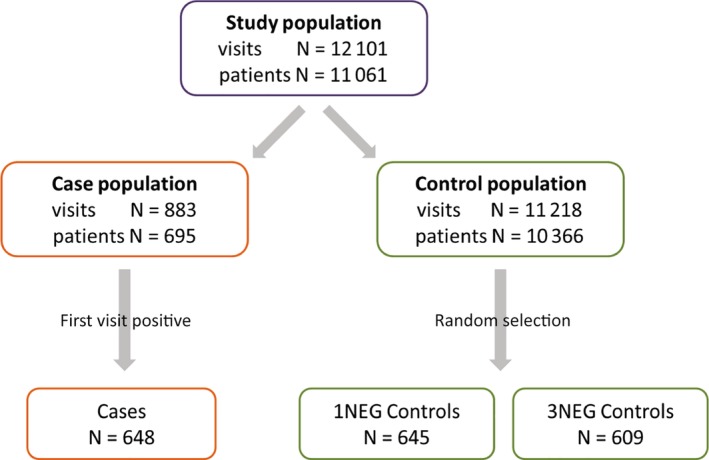
Results: During the study period, 5.9% (648/11 061) of hospitalized large animals were culture positive for Salmonella, with the majority being cattle (72%; 467/648) and horses (22%; 143/648). Although the odds of shedding varied by comparison group, overall, 69.4% of animal shedding could be attributed to systemic illness (population attributable fraction) in this study.
Conclusions and clinical importance: Findings of this study inform our understanding of factors affecting Salmonella shedding in hospitalized large animals, thus improving our ability for implementation of evidence-based control measures.
Keywords: biosecurity; epidemiology; infection control; infectious disease.
© 2019 The Authors. Journal of Veterinary Internal Medicine published by Wiley Periodicals, Inc. on behalf of the American College of Veterinary Internal Medicine.
Conflict of interest statement
Authors declare no conflict of interest.
Figures
References
-
- Benedict KM, Morley PS, Van Metre DC. Characteristics of biosecurity and infection control programs at veterinary teaching hospitals. J Am Vet Med Assoc. 2008;233(5):767‐773. - PubMed
-
- Dallap Schaer BL, Aceto H, Rankin SC. Outbreak of salmonellosis caused by Salmonella enterica serovar Newport MDR‐AmpC in a large animal veterinary teaching hospital. J Vet Intern Med. 2010;24(5):1138‐1146. - PubMed
-
- Steneroden KK, van Metre DC, Jackson C, Morley PS. Detection and control of a nosocomial outbreak caused by Salmonella newport at a large animal hospital. J Vet Intern Med. 2010;24(3):606‐616. - PubMed
-
- Burgess BA, Morley PS, Hyatt DR. Environmental surveillance for Salmonella enterica in a veterinary teaching hospital. J Am Vet Med Assoc. 2004;225(9):1344‐1348. - PubMed
-
- Smith BP, Reina‐Guerra M, Hardy AJ. Prevalence and epizootiology of equine salmonellosis. J Am Vet Med Assoc. 1978;172(3):353‐356. - PubMed
MeSH terms
Grants and funding
LinkOut - more resources
Full Text Sources
Medical
