


The effectiveness and safety of introducing condom-catheter uterine balloon tamponade for postpartum haemorrhage at secondary level hospitals in Uganda, Egypt and Senegal: a stepped wedge, cluster-randomised trial
- PMID: 31410966
- PMCID: PMC6899652
- DOI: 10.1111/1471-0528.15903
The effectiveness and safety of introducing condom-catheter uterine balloon tamponade for postpartum haemorrhage at secondary level hospitals in Uganda, Egypt and Senegal: a stepped wedge, cluster-randomised trial
Abstract
Objective: To assess the effectiveness of introducing condom-catheter uterine balloon tamponade (UBT) for postpartum haemorrhage (PPH) management in low- and middle-income settings.
Design: Stepped wedge, cluster-randomised trial.
Setting: Eighteen secondary-level hospitals in Uganda, Egypt and Senegal.
Population: Women with vaginal delivery from October 2016 to March 2018.
Methods: Use of condom-catheter UBT for PPH management was introduced using a half-day training and provision of pre-packaged UBT kits. Hospitals were randomised to when UBT was introduced. The incident rate (IR) of study outcomes was compared in the control (i.e. before UBT) and intervention (i.e. after UBT) periods. Mixed effects regression models accounted for clustering (random effect) and time period (fixed effect).
Main outcome measures: Combined IR of PPH-related invasive surgery and/or maternal death.
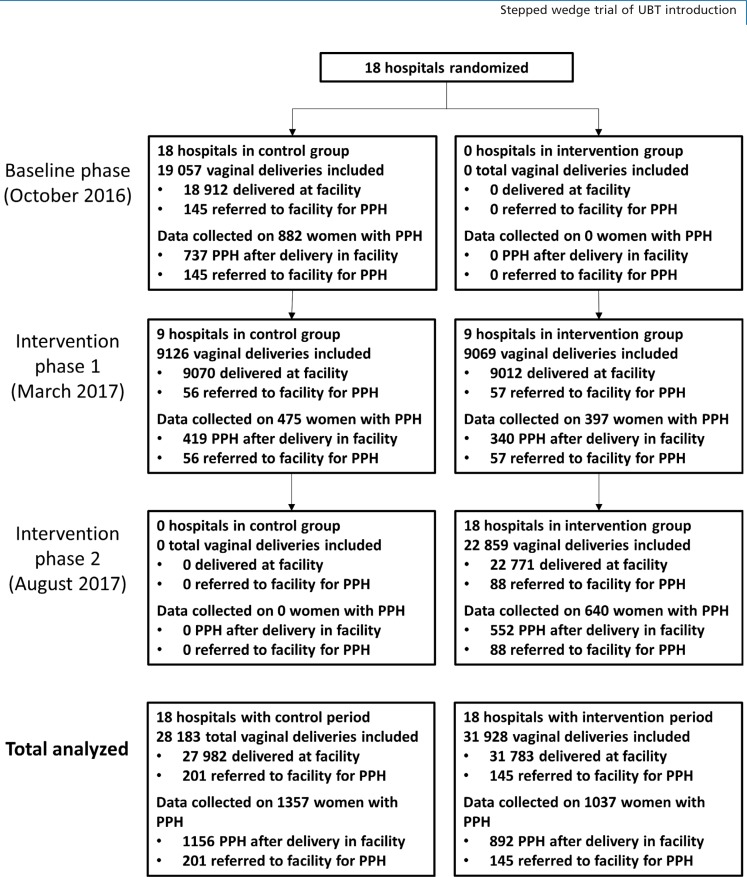
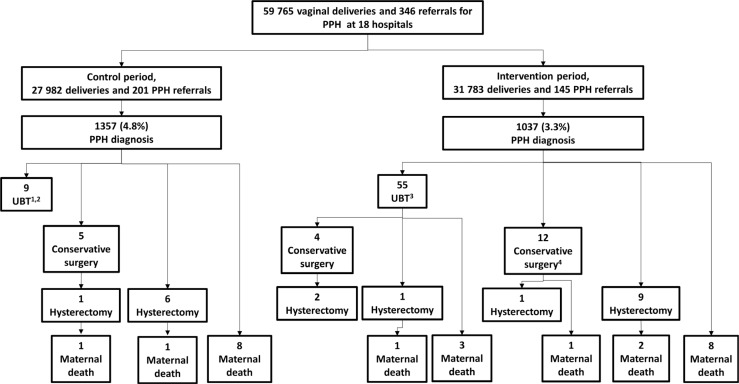
Results: There were 28 183 and 31 928 deliveries in the control and intervention periods, respectively. UBT was used for 9/1357 and 55/1037 women diagnosed with PPH in control and intervention periods, respectively. PPH-related surgery or maternal death occurred in 19 women in the control period (IR = 6.7/10 000 deliveries) and 37 in the intervention period (IR = 11.6/10 000 deliveries). The adjusted IR ratio was 4.08 (95% confidence interval 1.07-15.58). Secondary outcomes, including rates of transfer and blood transfusion, were similar in the trial periods.
Conclusions: Introduction of condom-catheter UBT in these settings did not improve maternal outcomes and was associated with an increase in the combined incidence of PPH-related surgery and maternal death. The lack of demonstrated benefit of UBT introduction with respect to severe outcomes warrants reflection on its role.
Tweetable abstract: Stepped wedge trial shows UBT introduction does not reduce the combined incidence of PPH-related surgery or death.
Keywords: Maternal morbidity; maternal mortality; postpartum haemorrhage; refractory; treatment; uterine balloon tamponade.
© 2019 Gynuity Health Projects. BJOG: An International Journal of Obstetrics and Gynaecology published by John Wiley & Sons Ltd on behalf of Royal College of Obstetricians and Gynaecologists.
Figures
Comment in
-
Does balloon tamponade really make postpartum haemorrhage worse?BJOG. 2019 Dec;126(13):1622. doi: 10.1111/1471-0528.15948. Epub 2019 Oct 3. BJOG. 2019. PMID: 31529662 Free PMC article. No abstract available.
-
Re: The effectiveness and safety of introducing condom-catheter uterine balloon tamponade for postpartum haemorrhage at secondary level hospitals in Uganda, Egypt and Senegal: a stepped wedge, cluster-randomised trial: Difficulty evaluating the efficacy of introducing the condom-catheter.BJOG. 2020 Feb;127(3):425. doi: 10.1111/1471-0528.16001. Epub 2019 Nov 20. BJOG. 2020. PMID: 31749305 No abstract available.
References
-
- Say L, Chou D, Gemmill A, Tuncçalp Ö, Moller A-B, Daniels J. Global causes of maternal death: a WHO systematic analysis. Lancet Glob Heal 2014;2:e323–33. - PubMed
-
- World Health Organization Trends in Maternal Mortality 1990 to 2015: Estimates by the WHO, UNICEF, UNFPA, the World Bank and the United Nations Population Division. Geneva: World Health Organization; 1990. p. 2015.
-
- Rocha Filho EA, Costa ML, Cecatti JG, Parpinelli MA, Haddad SM, Pacagnella RC, et al. . Severe maternal morbidity and near miss due to postpartum haemorrhage in a national multicenter surveillance study. Int J Gynecol Obstet 2015;128. - PubMed
-
- WHO WHO Recommendations for the Prevention and Treatment of Postpartum Haemorrhage Geneva: World Health Organization; 2012. - PubMed
Publication types
MeSH terms
Associated data
- Actions
Grants and funding
LinkOut - more resources
Full Text Sources
