Development of a Novel Risk Prediction Model for Sudden Cardiac Death in Childhood Hypertrophic Cardiomyopathy (HCM Risk-Kids)
- PMID: 31411652
- PMCID: PMC6694401
- DOI: 10.1001/jamacardio.2019.2861
Development of a Novel Risk Prediction Model for Sudden Cardiac Death in Childhood Hypertrophic Cardiomyopathy (HCM Risk-Kids)
Abstract
Importance: Sudden cardiac death (SCD) is the most common mode of death in childhood hypertrophic cardiomyopathy (HCM), but there is no validated algorithm to identify those at highest risk.
Objective: To develop and validate an SCD risk prediction model that provides individualized risk estimates.
Design, setting, and participants: A prognostic model was developed from a retrospective, multicenter, longitudinal cohort study of 1024 consecutively evaluated patients aged 16 years or younger with HCM. The study was conducted from January 1, 1970, to December 31, 2017.
Exposures: The model was developed using preselected predictor variables (unexplained syncope, maximal left-ventricular wall thickness, left atrial diameter, left-ventricular outflow tract gradient, and nonsustained ventricular tachycardia) identified from the literature and internally validated using bootstrapping.
Main outcomes and measures: A composite outcome of SCD or an equivalent event (aborted cardiac arrest, appropriate implantable cardioverter defibrillator therapy, or sustained ventricular tachycardia associated with hemodynamic compromise).
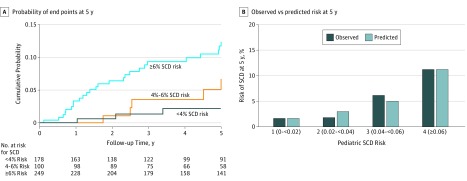
Results: Of the 1024 patients included in the study, 699 were boys (68.3%); mean (interquartile range [IQR]) age was 11 (7-14) years. Over a median follow-up of 5.3 years (IQR, 2.6-8.3; total patient years, 5984), 89 patients (8.7%) died suddenly or had an equivalent event (annual event rate, 1.49; 95% CI, 1.15-1.92). The pediatric model was developed using preselected variables to predict the risk of SCD. The model's ability to predict risk at 5 years was validated; the C statistic was 0.69 (95% CI, 0.66-0.72), and the calibration slope was 0.98 (95% CI, 0.59-1.38). For every 10 implantable cardioverter defibrillators implanted in patients with 6% or more of a 5-year SCD risk, 1 patient may potentially be saved from SCD at 5 years.
Conclusions and relevance: This new, validated risk stratification model for SCD in childhood HCM may provide individualized estimates of risk at 5 years using readily obtained clinical risk factors. External validation studies are required to demonstrate the accuracy of this model's predictions in diverse patient populations.
Conflict of interest statement
Figures
Comment in
-
Risk Prediction Model in Children With Hypertrophic Cardiomyopathy: A Work in Progress.JAMA Cardiol. 2019 Sep 1;4(9):927. doi: 10.1001/jamacardio.2019.2945. JAMA Cardiol. 2019. PMID: 31411634 Free PMC article. No abstract available.
-
Concerns About the HCM Risk-Kids Study.JAMA Cardiol. 2020 Mar 1;5(3):362. doi: 10.1001/jamacardio.2019.5783. JAMA Cardiol. 2020. PMID: 31995117 No abstract available.
-
Concerns About the HCM Risk-Kids Study-Reply.JAMA Cardiol. 2020 Mar 1;5(3):363-364. doi: 10.1001/jamacardio.2019.5789. JAMA Cardiol. 2020. PMID: 31995120 No abstract available.
-
Concerns About the HCM Risk-Kids Study.JAMA Cardiol. 2020 Mar 1;5(3):362-363. doi: 10.1001/jamacardio.2019.5786. JAMA Cardiol. 2020. PMID: 31995123 No abstract available.
-
Should lethal arrhythmias in hypertrophic cardiomyopathy be predicted using non-electrophysiological methods?Europace. 2023 May 19;25(5):euad045. doi: 10.1093/europace/euad045. Europace. 2023. PMID: 36942430 Free PMC article.
-
Risk stratification in pediatric hypertrophic cardiomyopathy.Heart Rhythm. 2024 Jan;21(1):128-129. doi: 10.1016/j.hrthm.2023.10.009. Heart Rhythm. 2024. PMID: 38176768 No abstract available.
References
-
- Alexander PMA, Nugent AW, Daubeney PEF, et al. ; National Australian Childhood Cardiomyopathy Study . Long-term outcomes of hypertrophic cardiomyopathy diagnosed during childhood: results from a national population-based study. Circulation. 2018;138(1):29-36. doi: 10.1161/CIRCULATIONAHA.117.028895 - DOI - PubMed
-
- Gersh BJ, Maron BJ, Bonow RO, et al. ; American College of Cardiology Foundation/American Heart Association Task Force on Practice; American Association for Thoracic Surgery; American Society of Echocardiography; American Society of Nuclear Cardiology; Heart Failure Society of America; Heart Rhythm Society; Society for Cardiovascular Angiography and Interventions; Society of Thoracic Surgeons . 2011 ACCF/AHA guideline for the diagnosis and treatment of hypertrophic cardiomyopathy: a report of the American College of Cardiology Foundation/American Heart Association Task Force on Practice Guidelines. J Thorac Cardiovasc Surg. 2011;142(6):e153-e203. doi: 10.1016/j.jtcvs.2011.10.020 - DOI - PubMed
-
- Elliott PM, Anastasakis A, Borger MA, et al. ; Authors/Task Force Members . 2014 ESC guidelines on diagnosis and management of hypertrophic cardiomyopathy: the Task Force for the Diagnosis and Management of Hypertrophic Cardiomyopathy of the European Society of Cardiology (ESC). Eur Heart J. 2014;35(39):2733-2779. doi: 10.1093/eurheartj/ehu284 - DOI - PubMed