


The relationship between plasma amino acids and circulating albumin and haemoglobin in postabsorptive stroke patients
- PMID: 31412042
- PMCID: PMC6693779
- DOI: 10.1371/journal.pone.0219756
The relationship between plasma amino acids and circulating albumin and haemoglobin in postabsorptive stroke patients
Abstract
Background: This retrospective study had two main aims: (1) to document possible correlations between plasma Amino Acids (AAs) and circulating Albumin (Alb) and Haemoglobin (Hb); and (2) to identify which AAs were predictors of Alb and Hb.
Methods: The study considered 125 stroke subjects (ST) (61.6% males; 65.6 +/- 14.9 years) who met the eligibility criteria (absence of co morbidities associated with altered plasma AAs and presence of plasma AAs determined after overnight fasting). Fifteen matched healthy subjects with measured plasma AAs served as controls.
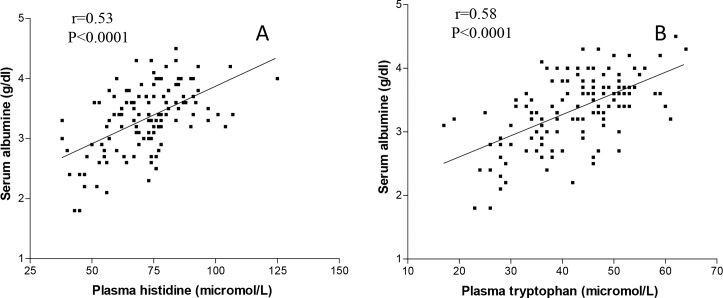
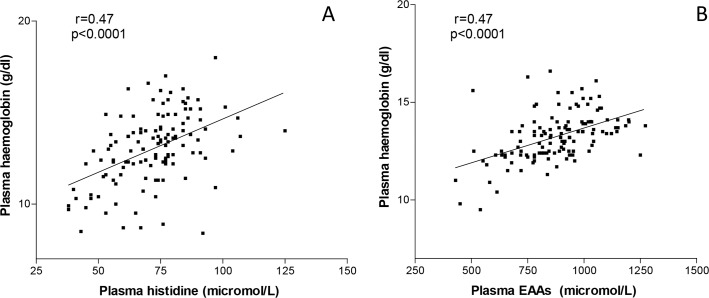
Results: The best correlations of Alb were with tryptophan (Trp) and histidine (His) (r = + 0.53; p < 0.0001), and those of Hb were with histidine (r = +0.47) and Essential AAs (r = +0.47) (both p<0.0001). In multivariate analysis, Trp (p< 0.0001) and His (p = 0.01) were shown to be the best positive predictors of Alb, whereas glutamine (p = 0.006) was the best positive predictor of Hb.
Conclusions: The study shows that the majority of plasma AAs were positively correlated with Alb and Hb. The best predictors of circulating Alb and Hb were the levels of tryptophan and glutamine, respectively.
Conflict of interest statement
The author Roberto Aquilani is a scientific consultant at Professional Dietetics (Milano, Italy). This company had no role in study design, data collection and analysis, decision to publish, or preparation of the manuscript. This does not alter the authors' adherence to PLOS ONE policies on sharing data and materials. The other authors declare no conflict of interest.
Figures
References
-
- Abbott R.D.; Donahue R.P.; MacMahon S.W.; Reed D.M.; Yano K. Diabetes and the risk of stroke. The Honolulu Heart Program. JAMA.1987, February 20; 257(7):949–52. - PubMed
-
- Mathers C.D.; Vos E.T.; Stevenson C.E.; Begg S.J. The Australian Burden of Disease Study: measuring the loss of health from diseases, injuries and risk factors. Med J Aust. 2000. June 19;172(12):592–6. - PubMed
MeSH terms
Substances
LinkOut - more resources
Full Text Sources
Medical
Miscellaneous
