


Relationship Between Brachial-Ankle Pulse Wave Velocity and Incident Hypertension According to 2017 ACC/AHA High Blood Pressure Guidelines
- PMID: 31412746
- PMCID: PMC6759909
- DOI: 10.1161/JAHA.119.013019
Relationship Between Brachial-Ankle Pulse Wave Velocity and Incident Hypertension According to 2017 ACC/AHA High Blood Pressure Guidelines
Abstract
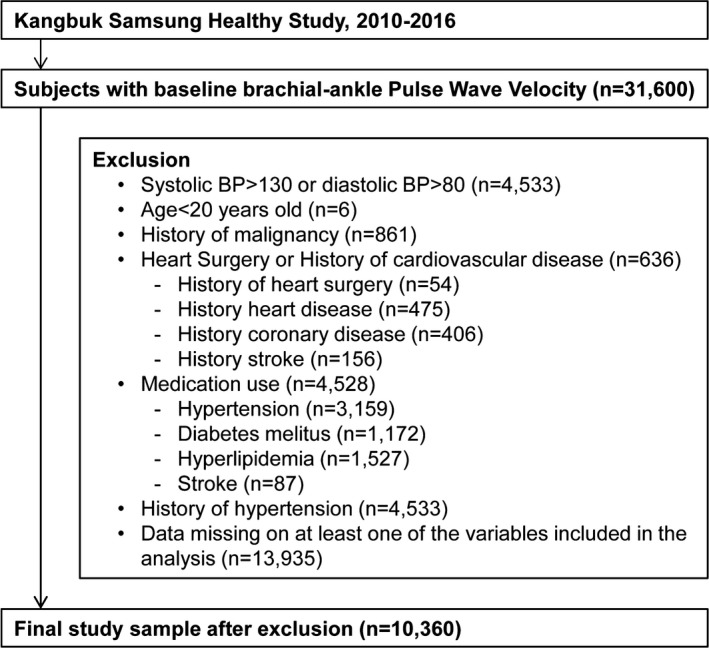
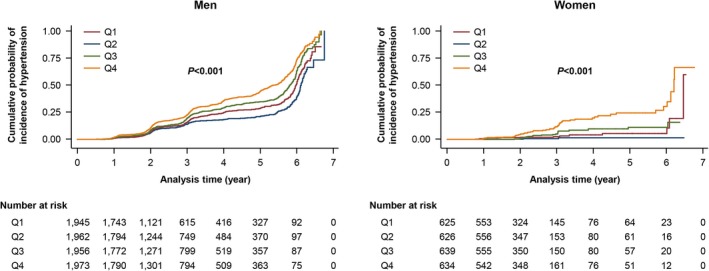
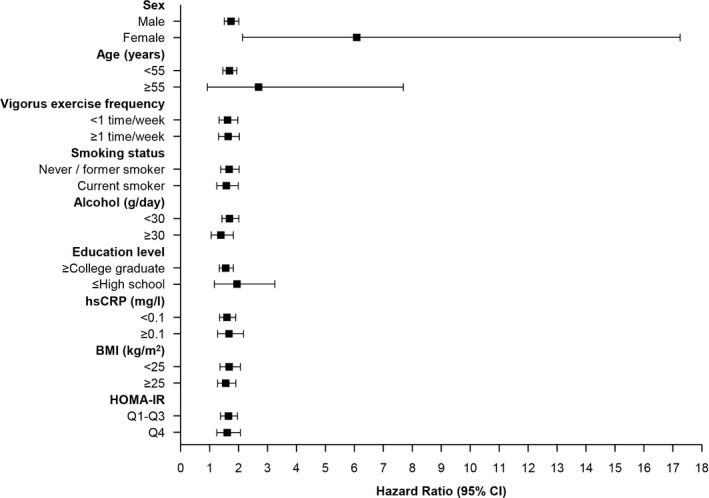
Background Arterial stiffness predicts both cardiovascular events and incident hypertension. However, whether brachial-ankle pulse wave velocity (baPWV) is predictive of incident hypertension based on the 2017 American College of Cardiology/American Heart Association (ACC/AHA) High Blood Pressure Guidelines has not been established. We performed a large cohort study to investigate whether incident hypertension could be predicted from baPWV measurements as a measure of arterial stiffness, even when applying updated hypertension criteria. Methods and Results A total of 10 360 Korean adults who underwent baPWV examination during a health-screening program between 2010 and 2016 were enrolled. Hypertension was defined according to the 2017 ACC/AHA Guidelines as 130/80 mm Hg. Cox proportional hazard analysis was used to assess the risk of incident hypertension according to baPWV quartiles. The mean age of the study subjects was 40.2 years and 75.6% were men. During the follow-up period (median 2.17 years), 2000 subjects (19.3%) developed hypertension. The subjects in the highest baPWV quartile group showed an increased risk of hypertension compared with the lowest baPWV quartile group as confirmed by multivariate adjusted hazard ratios of 1.64 (95% CI 1.41-1.89; P<0.001) in men and 12.36 (95% CI 4.41-34.62; P=0.005) in women. The increased risk of developing hypertension was consistent after adjusting for several confounding factors. Conclusions Arterial stiffness measured by baPWV is associated with incident hypertension according to the updated 2017 ACC/AHA Guidelines and is a useful independent predictor of incident hypertension among relatively healthy people.
Keywords: arterial stiffness; atherosclerosis; brachial‐ankle pulse wave velocity; hypertension.
Figures
References
-
- Lawes CM, Bennett DA, Parag V, Woodward M, Whitlock G, Lam TH, Suh I, Rodgers A; Asia Pacific Cohort Studies Collaboration . Blood pressure indices and cardiovascular disease in the Asia Pacific Region: a pooled analysis. Hypertension. 2003;42:69–75. - PubMed
-
- Rapsomaniki E, Timmis A, George J, Pujades‐Rodriguez M, Shah AD, Denaxas S, White IR, Caulfield MJ, Deanfield JE, Smeeth L, Williams B, Hingorani A, Hemingway H. Blood pressure and incidence of twelve cardiovascular diseases: lifetime risks, healthy life‐years lost, and age‐specific associations in 1.25 million people. Lancet. 2014;383:1899–1911. - PMC - PubMed
-
- Shen L, Ma H, Xiang MX, Wang JA. Meta‐analysis of cohort studies of baseline prehypertension and risk of coronary heart disease. Am J Cardiol. 2013;112:266–271. - PubMed
-
- Kearney PM, Whelton M, Reynolds K, Muntner P, Whelton PK, He J. Global burden of hypertension: analysis of worldwide data. Lancet. 2005;365:217–223. - PubMed
-
- GBD 2016 Risk Factors Collaborators . Global, regional, and national comparative risk assessment of 84 behavioural, environmental and occupational, and metabolic risks or clusters of risks, 1990–2016: a systematic analysis for the global burden of disease study 2016. Lancet. 2017;390:1345–1422. - PMC - PubMed
MeSH terms
LinkOut - more resources
Full Text Sources
Medical
