. 2019 Jun 3;8(8):1615817.
doi: 10.1080/2162402X.2019.1615817. eCollection 2019.

Vaccinia-based oncolytic immunotherapy Pexastimogene Devacirepvec in patients with advanced hepatocellular carcinoma after sorafenib failure: a randomized multicenter Phase IIb trial (TRAVERSE)

Affiliations

Vaccinia-based oncolytic immunotherapy Pexastimogene Devacirepvec in patients with advanced hepatocellular carcinoma after sorafenib failure: a randomized multicenter Phase IIb trial (TRAVERSE)

M Moehler et al. Oncoimmunology. .

Abstract

Pexastimogene devacirepvec (Pexa-Vec) is a vaccinia virus-based oncolytic immunotherapy designed to preferentially replicate in and destroy tumor cells while stimulating anti-tumor immunity by expressing GM-CSF. An earlier randomized Phase IIa trial in predominantly sorafenib-naïve hepatocellular carcinoma (HCC) demonstrated an overall survival (OS) benefit. This randomized, open-label Phase IIb trial investigated whether Pexa-Vec plus Best Supportive Care (BSC) improved OS over BSC alone in HCC patients who failed sorafenib therapy (TRAVERSE). 129 patients were randomly assigned 2:1 to Pexa-Vec plus BSC vs. BSC alone. Pexa-Vec was given as a single intravenous (IV) infusion followed by up to 5 IT injections. The primary endpoint was OS. Secondary endpoints included overall response rate (RR), time to progression (TTP) and safety. A high drop-out rate in the control arm (63%) confounded assessment of response-based endpoints. Median OS (ITT) for Pexa-Vec plus BSC vs. BSC alone was 4.2 and 4.4 months, respectively (HR, 1.19, 95% CI: 0.78-1.80; p = .428). There was no difference between the two treatment arms in RR or TTP. Pexa-Vec was generally well-tolerated. The most frequent Grade 3 included pyrexia (8%) and hypotension (8%). Induction of immune responses to vaccinia antigens and HCC associated antigens were observed. Despite a tolerable safety profile and induction of T cell responses, Pexa-Vec did not improve OS as second-line therapy after sorafenib failure. The true potential of oncolytic viruses may lie in the treatment of patients with earlier disease stages which should be addressed in future studies. ClinicalTrials.gov: NCT01387555.

Keywords: Hepatocellular carcinoma; Pexa-Vec; oncolytic immunotherapy; oncolytic vaccinia; sorafenib.


Figures
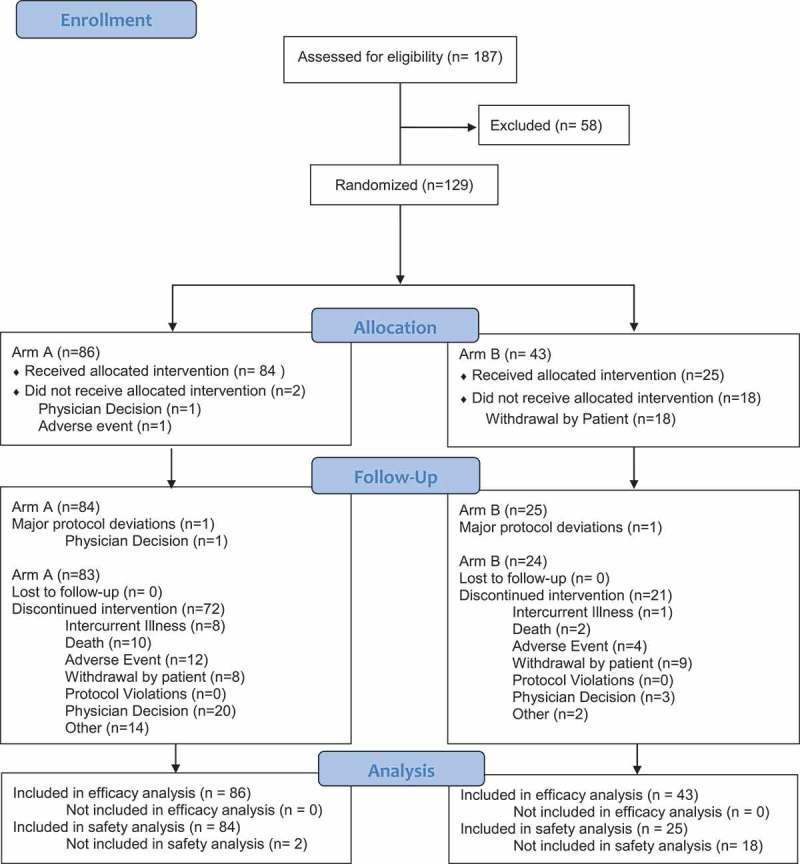
Figure 1.
Figure 1.
CONSORT diagram of sorafenib-pretreated patients with advanced hepatocellular carcinoma in the TRAVERSE study.
Figure 2.
Figure 2.
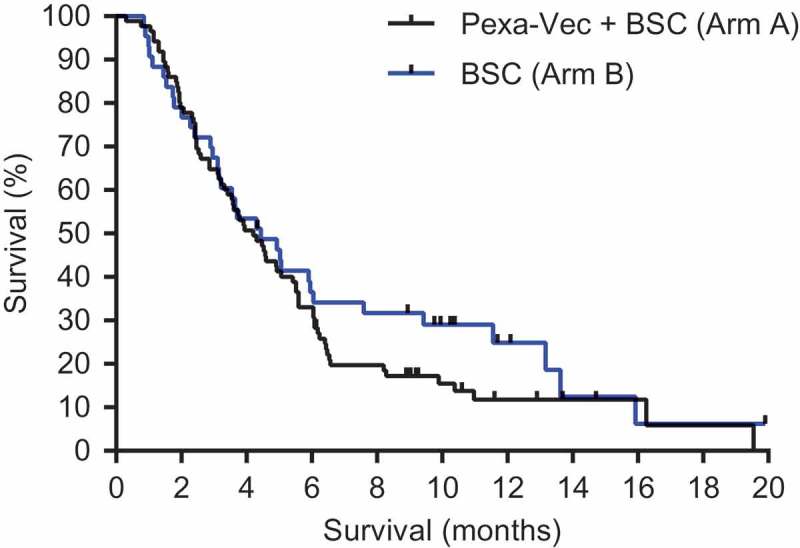
Kaplan-Meier estimates overall survival (OS). OS was computed on all randomized patients. Those patients who had not died or were lost to follow-up at the time of database lock were censored on the last date on which they were known to be alive.
Figure 3.
Figure 3.
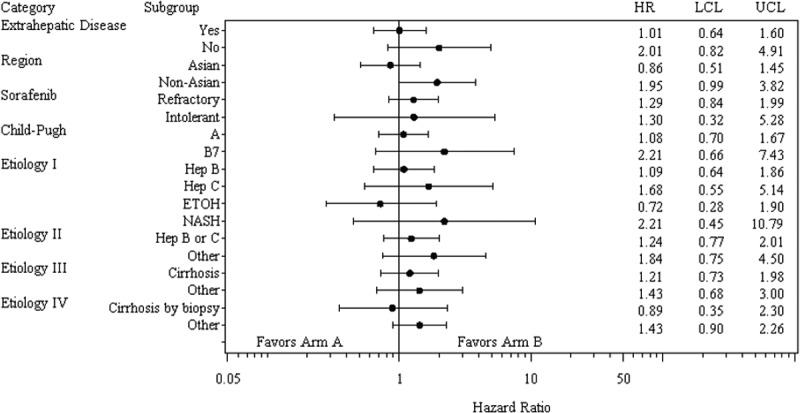
Overall survival in selected subsets. Hep B, hepatitis B; Hep C, hepatitis C; EtOH, alcohol, NASH, non-alcoholic steatohepatitis; HR, hazard ratio; LCL lower control limit; UCL, upper control limit.
Figure 4.
Figure 4.
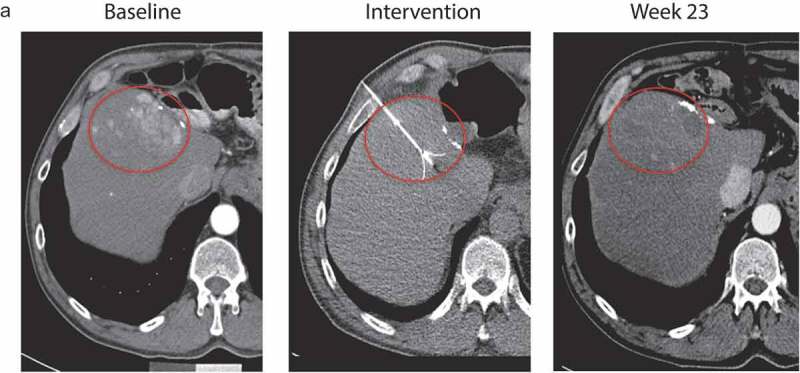
Patient 211–001 exhibited a response to Pexa-Vec treatment in the injected tumor as demonstrated by CT scans of this patient before (baseline), during (intervention) and 23 weeks after treatment showing a strong reduction in the extent of the tumor at week 23.
Figure 5.
Figure 5.
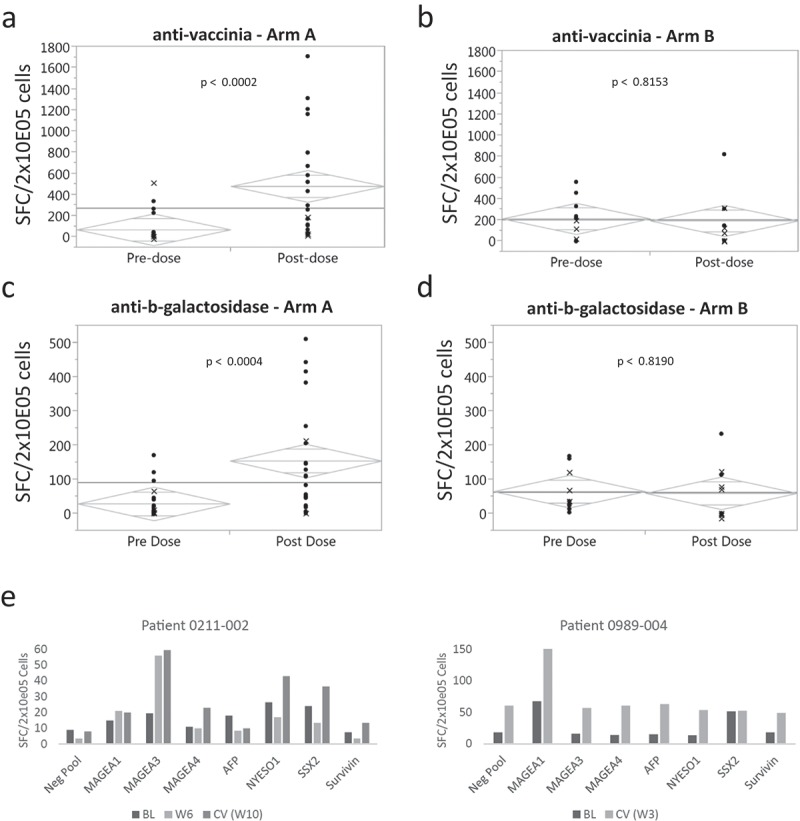
ELISPOT analysis of immune response to vaccinia, β-galactosidase and tumor antigens before (pre-dose) and 6 weeks after treatment (post-dose). Detection of T-cells specific for (a) vaccinia and (c) β-galactosidase peptides for all evaluable patients treated with Pexa-Vec (23 patients for vaccinia [A] and 22 patients for β-galactosidase [C]) and for 10 patients in the control arm (b = vaccinia and d = β-galactosidase peptides) is shown. The y axis represents the SFC/2x10E05 of the sample normalized by subtracting the respective negative pool (NC). The grey diamonds represent the 95% confidence interval. The data points depicted with an x indicate that one of the replicate values for either the sample or the respective negative pool was missing. (e) Detection of T-cells specific for tumor-associated antigen peptides for two patients with detectable responses against MAGE-A1 and MAGE-A3, respectively. Detection of T-cells specific for HCV peptides in HCV positive patients (Supplementary Figure).

References

    1. GLOBOCAN Estimated Cancer Incidence, Mortality and Prevalence Worldwide in 2012; 2012. doi:10.1094/PDIS-11-11-0999-PDN - DOI
    1. El-Serag HB. Epidemiology of viral hepatitis and hepatocellular carcinoma. Gastroenterology. 2012;142:1264. doi:10.1053/j.gastro.2011.12.061. - DOI - PMC - PubMed
    1. Wilhelm SM, Carter C, Tang L, et al. BAY 43-9006 exhibits broad spectrum oral antitumor activity and targets the RAF/MEK/ERK pathway and receptor tyrosine kinases involved in tumor progression and angiogenesis. Cancer Res. 2004;64:7099–7109. doi:10.1158/0008-5472.CAN-04-1443. - DOI - PubMed
    1. Wilhelm SM, Adnane L, Newell P, Villanueva A, Llovet JM, Lynch M. Preclinical overview of sorafenib, a multikinase inhibitor that targets both Raf and VEGF and PDGF receptor tyrosine kinase signaling. Mol Cancer Ther. 2008;7:3129–3140. doi:10.1158/1535-7163.MCT-08-0013. - DOI - PubMed
    1. Kudo M, Finn RS, Qin S, et al. Lenvatinib versus sorafenib in first-line treatment of patients with unresectable hepatocellular carcinoma: a randomised phase 3 non-inferiority trial. Lancet. 2018;391:1163–1173. doi:10.1016/S0140-6736(18)30207-1. - DOI - PubMed

Publication types

Associated data

LinkOut - more resources