Adoptive lymphocyte transfer to an HIV-infected progressor from an elite controller
- PMID: 31415245
- PMCID: PMC6795294
- DOI: 10.1172/jci.insight.130664
Adoptive lymphocyte transfer to an HIV-infected progressor from an elite controller
Abstract
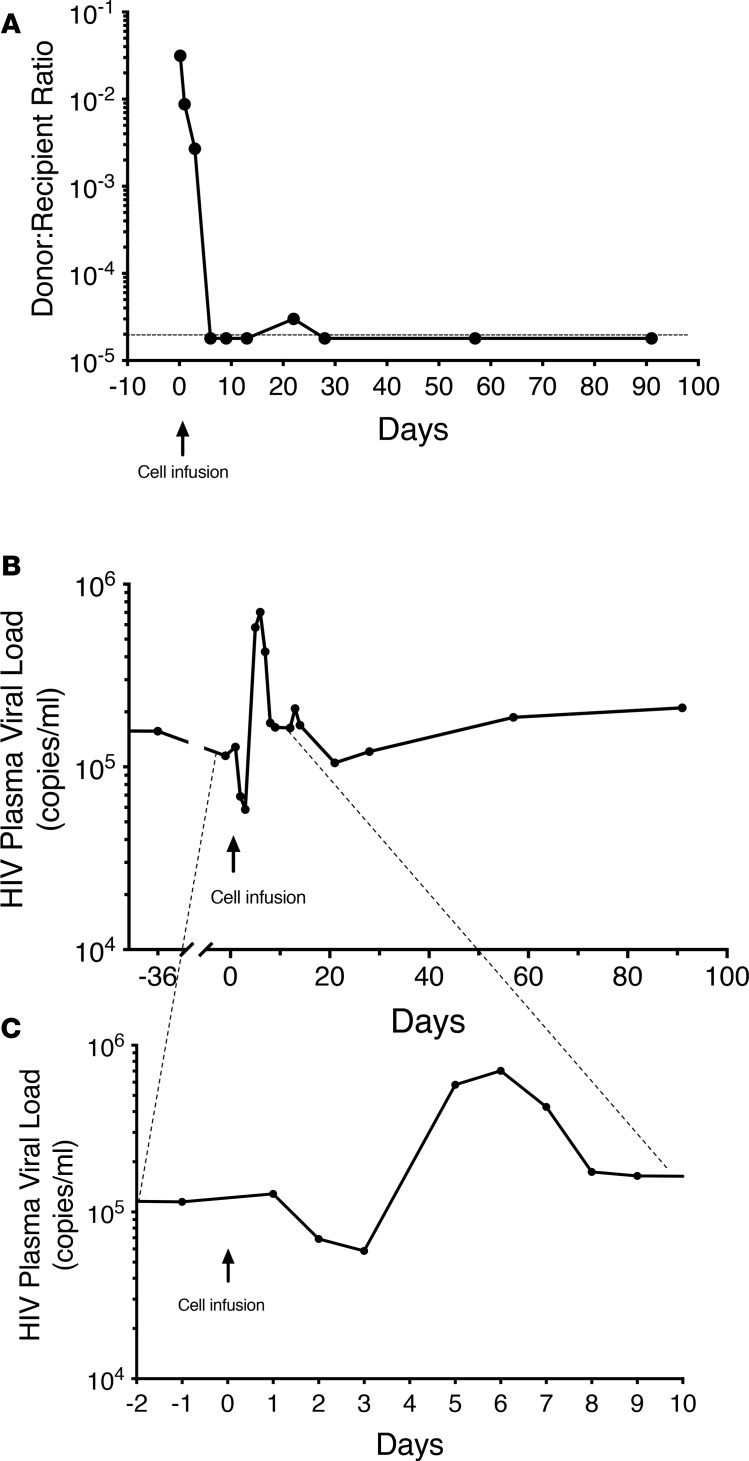
BACKGROUNDHIV-infected patients with poor virologic control and multidrug-resistant virus have limited therapeutic options. The current study was undertaken to evaluate the safety, immunologic effects, and antiviral activity of peripheral lymphocytes transferred from an elite controller, whose immune system is able to control viral replication without antiretroviral medications, to an HLA-B*2705-matched progressor.METHODSApproximately 22 billion cells were collected from an elite controller by lymphapheresis and infused within 6 hours into a recipient with a preinfusion CD4+ T cell count of 10 cells/μL (1%) and HIV plasma viral load of 114,993 copies/mL.RESULTSDonor cells were cleared from the recipient's peripheral blood by day 8. A transient decrease in viral load to 58,421 (day 3) was followed by a rebound to 702,972 (day 6) before returning to baseline values by day 8. The decreased viral load was temporally associated with peak levels of donor T cells, including CD8+ T cells that had high levels of expression of Ki67, perforin, and granzyme B. Notably, recipient CD8+ T cells also showed increased expression of these markers, especially in HIV-specific tetramer-positive cells.CONCLUSIONThese results suggest that the adoptive transfer of lymphocytes from an HIV-infected elite controller to an HIV-infected patient with progressive disease may be able to perturb the immune system of the recipient in both positive and negative ways.TRIAL REGISTRATIONClinicalTrials.gov NCT00559416.FUNDINGIntramural Research Programs of the US NIH Clinical Center and the National Institute of Allergy and Infectious Diseases (NIAID); the National Cancer Institute.
Keywords: AIDS/HIV; Adaptive immunity; Immunotherapy; Infectious disease; T cells.
Conflict of interest statement
Figures



Similar articles
-
CCR5-edited CD4+ T cells augment HIV-specific immunity to enable post-rebound control of HIV replication.J Clin Invest. 2021 Apr 1;131(7):e144486. doi: 10.1172/JCI144486. J Clin Invest. 2021. PMID: 33571163 Free PMC article. Clinical Trial.
-
Elite suppression of HIV-1 replication.Immunity. 2008 Dec 19;29(6):845-7. doi: 10.1016/j.immuni.2008.12.002. Immunity. 2008. PMID: 19100698
-
Differential Impact of In Vivo CD8+ T Lymphocyte Depletion in Controller versus Progressor Simian Immunodeficiency Virus-Infected Macaques.J Virol. 2015 Sep;89(17):8677-86. doi: 10.1128/JVI.00869-15. Epub 2015 Jun 10. J Virol. 2015. PMID: 26063417 Free PMC article.
-
Association of immune complexes and plasma viral load with CD4+ cell depletion, CD8+ DR+ and CD16+ cell counts in HIV+ hemophilia patients. Implications for the immunopathogenesis of HIV-induced CD4+ lymphocyte depletion.Immunol Lett. 2001 Mar 1;76(2):69-78. doi: 10.1016/s0165-2478(01)00181-x. Immunol Lett. 2001. PMID: 11274723
-
Entering a new era of harnessing natural killer cell responses in HIV infection.EBioMedicine. 2019 Jun;44:26-27. doi: 10.1016/j.ebiom.2019.05.045. Epub 2019 May 27. EBioMedicine. 2019. PMID: 31147292 Free PMC article. Review. No abstract available.
Cited by
-
Sustainable Antiviral Efficacy of Rejuvenated HIV-Specific Cytotoxic T Lymphocytes Generated from Induced Pluripotent Stem Cells.J Virol. 2022 Mar 23;96(6):e0221721. doi: 10.1128/jvi.02217-21. Epub 2022 Feb 2. J Virol. 2022. PMID: 35107374 Free PMC article.
-
A Combination of M50I and V151I Polymorphic Mutations in HIV-1 Subtype B Integrase Results in Defects in Autoprocessing.Viruses. 2021 Nov 22;13(11):2331. doi: 10.3390/v13112331. Viruses. 2021. PMID: 34835137 Free PMC article.
-
HIV-1 suppression and rare dolutegravir resistance in antiretroviral-experienced people with HIV in Liberia.Commun Med (Lond). 2025 May 9;5(1):164. doi: 10.1038/s43856-025-00875-x. Commun Med (Lond). 2025. PMID: 40346187 Free PMC article.
-
Cell therapies for viral diseases: a new frontier.Semin Immunopathol. 2025 Jan 2;47(1):5. doi: 10.1007/s00281-024-01031-8. Semin Immunopathol. 2025. PMID: 39747475 Free PMC article. Review.
-
Stem Cell-Derived Viral Antigen-Specific T Cells Suppress HIV Replication and PD-1 Expression on CD4+ T Cells.Viruses. 2021 Apr 25;13(5):753. doi: 10.3390/v13050753. Viruses. 2021. PMID: 33923025 Free PMC article.
References
Publication types
MeSH terms
Substances
Associated data
Grants and funding
LinkOut - more resources
Full Text Sources
Medical
Research Materials