


Preservation of cell-based immunotherapies for clinical trials
- PMID: 31416704
- PMCID: PMC6746578
- DOI: 10.1016/j.jcyt.2019.07.004
Preservation of cell-based immunotherapies for clinical trials
Abstract
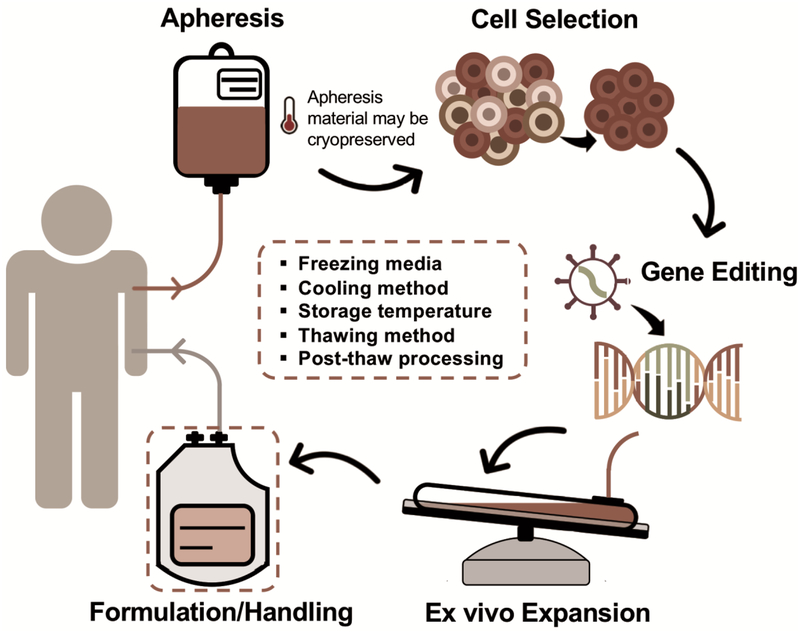
In the unique supply chain of cellular therapies, preservation is important to keep the cell product viable. Many factors in cryopreservation affect the outcome of a cell therapy: (i) formulation and introduction of a freezing medium, (ii) cooling rate, (iii) storage conditions, (iv) thawing conditions and (v) post-thaw processing. This article surveys clinical trials of cellular immunotherapy that used cryopreserved regulatory, chimeric antigen receptor or gamma delta T cells, dendritic cells or natural killer (NK) cells. Several observations are summarized from the given information. The aforementioned cell types have been similarly frozen in media containing 5-10% dimethyl sulfoxide (DMSO) with plasma, serum or human serum albumin. Two common freezing methods are an insulated freezing container such as Nalgene Mr. Frosty and a controlled-rate freezer at a cooling rate of -1°C/min. Water baths at approximately 37°C have been commonly used for thawing. Post-thaw processing of cryopreserved cells varied greatly: some studies infused the cells immediately upon thawing; some diluted the cells in a carrier solution of varying formulation before infusion; some washed cells to remove cryoprotective agents; and others re-cultured cells to recover cell viability or functionality lost due to cryopreservation. Emerging approaches to preserving cellular immunotherapies are also described. DMSO-free formulations of the freezing media have demonstrated improved preservation of cell viability in T lymphocytes and of cytotoxic function in natural killer cells. Saccharides are a common type of molecule used as an alternative cryoprotective agent to DMSO. Improving methods of preservation will be critical to growth in the clinical use of cellular immunotherapies.
Keywords: T cells; cell therapies; cryopreservation; dendritic cells; natural killer cells.
Copyright © 2019 International Society for Cell and Gene Therapy. Published by Elsevier Inc. All rights reserved.
Conflict of interest statement
Disclosure of Interest
No competing financial interests exist.
Figures
References
-
- Hubel A Preservation of cells: a practical manual. Hobokken, NJ: Wiley-Blackwell; 2018.
-
- Lovelock JE, Bishop MW. Prevention of freezing damage to living cells by dimethyl sulphoxide. Nature 1959;183:1394–5. - PubMed
-
- Levin RL, Miller TW. An optimum method for the introduction or removal of permeable cryoprotectants: isolated cells. Cryobiology 1981;18:32–48. - PubMed
Publication types
MeSH terms
Grants and funding
LinkOut - more resources
Full Text Sources
Other Literature Sources
Medical
