


Utilizing the genomically adjusted radiation dose (GARD) to personalize adjuvant radiotherapy in triple negative breast cancer management
- PMID: 31416721
- PMCID: PMC6796536
- DOI: 10.1016/j.ebiom.2019.08.019
Utilizing the genomically adjusted radiation dose (GARD) to personalize adjuvant radiotherapy in triple negative breast cancer management
Abstract
Background: Utilizing the linear quadratic model and the radiosensitivity index (RSI), we have derived an expression for the genomically adjusted radiation dose (GARD) to model radiation dose effect. We hypothesize GARD is associated with local recurrence and can be used to optimize individual triple negative breast cancer (TNBC) radiation dose.
Methods: TN patients from two independent datasets were assessed. The first cohort consisted of 58 patients treated at 5 European centers with breast conservation surgery followed by adjuvant radiotherapy (RT). The second dataset consisted of 55 patients treated with adjuvant radiation therapy.
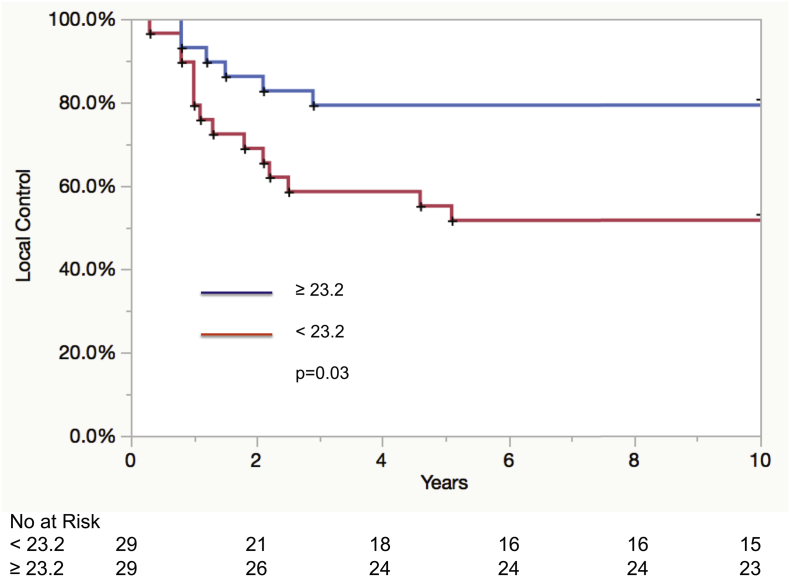
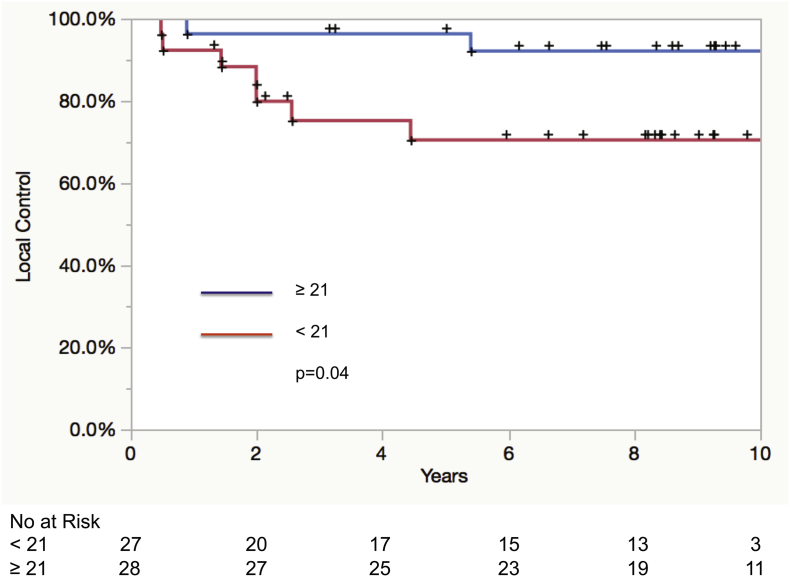
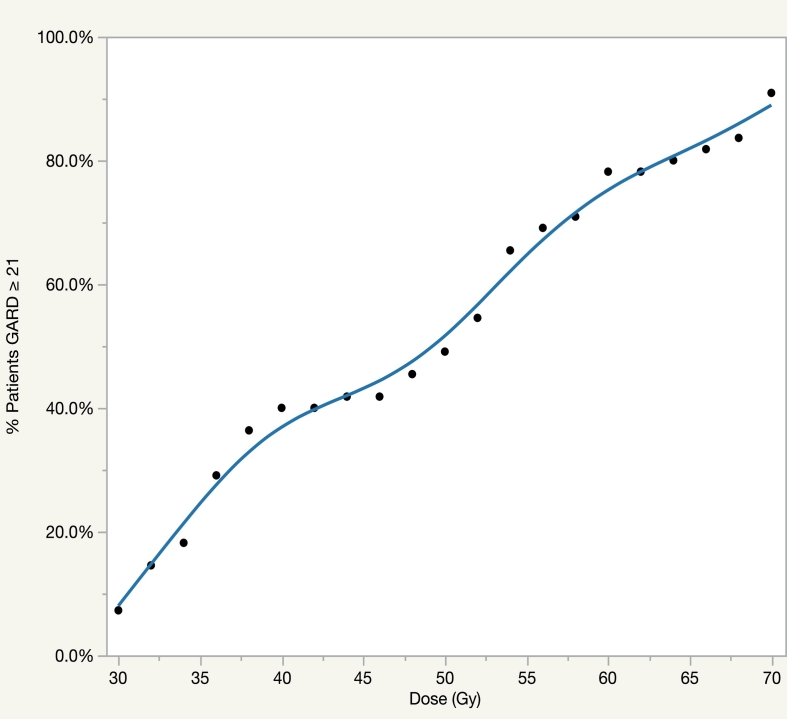
Findings: In cohort 1, multivariable analysis revealed that as a dichotomous variable (HR: 2.5 95% CI 1-7.1; p = .05), GARD was associated with local control. This was confirmed in the second independent dataset where GARD was the only significant factor associated with local control (HR: 4.4 95% CI 1.1-29.5; p = .04). We utilized GARD to calculate an individualized radiation dose for each TN patient in cohort 2 by determining the physical dose required to achieve the GARD target value (GARD ≥ 21). While 7% of patients were optimized with a dose of 30 Gy, 91% of patients would be optimized with 70 Gy.
Interpretation: GARD is associated with local control following whole breast or post-mastectomy radiotherapy (RT) in TN patients. By modeling RT dose effect with GARD, we demonstrate that no single dose is optimal for all patients and propose the first dose range to optimize RT at an individual patient level in TNBC.
Keywords: Breast cancer; Genomically adjusted radiation dose; Personalized radiotherapy; Radiotherapy.
Copyright © 2019. Published by Elsevier B.V.
Conflict of interest statement
Steven A. Eschrich PhD and Javier F. Torres-Roca MD report stock and leadership in Cvergenx, Inc. and royalty and patents on RSI. Javier F. Torres-Roca MD and Jacob G. Scott MD PhD report royalty and patents on GARD.
Figures
References
-
- Fisher B., Anderson S., Bryant J., Margolese R.G., Deutsch M., Fisher E.R. Twenty-year follow-up of a randomized trial comparing total mastectomy, lumpectomy, and lumpectomy plus irradiation for the treatment of invasive breast cancer. N Engl J Med. 2002;347(16):1233–1241. - PubMed
-
- Haviland J.S., Owen J.R., Dewar J.A., Agrawal R.K., Barrett J., Barrett-Lee P.J. The UK Standardisation of Breast Radiotherapy (START) trials of radiotherapy hypofractionation for treatment of early breast cancer: 10-year follow-up results of two randomised controlled trials. Lancet Oncol. 2013;14(11):1086–1094. - PubMed
-
- Whelan T.J., Pignol J.P., Levine M.N., Julian J.A., MacKenzie R., Parpia S. Long-term results of hypofractionated radiation therapy for breast cancer. N Engl J Med. 2010;362(6):513–520. - PubMed
Publication types
MeSH terms
Substances
Grants and funding
LinkOut - more resources
Full Text Sources
Other Literature Sources
