. 2019 Apr 6;12(7):1287-1304.
doi: 10.1111/eva.12791. eCollection 2019 Aug.

Conservation through the lens of (mal)adaptation: Concepts and meta-analysis

Affiliations

Conservation through the lens of (mal)adaptation: Concepts and meta-analysis

Alison Margaret Derry et al. Evol Appl. .

Abstract

Evolutionary approaches are gaining popularity in conservation science, with diverse strategies applied in efforts to support adaptive population outcomes. Yet conservation strategies differ in the type of adaptive outcomes they promote as conservation goals. For instance, strategies based on genetic or demographic rescue implicitly target adaptive population states whereas strategies utilizing transgenerational plasticity or evolutionary rescue implicitly target adaptive processes. These two goals are somewhat polar: adaptive state strategies optimize current population fitness, which should reduce phenotypic and/or genetic variance, reducing adaptability in changing or uncertain environments; adaptive process strategies increase genetic variance, causing maladaptation in the short term, but increase adaptability over the long term. Maladaptation refers to suboptimal population fitness, adaptation refers to optimal population fitness, and (mal)adaptation refers to the continuum of fitness variation from maladaptation to adaptation. Here, we present a conceptual classification for conservation that implicitly considers (mal)adaptation in the short-term and long-term outcomes of conservation strategies. We describe cases of how (mal)adaptation is implicated in traditional conservation strategies, as well as strategies that have potential as a conservation tool but are relatively underutilized. We use a meta-analysis of a small number of available studies to evaluate whether the different conservation strategies employed are better suited toward increasing population fitness across multiple generations. We found weakly increasing adaptation over time for transgenerational plasticity, genetic rescue, and evolutionary rescue. Demographic rescue was generally maladaptive, both immediately after conservation intervention and after several generations. Interspecific hybridization was adaptive only in the F1 generation, but then rapidly leads to maladaptation. Management decisions that are made to support the process of adaptation must adequately account for (mal)adaptation as a potential outcome and even as a tool to bolster adaptive capacity to changing conditions.

Keywords: adaptation; demographic rescue; evolutionary rescue; gene flow; genetic rescue; hybridization; transgenerational plasticity; translocation.


Conflict of interest statement

None declared.

Figures
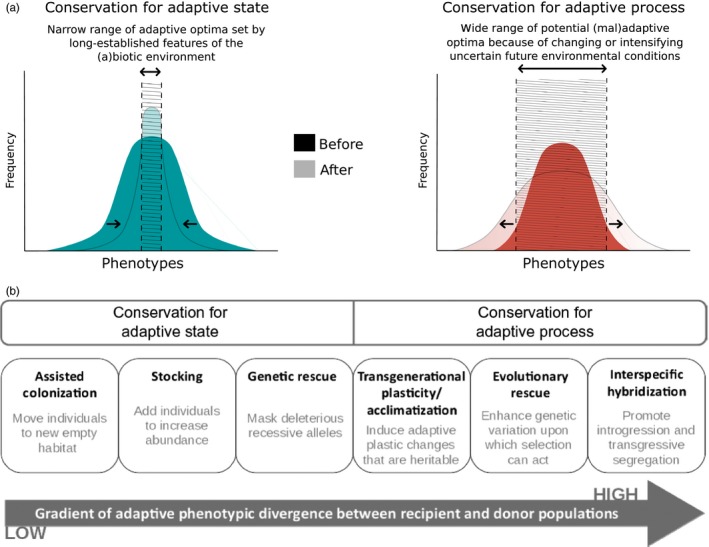
Figure 1
Figure 1
A conceptual classification for considering conservation goals that seek to reduce or integrate (mal)adaptation. (a) Adaptive state versus adaptive process. In both panels, the darker and lighter shading indicates the population trait or fitness frequency before and after implementing a conservation practice, respectively. Adaptive state assumes that the population is replenished with individuals so that its fitness returns to a known adaptive optimum presumably set by some long‐established features of the (a)biotic environment. This is illustrated by a narrow range of possible adaptive optima along the phenotype axis in the hatched area of “after” histogram. The result is the mean population fitness closely matches the optimal phenotype, at a given time point, at the expense of reduced heritable trait variation. Adaptive process, by contrast, assumes that the optimal phenotype in the future is uncertain because (i) there are multiple (mal)adaptive optima to which it is unknown the population will evolve into the future, or (ii) that a sustained adaptive process will be required to a reach a new optimum in the presence of an intensifying stressor, which may be far from any known phenotype. This is illustrated by the broad range of possible (mal)adaptive optima along the phenotype axis in the hatched area of the “after” histogram. The result is that the heritable trait variation is increased at the expense of reduced mean population fitness in relation to the optimal phenotype. (b) Examples of conservation strategies that occur along a continuum of conservation goals between adaptive state and process. Whereas adaptive state conservation strategies involve the admixture of adaptively similar populations to minimize maladaptation and optimize mean population fitness, adaptive process conservation strategies involve the admixture of adaptively divergent populations to increase heritable (mal)adaptive variation
Figure 2
Figure 2
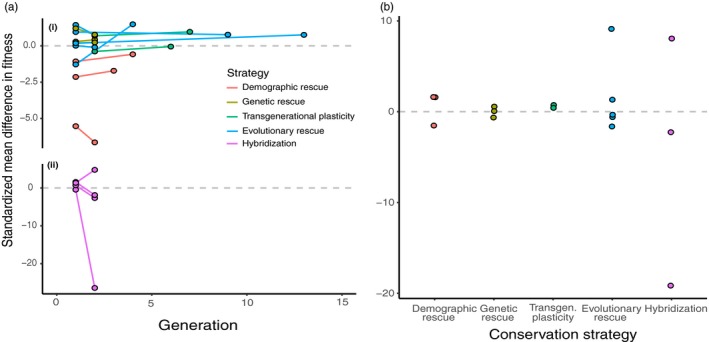
Fitness responses to different conservation strategies. (a) Standardized mean differences (SMD) were calculated for fitness values measured over three time periods (1. before conservation, 2. soon after conservation, and 3. multiple generations after conservation) (Table 3). SMDs between time periods 1–2 and 2–3 are shown with respect to generation time. Because of differences in magnitude, SMDs for (ii) “hybridization” are shown separately (and using a different scale) from SMDs pertaining to (i) all other strategies. (b) The SMD was also calculated between each of these two time periods to evaluate the overall effect of each conservation strategy

References

    1. Agashe, D. , Falk, J. J. , & Bolnick, D. I. (2011). Effects of founding genetic variation on adaptation to a novel resource. Evolution, 65, 2481–2491. 10.1111/j.1558-5646.2011.01307.x - DOI - PubMed
    1. Aitken, S. N. , & Whitlock, M. C. (2013). Assisted gene flow to facilitate local adaptation to climate change. Annual Review of Ecology, Evolution, and Systematics, 44(1), 367–388. 10.1146/annurev-ecolsys-110512-135747 - DOI
    1. Allan, B. J. , Miller, G. M. , McCormick, M. I. , Domenici, P. , & Munday, P. L. . (2014). Parental effects improve escape performance of juvenile reef fish in a high‐CO2 world. Proceedings of the Royal Society of London B: Biological Sciences, 281, 20132179. - PMC - PubMed
    1. Angilletta, M. J., Jr. (2009). Thermal adaptation: A theoretical and empirical synthesis. Oxford, UK: Oxford University Press.
    1. Araki, H. , Cooper, B. , & Blouin, M. S. (2007). Genetic effects of captive breeding cause a rapid, cumulative fitness decline in the wild. Science, 318, 100–103. 10.1126/science.1145621 - DOI - PubMed

LinkOut - more resources