Review
. 2019 Jul 31:7:186.
doi: 10.3389/fbioe.2019.00186. eCollection 2019.

Biosensors for On-Farm Diagnosis of Mastitis

Affiliations
Review

Biosensors for On-Farm Diagnosis of Mastitis

Sofia A M Martins et al. Front Bioeng Biotechnol. .

Abstract

Bovine mastitis is an inflammation of the mammary gland caused by a multitude of pathogens with devastating consequences for the dairy industry. Global annual losses are estimated to be around €30 bn and are caused by significant milk losses, poor milk quality, culling of chronically infected animals, and occasional deaths. Moreover, mastitis management routinely implies the administration of antibiotics to treat and prevent the disease which poses serious risks regarding the emergence of antibiotic resistance. Conventional diagnostic methods based on somatic cell counts (SCC) and plate-culture techniques are accurate in identifying the disease, the respective infectious agents and antibiotic resistant phenotypes. However, pressure exists to develop less lengthy approaches, capable of providing on-site information concerning the infection, and in this way, guide, and hasten the most adequate treatment. Biosensors are analytical tools that convert the presence of biological compounds into an electric signal. Benefitting from high signal-to-noise ratios and fast response times, when properly tuned, they can detect the presence of specific cells and cell markers with high sensitivity. In combination with microfluidics, they provide the means for development of automated and portable diagnostic devices. Still, while biosensors are growing at a fast pace in human diagnostics, applications for the veterinary market, and specifically, for the diagnosis of mastitis remain limited. This review highlights current approaches for mastitis diagnosis and describes the latest outcomes in biosensors and lab-on-chip devices with the potential to become real alternatives to standard practices. Focus is given to those technologies that, in a near future, will enable for an on-farm diagnosis of mastitis.

Keywords: biosensors; dairy industry; diagnostics; mastitis; microfluidics; point-of-care.


Figures
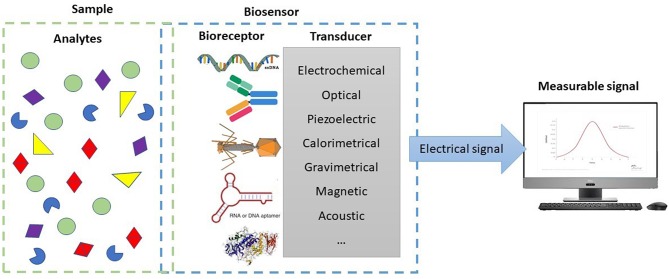
Figure 1
Figure 1
Schematic representation of the elements of a biosensor.
Figure 2
Figure 2
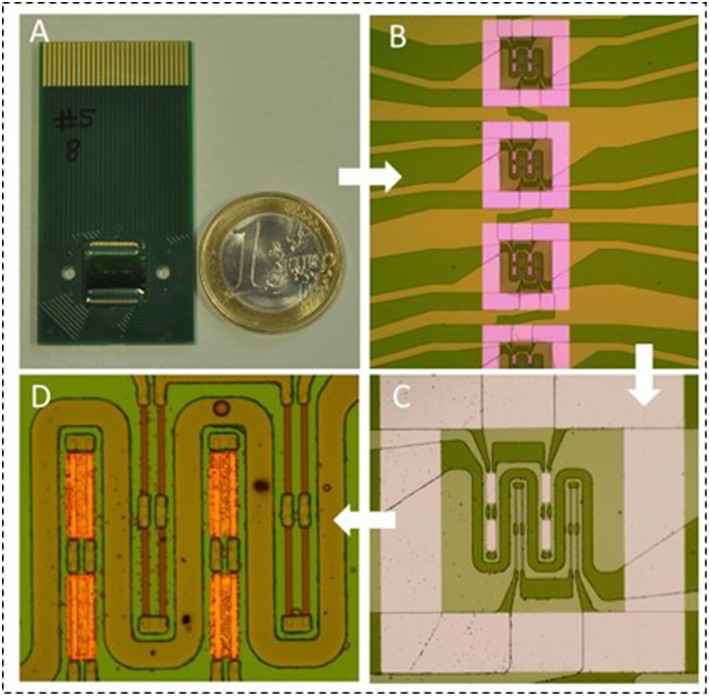
(A) Picture of the magnetoresistive biochip developed by Magnomics S.A. (B) Zoom-in of some of the 15 sensing sites for automatic spotting of biorecognition probes. (C) Detail of one sensing site with 2 sensors. One active sensor (gold coated) and one reference sensor (bare). (D) Zoom-in of the sensors. Each sensor is composed of 8 sensor segments. The sensors are surrounded by a current line for magnetic attraction of the magnetic particles.
Figure 3
Figure 3
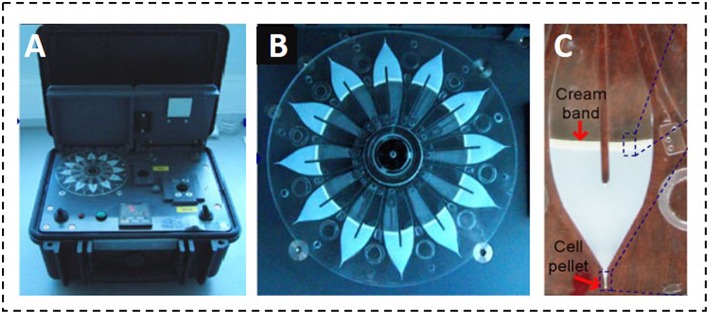
Portable microfluidic sedimentation cytometer proposed by Garcia-Cordero et al. (A) Portable reader to spin the disc; (B) Microfluidic CD cartridge showing the capacity for 12 milk samples; (C) Photographic capture of a centrifuged chamber showing the pellet and the cream band. Adapted with permission from Garcia-Cordero et al. (2010). Copyright 2010 Springer Switzerland AG.
Figure 4
Figure 4
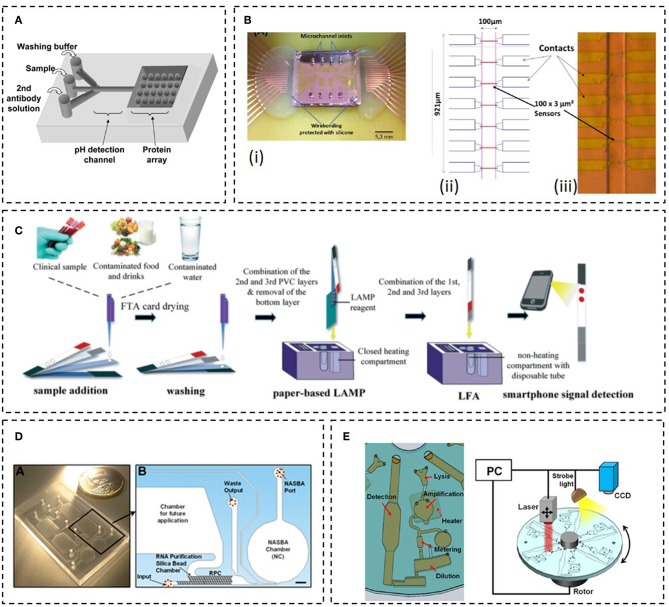
Examples of LoC systems for the detection of bacteria. (A) Schematics of the device proposed by Choi et al. Adapted from Choi et al. (2006); (B) Final device proposed by Duarte et al. with the MR chip bonded to the polydimethylsiloxane (PDMS) microchannels (i); Sensor layout showing the distribution of the Spin-valve sensors along the microchannels (ii) and a photograph showing a representative microchannel aligned over the sensors (iii). Adapted from Duarte et al. (2016); (C) 3D paper-based microfluidic proposed by Choi et al. Reprinted with permission from Choi et al. (2016). Copyright 2016 Royal Society of Chemistry; (D) Monolithic device proposed by Dimov et al. (inset A) and schematics showing the different unitary operations occurring inside the device (inset B). Adapted with permission from Dimov et al. (2008). Copyright 2008 Royal Society of Chemistry; (E) Scheme of the LoC device proposed by Kim et al. Adapted with permission from Kim et al. (2014). Copyright 2014 American Chemical Society.
Figure 5
Figure 5
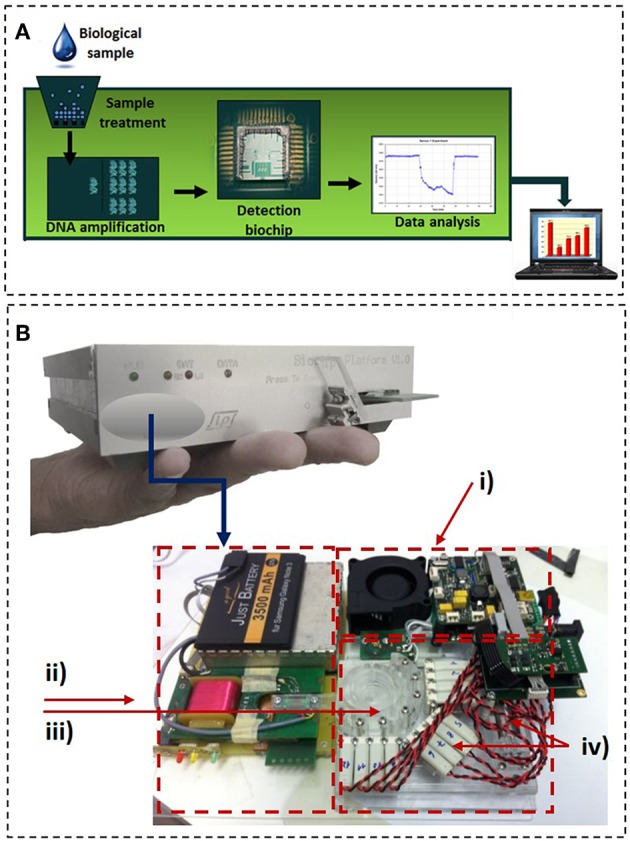
Magnomics S.A. device. (A) Schematics of the concept proposed by Magnomics S.A. (B) Prototype device developed by Magnomics S.A. highlighting the microfluidic units for sample treatment, nucleic acid amplification, and detection: (i) Thermocycling; (ii) Magnetic detection; (iii) Sample preparation unit; (iv) Integrated valves and pump.

References

    1. Abbasian F., Ghafar-Zadeh E., Magierowski S. (2018). Microbiological sensing technologies: a review. Bioengineering. 5:20. 10.3390/bioengineering5010020 - DOI - PMC - PubMed
    1. Addis M. F., Tedde V., Puggioni G. M. G., Pisanu S., Casula A., Locatelli C., et al. . (2016). Evaluation of milk cathelicidin for detection of bovine mastitis. J. Dairy Sci. 99, 8250–8258. 10.3168/jds.2016-11407 - DOI - PubMed
    1. Adkins P. R. F., Middleton J. R. (2018). Methods for diagnosing mastitis. Vet. Clin. North Am. 34, 479–491. 10.1016/j.cvfa.2018.07.003 - DOI - PubMed
    1. Aga D. S., Lenczewski M., Snow D., Muurinen J., Sallach J. B., Wallace J. S. (2016). Challenges in the measurement of antibiotics and in evaluating their impacts in agroecosystems: a critical review. J. Environ. Qual. 45, 407–419. 10.2134/jeq2015.07.0393 - DOI - PubMed
    1. Akerstedt M., Bjorck L., Persson Waller K., Sternesjo A. (2006). Biosensor assay for determination of haptoglobin in bovine milk. J. Dairy Res. 73, 299–305. 10.1017/S0022029906001774 - DOI - PubMed