


Capillary refill time variation induced by passive leg raising predicts capillary refill time response to volume expansion
- PMID: 31420052
- PMCID: PMC6697974
- DOI: 10.1186/s13054-019-2560-0
Capillary refill time variation induced by passive leg raising predicts capillary refill time response to volume expansion
Abstract
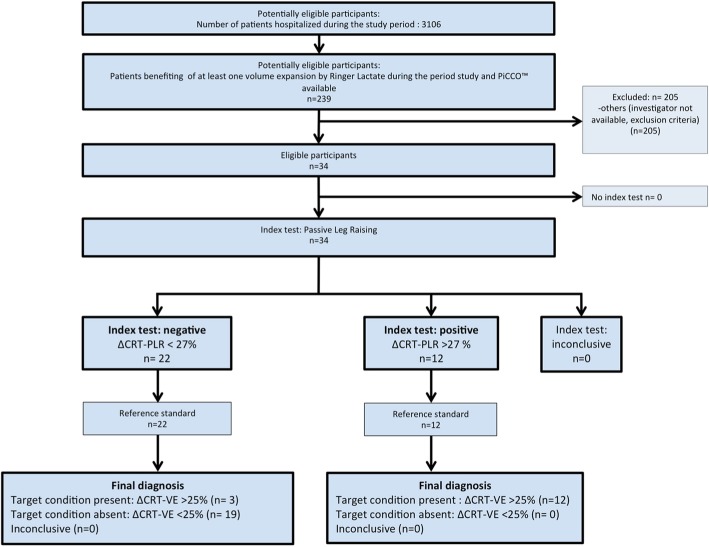
Background: A peripheral perfusion-targeted resuscitation during early septic shock has shown encouraging results. Capillary refill time, which has a prognostic value, was used. Adding accuracy and predictability on capillary refill time (CRT) measurement, if feasible, would benefit to peripheral perfusion-targeted resuscitation. We assessed whether a reduction of capillary refill time during passive leg raising (ΔCRT-PLR) predicted volume-induced peripheral perfusion improvement defined as a significant decrease of capillary refill time following volume expansion.
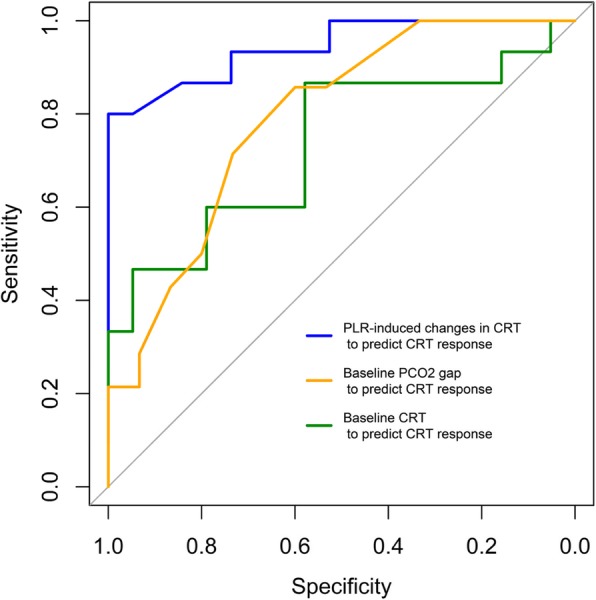
Methods: Thirty-four patients with acute circulatory failure were selected. Haemodynamic variables, metabolic variables (PCO2gap), and four capillary refill time measurements were recorded before and during a passive leg raising test and after a 500-mL volume expansion over 20 min. Receiver operating characteristic curves were built, and areas under the curves were calculated (ROCAUC). Confidence intervals (CI) were performed using a bootstrap analysis. We recorded mortality at day 90.
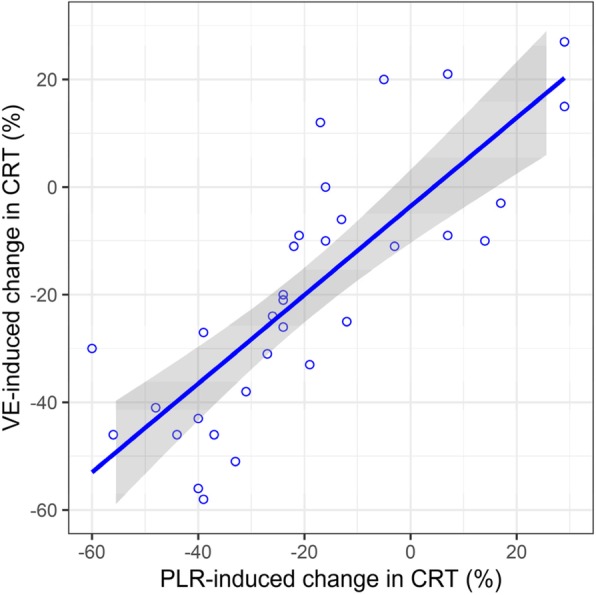
Results: The least significant change in the capillary refill time was 25% [95% CI, 18-30]. We defined CRT responders as patients showing a reduction of at least 25% of capillary refill time after volume expansion. A decrease of 27% in ΔCRT-PLR predicted peripheral perfusion improvement with a sensitivity of 87% [95% CI, 73-100] and a specificity of 100% [95% CI, 74-100]. The ROCAUC of ΔCRT-PLR was 0.94 [95% CI, 0.87-1.0]. The ROCAUC of baseline capillary refill time was 0.73 [95% CI, 0.54-0.90] and of baseline PCO2gap was 0.79 [0.61-0.93]. Capillary refill time was significantly longer in non-survivors than in survivors at day 90.
Conclusion: ΔCRT-PLR predicted peripheral perfusion response following volume expansion. This simple low-cost and non-invasive diagnostic method could be used in peripheral perfusion-targeted resuscitation protocols.
Trial registration: CPP Lyon Sud-Est II ANSM: 2014-A01034-43 Clinicaltrial.gov, NCT02248025 , registered 13th of September 2014.
Keywords: Capillary refill time; Circulatory shock; Fluid responsiveness; Microcirculation; PCO2gap; Passive leg raising; Peripheral perfusion.
Conflict of interest statement
The corresponding author has created a medtech company called DICARTECH which is developing a device to assess capillary refill time. All other authors declare that they have no competing interests.
Figures
References
-
- Cecconi Maurizio, De Backer Daniel, Antonelli Massimo, Beale Richard, Bakker Jan, Hofer Christoph, Jaeschke Roman, Mebazaa Alexandre, Pinsky Michael R., Teboul Jean Louis, Vincent Jean Louis, Rhodes Andrew. Consensus on circulatory shock and hemodynamic monitoring. Task force of the European Society of Intensive Care Medicine. Intensive Care Medicine. 2014;40(12):1795–1815. doi: 10.1007/s00134-014-3525-z. - DOI - PMC - PubMed
-
- Rhodes A, Evans LE, Alhazzani W, Levy MM, Antonelli M, Ferrer R, et al. Surviving Sepsis Campaign: international guidelines for management of sepsis and septic shock. Crit Care Med. 2017;1. - PubMed
Publication types
MeSH terms
Substances
Associated data
LinkOut - more resources
Full Text Sources
Other Literature Sources
Medical
Research Materials
Miscellaneous
