Review
. 2019 Aug 27;116(35):17147-17155.
doi: 10.1073/pnas.1902026116. Epub 2019 Aug 16.

Intermembrane transport: Glycerophospholipid homeostasis of the Gram-negative cell envelope

Affiliations
Review

Intermembrane transport: Glycerophospholipid homeostasis of the Gram-negative cell envelope

Matthew J Powers et al. Proc Natl Acad Sci U S A. .

Abstract

This perspective addresses recent advances in lipid transport across the Gram-negative inner and outer membranes. While we include a summary of previously existing literature regarding this topic, we focus on the maintenance of lipid asymmetry (Mla) pathway. Discovered in 2009 by the Silhavy group [J. C. Malinverni, T. J. Silhavy, Proc. Natl. Acad. Sci. U.S.A. 106, 8009-8014 (2009)], Mla has become increasingly appreciated for its role in bacterial cell envelope physiology. Through the work of many, we have gained an increasingly mechanistic understanding of the function of Mla via genetic, biochemical, and structural methods. Despite this, there is a degree of controversy surrounding the directionality in which Mla transports lipids. While the initial discovery and subsequent studies have posited that it mediated retrograde lipid transport (removing glycerophospholipids from the outer membrane and returning them to the inner membrane), others have asserted the opposite. This Perspective aims to lay out the evidence in an unbiased, yet critical, manner for Mla-mediated transport in addition to postulation of mechanisms for anterograde lipid transport from the inner to outer membranes.

Keywords: LPS; Mla; glycerophospholipid; lipoprotein; outer membrane.


Conflict of interest statement

The authors declare no conflict of interest.

Figures
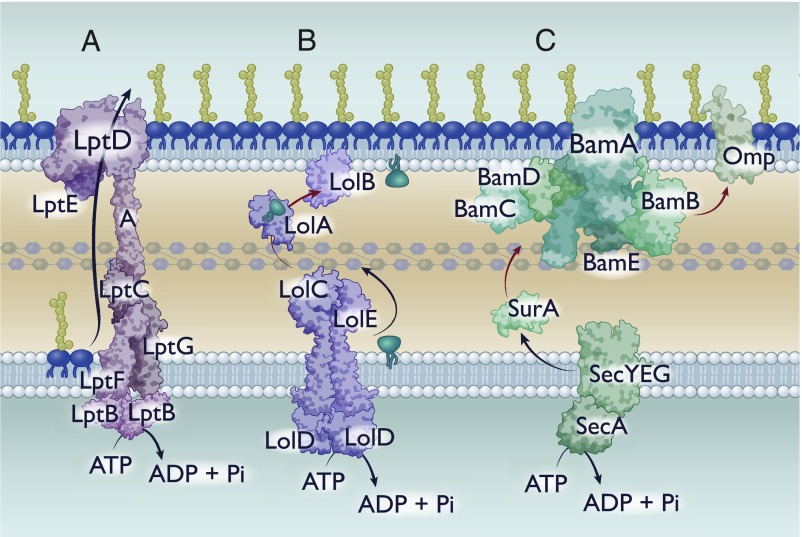
Fig. 1.
Fig. 1.
Known mechanisms of hydrophobic substrate transfer across the periplasm. Cartoon depictions of hydrophobic substrate transfer across the periplasm. Black arrows indicate energy-dependent processes. Red arrows represent transfer that must occur without energy. (A) Lpt-mediated transfer of LPS. (B) Lol-mediated transfer of lipoproteins. (C) Chaperone-mediated transport of hydrophobic proteins.
Fig. 2.
Fig. 2.
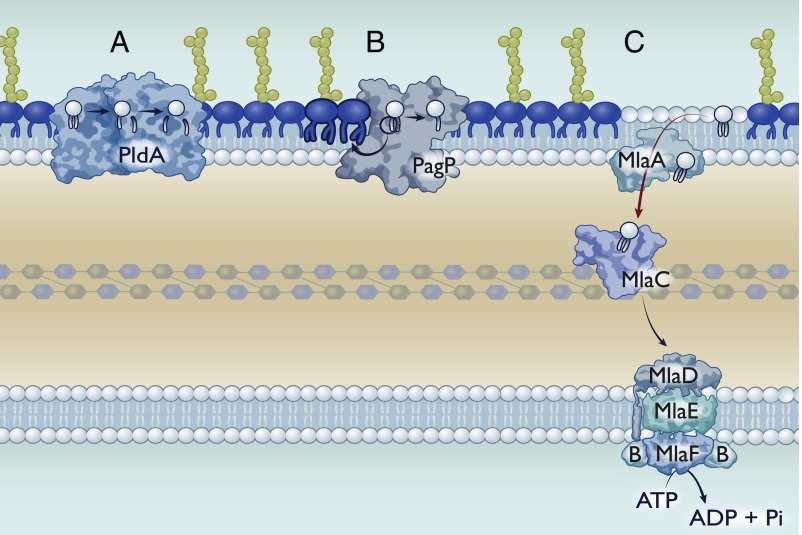
Asymmetry maintenance mechanisms in Gram-negative bacteria. Gram-negative bacteria have multiple mechanisms to maintain asymmetry, although their presence or absence is species-dependent. (A) PldA is an outer membrane phospholipase that sequentially degrades GPLs. Its active site is exposed to the outer leaflet of the outer membrane, such that it can only degrade mislocalized GPLs. PldA can remove both the sn-1 and sn-2 fatty acids. (B) PagP is an outer membrane palmitoyltransferase that catalyzes the transfer of the sn-1 palmitate from a GPL to lipid A, resulting in a hepta-acylated lipid A species. The resulting lyso-GPL could be either removed via an unknown mechanism or degraded by PldA. (C) The Mla system for GPL transport. Importantly, we have depicted Mla as mediating retrograde transport; however, this perspective addresses evidence for both retrograde and anterograde transport.
Fig. 3.
Fig. 3.
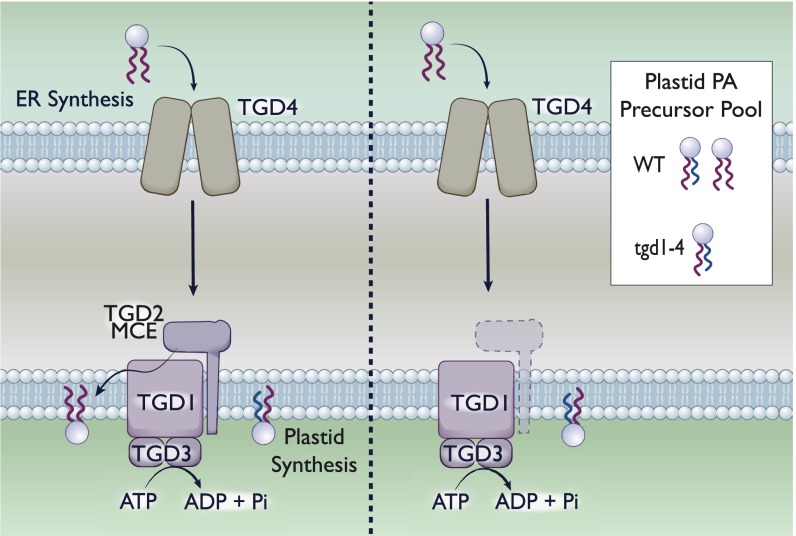
MCE domain protein TGD2 mediates PA transport in chloroplasts. The tgd1-4 genes in plant chloroplasts encode for multiple components of a PA import complex. The sn-2 position of PA differs depending on its origin: ER-derived PA has 18 carbon fatty acids, whereas plastid-derived PA has 16 carbon fatty acids, although the degree of unsaturation can vary. (Left) With the TGD1–4 system intact, the plastid is capable of both de novo synthesis and import of PA. As such, the PA precursor pool contains a roughly equivalent mixture (for A. thaliana) of both species. (Right). A deletion of any tgd1-4 genes eliminates the ability of the plastid to import PA from the ER. As such, the resultant pool of PA in the plastid is de novo-synthesized. We are depicting the deletion of tgd; however, a deletion of any individual component has been demonstrated to eliminate PA import.
Fig. 4.
Fig. 4.
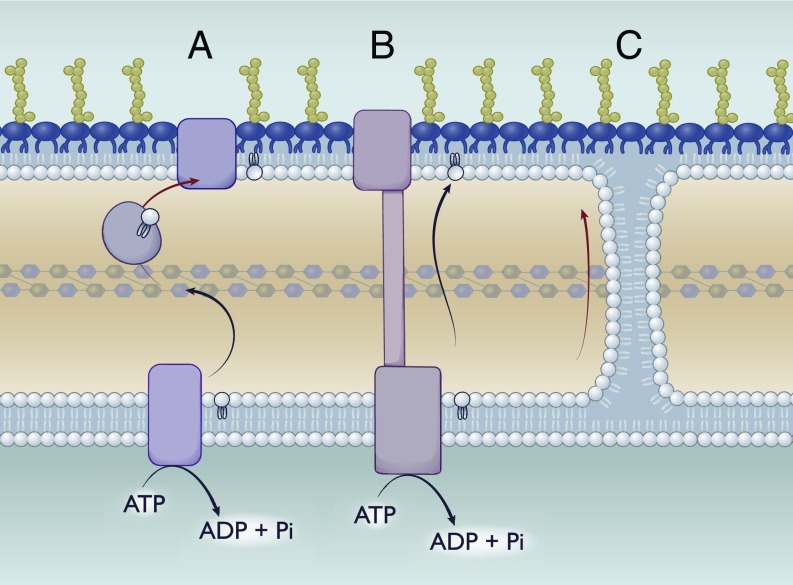
The quest for anterograde transport: Potential mechanisms. Possible mechanisms to mediate transport of GPLs from the inner membrane to the outer membrane. (A) Transport using a periplasmic chaperone. Similar to Lol, transport could be mediated via a periplasmic chaperone that would bind to GPLs either nonspecifically or in a head group-dependent manner. (B) Transport via a periplasmic-spanning bridge. Similar to the Lpt system, this model would rely on a continuous protein bridge consisting of an inner membrane complex, periplasmic components, and an outer membrane partner. (C) Passive diffusion via Bayer’s junctions. Bayer’s junctions have been proposed to form between the outer leaflet of the inner membrane and the inner leaflet of the outer membrane. These junctions could allow for the passive diffusion of GPLs between both inner and outer membranes continuously.

References

    1. Lombard J., Once upon a time the cell membranes: 175 years of cell boundary research. Biol. Direct 9, 32 (2014). - PMC - PubMed
    1. Voelker D. R., Organelle biogenesis and intracellular lipid transport in eukaryotes. Microbiol. Rev. 55, 543–560 (1991). - PMC - PubMed
    1. Sohlenkamp C., Geiger O., Bacterial membrane lipids: Diversity in structures and pathways. FEMS Microbiol. Rev. 40, 133–159 (2016). - PubMed
    1. Bell R. M., Mavis R. D., Osborn M. J., Vagelos P. R., Enzymes of phospholipid metabolism: Localization in the cytoplasmic and outer membrane of the cell envelope of Escherichia coli and Salmonella typhimurium. Biochim. Biophys. Acta 249, 628–635 (1971). - PubMed
    1. Pomorski T. G., Menon A. K., Lipid somersaults: Uncovering the mechanisms of protein-mediated lipid flipping. Prog. Lipid Res. 64, 69–84 (2016). - PMC - PubMed

Publication types

MeSH terms

Substances

LinkOut - more resources