


Trajectories of Growth Associated With Long-Term Stimulant Medication in the Multimodal Treatment Study of Attention-Deficit/Hyperactivity Disorder
- PMID: 31421233
- PMCID: PMC7021562
- DOI: 10.1016/j.jaac.2019.06.019
Trajectories of Growth Associated With Long-Term Stimulant Medication in the Multimodal Treatment Study of Attention-Deficit/Hyperactivity Disorder
Abstract
Objective: To estimate long-term stimulant treatment associations on standardized height, weight, and body mass index trajectories from childhood to adulthood in the Multimodal Treatment Study of Attention-Deficit/Hyperactivity Disorder (MTA).
Method: Of 579 children with DSM-IV ADHD-combined type at baseline (aged 7.0-9.9 years) and 289 classmates (local normative comparison group [LNCG]), 568 and 258 respectively, were assessed 8 times over 16 years (final mean age = 24.7). Parent interview data established subgroups with self-selected Consistent (n = 53, 9%), Inconsistent (n = 374, 66%), and Negligible (n = 141, 25%) stimulant medication use, as well as patients starting stimulants prior to MTA entry (n = 211, 39%). Height and weight growth trajectories were calculated for each subgroup.
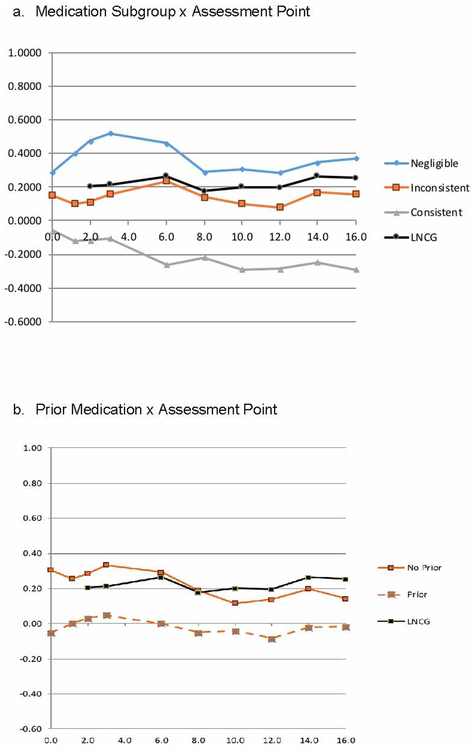
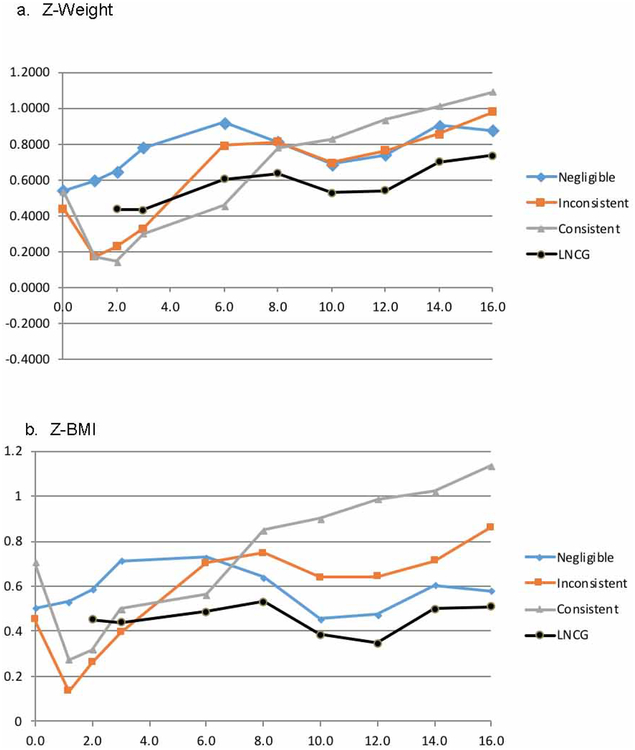
Results: Height z scores trajectories differed among subgroups (F = 2.22, p < .0001) and by stimulant use prior to study entry (F = 2.22, p < .001). The subgroup-by-assessment interaction was significant (F = 2.81, p < .0001). Paired comparisons revealed significant subgroup differences at endpoint: Consistent was shorter than Negligible (-0.66 z units /-4.06 cm /1.6 inches, t = -3.17, p < 0.0016), Consistent shorter than Inconsistent (-0.45 z units /-2.74 cm /-1.08 inches, t = -2.39, p < .0172), and the Consistent shorter than LNCG (-0.54 z units/+3.34 cm/ 1.31 inches, t = -3.30, p < 0.001). Weight z scores initially diverged among subgroups, converged in adolescence, and then diverged again in adulthood when the Consistent outweighed the LNCG (+ 3.561 z units /+7.47 kg /+16.46 lb, p < .0001).
Conclusion: Compared with those negligibly medicated and the LNCG, 16 years of consistent stimulant treatment of children with ADHD in the MTA was associated with changes in height trajectory, a reduction in adult height, and an increase in weight and body mass index.
Clinical trial registration information: Multimodal Treatment Study of Children With Attention Deficit and Hyperactivity Disorder (MTA); https://clinicaltrials.gov/; NCT00000388.
Keywords: ADHD; adult height; growth trajectory; longitudinal study; stimulant medication.
Copyright © 2019 American Academy of Child and Adolescent Psychiatry. Published by Elsevier Inc. All rights reserved.
Figures
Comment in
-
Editorial: Time for a New Conversation on Stimulant Use.J Am Acad Child Adolesc Psychiatry. 2020 Aug;59(8):929-930. doi: 10.1016/j.jaac.2019.10.004. Epub 2019 Oct 18. J Am Acad Child Adolesc Psychiatry. 2020. PMID: 31634569
References
-
- Safer D, Allen R, Barr E, Depression of growth in hyperactive children on stimulant drugs. N Engl J Med 1972; 287:217–220 - PubMed
-
- Safer DJ, Allen RP, Barr E, Growth rebound after termination of stimulant drugs. J Pediatr 1975; 86:113–116 - PubMed
-
- Satterfield JH, Cantwell DP, Schell A, Blaschke T, Growth of hyperactive children with methylphenidate. Arch Gen Psychiatry 1979; 36:212–217 - PubMed
-
- Roche AF, Lipman RS, Overall JE, Hung W (1979), The effects of stimulant medication on the growth of hyperkinetic children. Pediatrics 1979; 63:847–850 - PubMed
-
- Gittelman-Klein R, Landa B, Mattes JA, Klein DF, Methylphenidate and growth in hyperactive children. Arch Gen Psychiatry 1988; 36:212–217 - PubMed
Publication types
MeSH terms
Substances
Associated data
Grants and funding
- HHSN271200800003C/DA/NIDA NIH HHS/United States
- HHSN271200800005C/DA/NIDA NIH HHS/United States
- HHSN271200800006C/DA/NIDA NIH HHS/United States
- N01 DA085552/DA/NIDA NIH HHS/United States
- N01 MH012008/MH/NIMH NIH HHS/United States
- U01 MH050461/MH/NIMH NIH HHS/United States
- K23 DA032577/DA/NIDA NIH HHS/United States
- N01 MH012007/MH/NIMH NIH HHS/United States
- HHSN271200800008C/DA/NIDA NIH HHS/United States
- HHSN271200800004C/DA/NIDA NIH HHS/United States
- U01 MH050440/MH/NIMH NIH HHS/United States
- HHSN271200800007C/DA/NIDA NIH HHS/United States
- N01 MH012012/MH/NIMH NIH HHS/United States
- N01 MH012010/MH/NIMH NIH HHS/United States
- HHSN271200800009C/DA/NIDA NIH HHS/United States
- U01 MH050467/MH/NIMH NIH HHS/United States
- R01 MH083692/MH/NIMH NIH HHS/United States
- N01 MH012011/MH/NIMH NIH HHS/United States
- N01 MH012004/MH/NIMH NIH HHS/United States
- N01 MH012009/MH/NIMH NIH HHS/United States
- U01 MH050453/MH/NIMH NIH HHS/United States
