


In utero and peripubertal metals exposure in relation to reproductive hormones and sexual maturation and progression among girls in Mexico City
- PMID: 31421446
- PMCID: PMC6734930
- DOI: 10.1016/j.envres.2019.108630
In utero and peripubertal metals exposure in relation to reproductive hormones and sexual maturation and progression among girls in Mexico City
Abstract
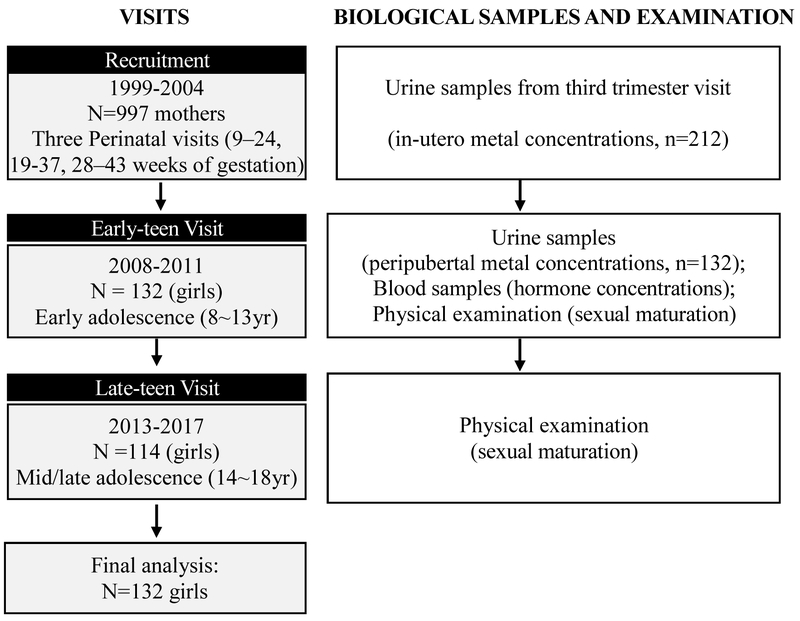
There is increasing evidence that several metals are endocrine disrupting chemicals (EDCs). In utero development and adolescence are critical windows of susceptibility to EDC exposure. With the exception of a few heavy metals, few human studies have evaluated the impact of metal exposure on pubertal development. Our aim was to investigate measures of in utero and peripubertal metal exposure in relation to reproductive hormone levels and sexual maturation and progression among girls from the Early Life Exposure in Mexico to Environmental Toxicants (ELEMENT) cohorts. We measured urinary concentrations of aluminum (Al), arsenic (As), barium (Ba), cadmium (Cd), cobalt (Co), copper (Cu), iron (Fe), manganese (Mn), molybdenum (Mo), nickel (Ni), antimony (Sb), selenium (Se), and zinc (Zn) in samples collected from women during their third trimester of pregnancy and from their female children at 8-13 years (n = 132). We measured serum testosterone, estradiol, dehydroepiandrosterone sulfate (DHEA-S), inhibin B, and sex hormone-binding globulin (SHBG) at age 8-13, and assessed Tanner stages for sexual maturation (breast, pubic hair development, and menarche status), at two time points (8-13, 14-18 years). We used linear regression to independently examine in utero and peripubertal metal concentrations as predictors of peripubertal hormones. In a longitudinal analysis using generalized estimation equations, we evaluated Tanner stage and menarche progression in relation to individual in utero and peripubertal metal concentrations. We found that higher in utero Zn was associated with increased inhibin B. Several metals at 8-13 years were associated with higher DHEA-S and estradiol, while Ni was positively but Cu was negatively associated with testosterone. In utero Ni, Al, and Cd were associated with slower progression of breast development after adjustment for child age and BMI z-score. For example, an IQR increase in in utero Al exposure was associated with 0.82 times lower odds of progressing to a higher Tanner stage for breast development per year (95% CI: 0.68, 0.99). Peripubertal concentrations of Ba and Al were also associated with being at a higher pubic hair Tanner stage and menarche at 8-13, but lower odds of progressing to the next stage at 14-18 years. We used Bayesian kernel machine regression (BKMR) to model the joint effect of multiple metals while accounting for correlated exposures, as well as potential non-linear relationships between metals and outcomes of interest, which yielded results similar to individual analyses. These findings suggest that female reproductive development may be vulnerable to the effects of metal exposure, and using both Tanner stages and hormone levels may provide clues about underlying mechanisms in two sensitive periods of development.
Keywords: Hormone; In utero exposure; Metal; Pregnancy; Puberty.
Copyright © 2019 Elsevier Inc. All rights reserved.
Conflict of interest statement
Competing interests
The authors declare that they have no competing interests.
Figures


References
-
- Agusa T, Kunito T, Iwata H, Monirith I, Chamnan C, Tana TS, et al. 2007. Mercury in hair and blood from residents of phnom penh (cambodia) and possible effect on serum hormone levels. Chemosphere 68:590–596. - PubMed
-
- Ali AT. 2014. Reproductive factors and the risk of endometrial cancer. Int J Gynecol Cancer 24:384–393. - PubMed
-
- AMAI. 2000. Avances del comité de niveles socioeconómicos. Vol. 2018:Comité de Niveles Socioeconómicos. Asociación Mexicana de Agencias de Investigación de Mercados y Opinión Pública, A.C.
-
- Anderson SE, Dallal GE, Must A. 2003. Relative weight and race influence average age at menarche: Results from two nationally representative surveys of us girls studied 25 years apart. Pediatrics 111:844–850. - PubMed
-
- Ashby SL, King LJ, Parke DV. 1980. Effect of acute administration of cadmium on the disposition of copper, zinc, and iron in the rat. Environ Res 21:177–185. - PubMed
MeSH terms
Substances
Grants and funding
LinkOut - more resources
Full Text Sources
Research Materials
Miscellaneous
