


Addressing personal parental values in decisions about childhood vaccination: Measure development
- PMID: 31421930
- PMCID: PMC6752201
- DOI: 10.1016/j.vaccine.2019.08.009
Addressing personal parental values in decisions about childhood vaccination: Measure development
Abstract
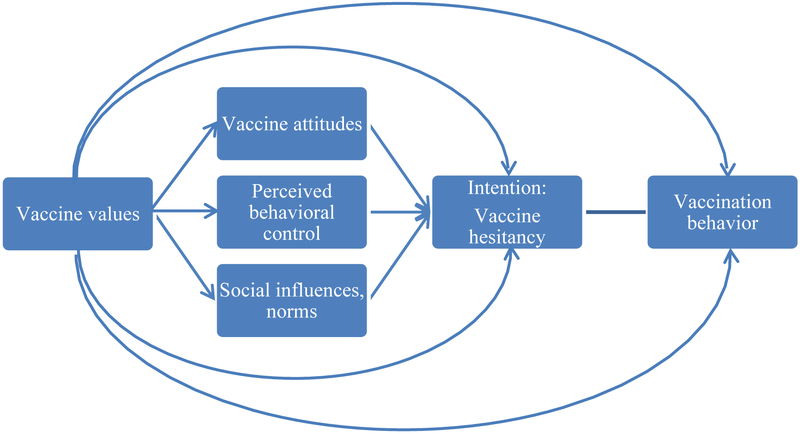
Objective: Evidence-based strategies to address vaccine hesitancy are lacking. Personal values are a measurable psychological construct that could be used to deliver personalized messages to influence vaccine hesitancy and behavior. Our objectives were to develop a valid, reliable self-report survey instrument to measure vaccine values based on the Schwartz theory of basic human values, and to test the hypothesis that vaccine values are distinct from vaccine attitudes and are related to vaccine hesitancy and behavior.
Methods: Parental Vaccine Values (PVV) scale items were generated using formative qualitative research and expert input, yielding 24 items for testing. 295 parents of children aged 14-30 months completed a self-report survey with measures of Schwartz's global values, the PVV, vaccine attitudes, and vaccine hesitancy. Factor analysis was used to determine vaccine values factor structure. Associations between vaccine values, vaccine attitudes, vaccine hesitancy, and vaccination behavior were assessed using linear and logistic regression models. Late vaccination was assessed from electronic medical records.
Results: A six-factor structure for vaccine values was determined with good fit (RMSEA = 0.07, Bentler's CFI = 0.91) with subscales for Conformity, Universalism, Tradition, Self-Direction, Security- Disease Prevention, and Security- Vaccine Risk. Vaccine values were moderately associated with Schwartz global values and vaccine attitudes, indicating discriminant validity from these constructs. Multivariable linear regression showed vaccine hesitancy was associated with vaccine values Conformity (partial R2 = 0.10) and Universalism (0.04) and vaccine attitudes Vaccine Safety (0.52) and Vaccine Benefit (0.16). Multivariable logistic regression showed that late vaccination was associated with vaccine value Self-direction (OR = 1.80, 95% CI: 1.26-2.65) and vaccine attitude of Vaccine Benefit (OR = 0.44, 95% CI: 0.32-0.60).
Conclusions: The PVV scale had good psychometric properties and appears related to but distinct from Schwartz global values and vaccine attitudes. Vaccine values are associated with vaccine hesitancy and late vaccination and may be useful in tailoring future interventions.
Keywords: Immunization; Parents; Vaccine hesitancy; Values.
Copyright © 2019 Elsevier Ltd. All rights reserved.
Conflict of interest statement
Declaration of interests
The authors declare that they have no known competing financial interests or personal relationships that could have appeared to influence the work reported in this paper.
Figures
References
-
- Roush SW, Murphy TV, Vaccine-Preventable Disease Table Working G. Historical comparisons of morbidity and mortality for vaccine-preventable diseases in the United States. JAMA. 2007;298(18):2155–2163. - PubMed
-
- Hamborsky J, Kroger A, Wolfe C. Epidemiology and Prevention of Vaccine-preventable Diseases: The Pink Book: Course Textbook. Public Health Foundation; 2015.
-
- Centers for Disease C, Prevention. Impact of vaccines universally recommended for children--United States, 1990-1998. MMWR Morb Mortal Wkly Rep. 1999;48(12):243–248. - PubMed
-
- Omer SB, Pan WK, Halsey NA, et al. Nonmedical exemptions to school immunization requirements: secular trends and association of state policies with pertussis incidence. JAMA. 2006;296(14):1757–1763. - PubMed
-
- Glanz JM, Newcomer SR, Narwaney KJ, et al. A population-based cohort study of undervaccination in 8 managed care organizations across the United States. JAMA Pediatr. 2013;167(3):274–281. - PubMed
Publication types
MeSH terms
Grants and funding
LinkOut - more resources
Full Text Sources
Medical
Miscellaneous
