. 2020 Jan;29(1):28-35.
doi: 10.1002/pro.3711. Epub 2019 Aug 29.

KEGG Mapper for inferring cellular functions from protein sequences

Affiliations

KEGG Mapper for inferring cellular functions from protein sequences

Minoru Kanehisa et al. Protein Sci. 2020 Jan.

Abstract

KEGG is a reference knowledge base for biological interpretation of large-scale molecular datasets, such as genome and metagenome sequences. It accumulates experimental knowledge about high-level functions of the cell and the organism represented in terms of KEGG molecular networks, including KEGG pathway maps, BRITE hierarchies, and KEGG modules. By the process called KEGG mapping, a set of protein coding genes in the genome, for example, can be converted to KEGG molecular networks enabling interpretation of cellular functions and other high-level features. Here we report a new version of KEGG Mapper, a suite of KEGG mapping tools available at the KEGG website (https://www.kegg.jp/ or https://www.genome.jp/kegg/), together with the KOALA family tools for automatic assignment of KO (KEGG Orthology) identifiers used in the mapping.

Keywords: KEGG; KEGG Mapper; KEGG Orthology; KEGG module; genome annotation; pathway analysis.


Figures

Figure 1
Figure 1
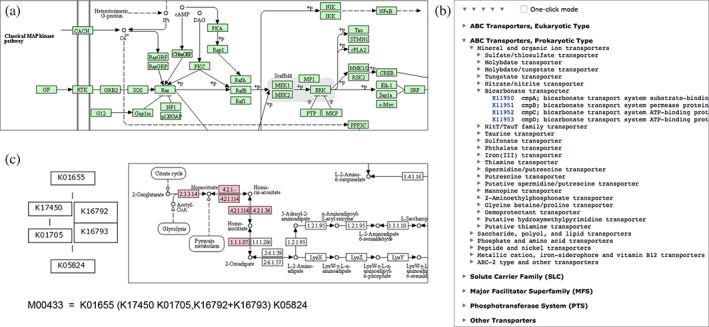
Knowledge representation of molecular interaction, reaction, and relation networks in KEGG. (a) KEGG pathway map for human MAPK signaling pathway (hsa04010). (b) BRITE hierarchy for transporter classification (ko02000). (c) KEGG module for lysine biosynthesis, 2‐oxoglutarate = > 2‐oxoadipate (M00433), corresponding to the highlighted part in lysine biosynthesis pathway (map00300). The logical expression of K numbers is also represented by the graphical diagram
Figure 2
Figure 2
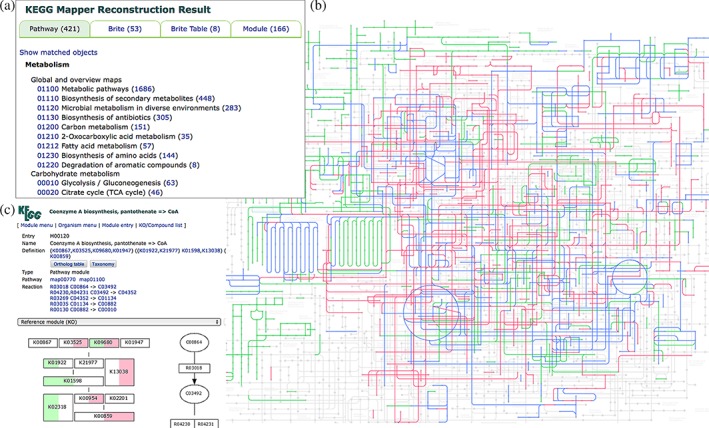
The result of Reconstruct Pathway from the combined gene set of Homo sapiens (T01001) and a gut metagenome sample (T30003). (a) the result page of KEGG pathway mapping, which shows that 421 matching pathway maps are found. (b) Reconstructed global map of metabolic pathways (map01100), where human specific pathways are shown in green, microbiome specific pathways in red, and shared pathways in blue. (c) the result in (a) shows that 166 complete modules are found. An example is coenzyme A biosynthesis (M00120), in which different gene sets, green for human and pink for microbiome, make this module complete
Figure 3
Figure 3
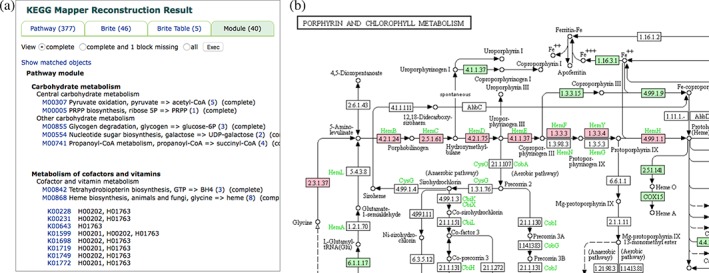
The result of Reconstruct Pathway from the entire set of disease genes represented by KOs in the KEGG DISEASE database. (a) the result page of mapping against KEGG modules, which shows that 40 complete modules are reconstructed. One of them is M00868 for heme biosynthesis, where all genes are associated with H01763 for porphyria. (b) the pathway module M00868 is shown in pink in the pathway map hsa00860 for porphyrin and chlorophyll metabolism. Eight genes in this module correspond to eight disease‐associated genes in H01763
Figure 4
Figure 4
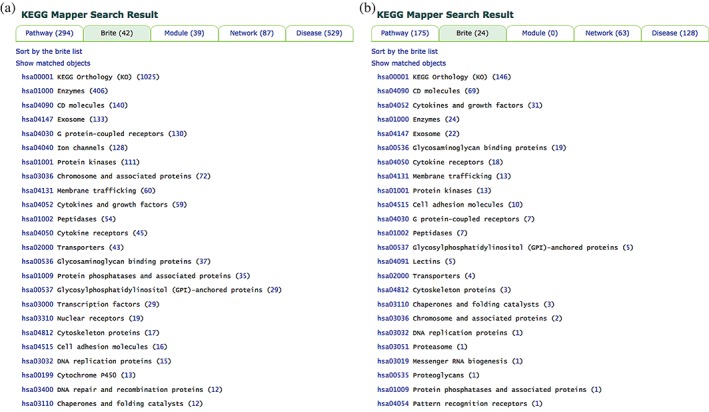
The result of Search Pathway from the human protein set of drug targets in the KEGG DRUG database. (a) the result page of mapping against BRITE hierarchies for the full set of drug targets, which shows that 42 matching hierarchy files are found with “enzymes” at the top, excluding the KEGG Orthology (KO) file. (b) the result page of mapping against BRITE hierarchies for the targets of monoclonal antibodies, which shows that 24 matching hierarchy files are found with “CD molecules” at the top

References

    1. Kanehisa M, Goto S. KEGG: Kyoto encyclopedia of genes and genomes. Nucleic Acids Res. 2000;28:27–30. - PMC - PubMed
    1. Ashburner M, Ball CA, Blake JA, et al. Gene ontology: Tool for the unification of biology. Nat Genet. 2000;25:25–29. - PMC - PubMed
    1. Kanehisa M, Sato Y, Kawashima K, Furumichi M, Tanabe M. KEGG as a reference resource for gene and protein annotation. Nucleic Acids Res. 2016;44:D457–D462. - PMC - PubMed
    1. Kanehisa M. Inferring antimicrobial resistance from pathogen genomes in KEGG. Methods Mol Biol. 2018;1807:225–239. - PubMed
    1. Pearson WR. Searching protein sequence libraries: Comparison of the sensitivity and selectivity of the Smith‐Waterman and FASTA algorithms. Genomics. 1991;11:635–650. - PubMed

Publication types