Clinical Trial
. 2019 Aug;7(16):e14199.
doi: 10.14814/phy2.14199.

Oral vancomycin treatment does not alter markers of postprandial inflammation in lean and obese subjects

Affiliations
Clinical Trial

Oral vancomycin treatment does not alter markers of postprandial inflammation in lean and obese subjects

Guido J Bakker et al. Physiol Rep. 2019 Aug.

Abstract

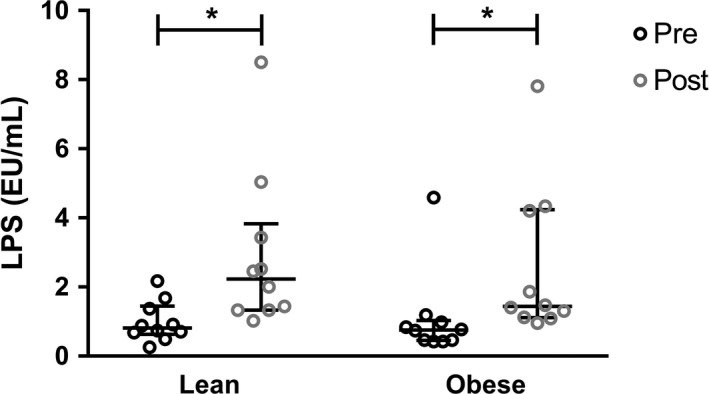
Intake of a high-fat meal induces a systemic inflammatory response in the postprandial which is augmented in obese subjects. However, the underlying mechanisms of this response have not been fully elucidated. We aimed to assess the effect of gut microbiota modulation on postprandial inflammatory response in lean and obese subjects. Ten lean and ten obese subjects with metabolic syndrome received oral vancomycin 500 mg four times per day for 7 days. Oral high-fat meal tests (50 g fat/m2 body surface area) were performed before and after vancomycin intervention. Gut microbiota composition, leukocyte counts, plasma lipopolysaccharides (LPS), LPS-binding protein (LBP), IL-6 and MCP-1 concentrations and monocyte CCR2 and cytokine expression were determined before and after the high-fat meal. Oral vancomycin treatment resulted in profound changes in gut microbiota composition and significantly decreased bacterial diversity in both groups (phylogenetic diversity pre- versus post-intervention: lean, 56.9 ± 7.8 vs. 21.4 ± 6.6, P < 0.001; obese, 53.9 ± 7.8 vs. 21.0 ± 5.9, P < 0.001). After intervention, fasting plasma LPS significantly increased (lean, median [IQR] 0.81 [0.63-1.45] EU/mL vs. 2.23 [1.33-3.83] EU/mL, P = 0.017; obese, median [IQR] 0.76 [0.45-1.03] EU/mL vs. 1.44 [1.11-4.24], P = 0.014). However, postprandial increases in leukocytes and plasma LPS were unaffected by vancomycin in both groups. Moreover, we found no changes in plasma LBP, IL-6 and MCP-1 or in monocyte CCR2 expression. Despite major vancomycin-induced disruption of the gut microbiota and increased fasting plasma LPS, the postprandial inflammatory phenotype in lean and obese subjects was unaffected in this study.

Keywords: Bacterial endotoxins; bacterial translocation; inflammation; obesity.


Conflict of interest statement

None.

Figures
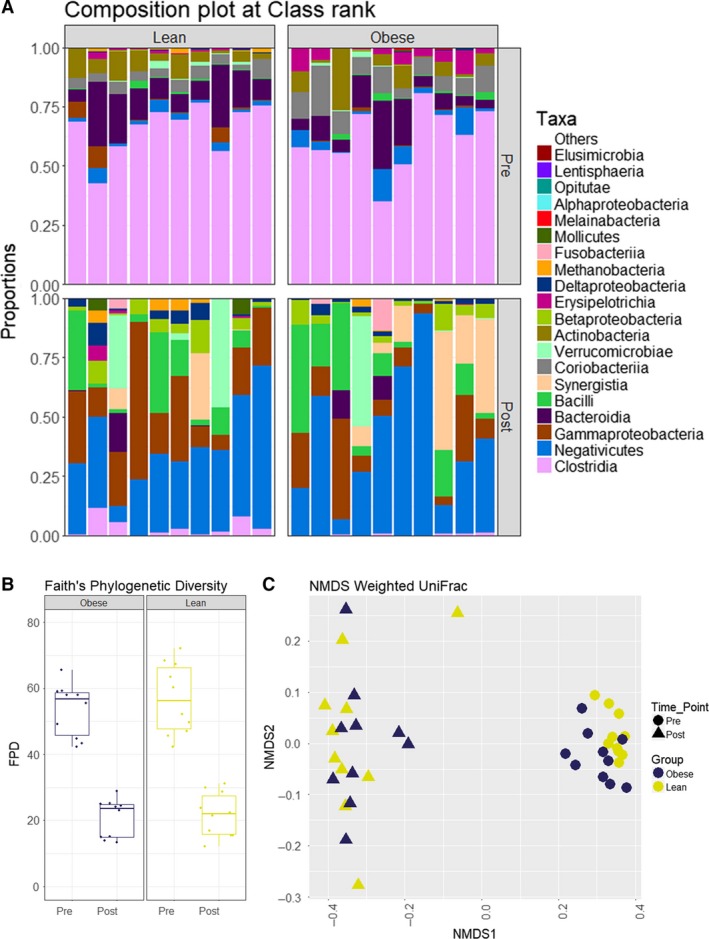
Figure 1
Figure 1
Effect of vancomycin on gut microbiota composition. Fecal microbial community characteristics of obese and lean subjects before and after treatment. Vancomycin treatment resulted in significant changes in gut microbiota composition in both groups. (A) microbial composition showing the 20 most abundant bacterial classes (upper part, preintervention; lower part, postintervention). (B) Faith’s phylogenetic diversity distribution showed a significant decrease in alpha‐diversity (lean, P < 0.001; obese, P < 0.001). (C) NMDS ordination of the weighted UniFrac distances showed a significant shift in beta‐diversity (lean, P = 0.001; obese, P = 0.001).
Figure 2
Figure 2
Effect of vancomycin on fasting plasma LPS. Vancomycin treatment significantly increased fasting plasma LPS in both groups (Wilcoxon signed rank test; lean, P = 0.017; obese, P = 0.014). Lines at median and IQR.
Figure 3
Figure 3
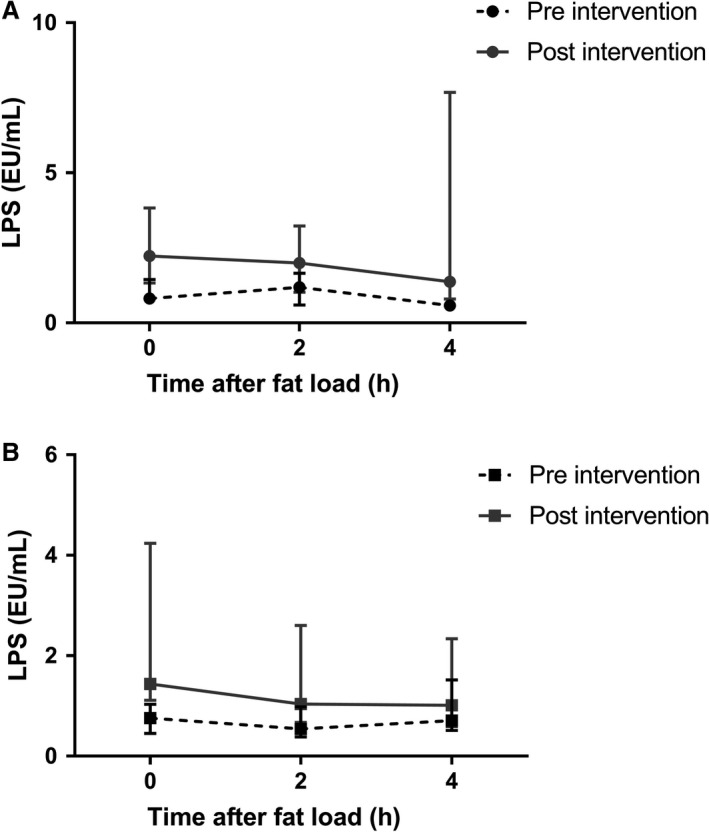
Postprandial LPS concentrations. LPS concentrations did not increase after the high‐fat meal in both the lean (A) and obese (B) group. Vancomycin treatment did not affect postprandial LPS concentrations (two‐way repeated measures ANOVA, time × treatment interaction: lean, P = 0.318, obese, P = 0.714). Lines show median and IQR.
Figure 4
Figure 4
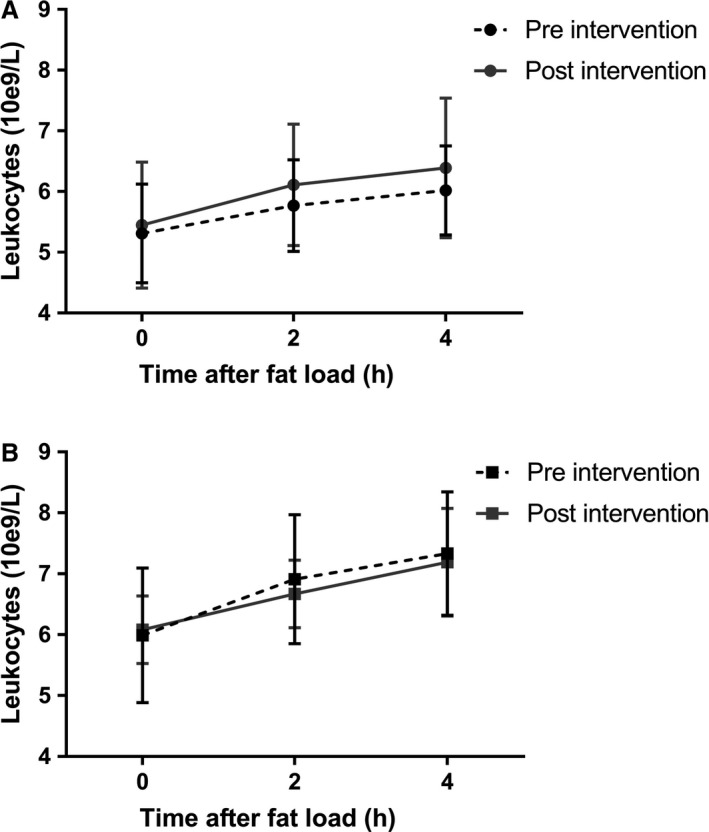
Postprandial blood leukocyte counts. Leukocyte counts significantly increased after the meal in both the lean (A) and obese (B) group (one‐way rm‐ANOVA: lean, P = 0.006 preintervention and P = 0.001 postintervention; obese, P = 0.001 preintervention and P = 0.003 postintervention). Vancomycin treatment did not affect postprandial leukocyte counts. Graphs show mean and SD.
Figure 5
Figure 5
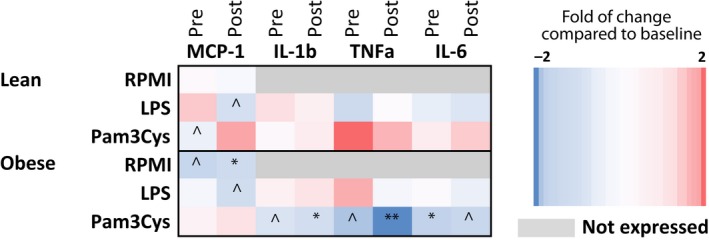
Effect of a high‐fat meal on monocyte cytokine production. Monocytes of lean and obese subjects were isolated before (t = 0 h) and after (t = 4 h) a high‐fat meal. Monocytes were stimulated with RPMI (negative control), LPS (TLR4 stimulation) or Pam3Cys (TLR2 stimulation). After 24 h, concentrations of MCP‐1, IL‐1β, TNF‐α and IL‐6 were measured in the supernatant. The heatmap shows the effects of the meal on monocyte cytokine production before (pre) and after (post) vancomycin treatment. Red indicates upregulated cytokine production after the meal compared to before the meal. Blue indicates a downregulation of cytokine production after the meal compared to before the meal. n = 10 per group. ^P < 0.1, *P < 0.05, **P < 0.01. RPMI, Roswell Park Memorial Institute.

References

    1. Alipour, A. , van Oostrom A. J., Izraeljan A., Verseyden C., Collins J. M., Frayn K. N., et al. 2008. Leukocyte activation by triglyceride‐rich lipoproteins. Arterioscler. Thromb. Vasc. Biol. 28:792–797. - PubMed
    1. Amar, J. , Chabo C., Waget A., Klopp P., Vachoux C., Bermudez‐Humaran L. G., et al. 2011. Intestinal mucosal adherence and translocation of commensal bacteria at the early onset of type 2 diabetes: molecular mechanisms and probiotic treatment. EMBO Mol. Med. 3:559–572. - PMC - PubMed
    1. Basu, S. , Haghiac M., Surace P., Challier J. C., Guerre‐Millo M., Singh K., et al. 2011. Pregravid obesity associates with increased maternal endotoxemia and metabolic inflammation. Obesity (Silver Spring) 19:476–482. - PMC - PubMed
    1. Beaslas, O. , Cueille C., Delers F., Chateau D., Chambaz J., Rousset M., et al. 2009. Sensing of dietary lipids by enterocytes: a new role for SR‐BI/CLA‐1. PLoS One 4:e4278. - PMC - PubMed
    1. Bernelot Moens, S. J. , Neele A. E., Kroon J., van der Valk F. M., Van den Bossche J., Hoeksema M. A., et al. 2017. PCSK9 monoclonal antibodies reverse the pro‐inflammatory profile of monocytes in familial hypercholesterolaemia. Eur. Heart J. 38:1584–1593. - PubMed

Publication types