Association Between Maternal Fluoride Exposure During Pregnancy and IQ Scores in Offspring in Canada
- PMID: 31424532
- PMCID: PMC6704756
- DOI: 10.1001/jamapediatrics.2019.1729
Association Between Maternal Fluoride Exposure During Pregnancy and IQ Scores in Offspring in Canada
Abstract
Importance: The potential neurotoxicity associated with exposure to fluoride, which has generated controversy about community water fluoridation, remains unclear.
Objective: To examine the association between fluoride exposure during pregnancy and IQ scores in a prospective birth cohort.
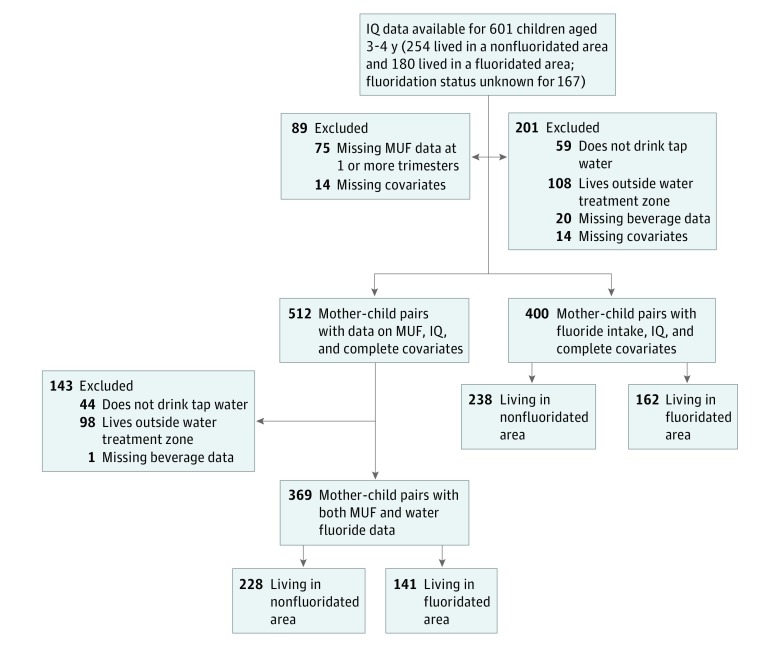
Design, setting, and participants: This prospective, multicenter birth cohort study used information from the Maternal-Infant Research on Environmental Chemicals cohort. Children were born between 2008 and 2012; 41% lived in communities supplied with fluoridated municipal water. The study sample included 601 mother-child pairs recruited from 6 major cities in Canada; children were between ages 3 and 4 years at testing. Data were analyzed between March 2017 and January 2019.
Exposures: Maternal urinary fluoride (MUFSG), adjusted for specific gravity and averaged across 3 trimesters available for 512 pregnant women, as well as self-reported maternal daily fluoride intake from water and beverage consumption available for 400 pregnant women.
Main outcomes and measures: Children's IQ was assessed at ages 3 to 4 years using the Wechsler Primary and Preschool Scale of Intelligence-III. Multiple linear regression analyses were used to examine covariate-adjusted associations between each fluoride exposure measure and IQ score.
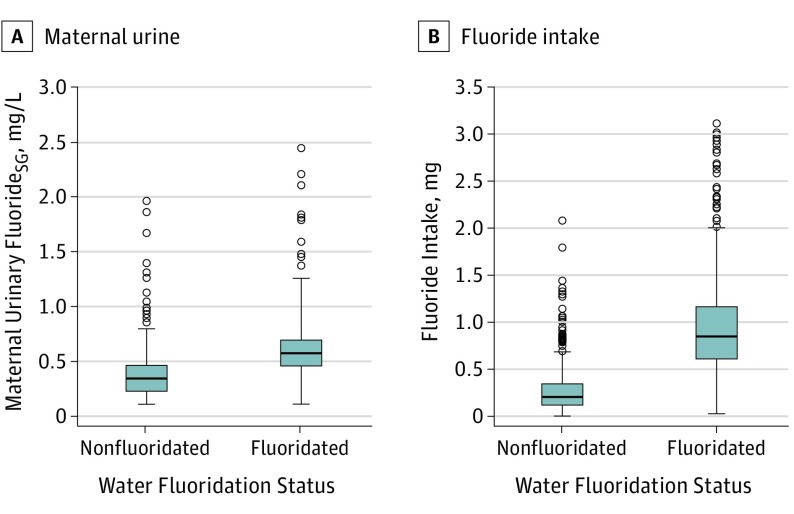
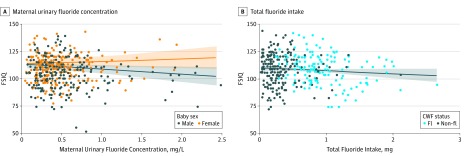
Results: Of 512 mother-child pairs, the mean (SD) age for enrollment for mothers was 32.3 (5.1) years, 463 (90%) were white, and 264 children (52%) were female. Data on MUFSG concentrations, IQ scores, and complete covariates were available for 512 mother-child pairs; data on maternal fluoride intake and children's IQ were available for 400 of 601 mother-child pairs. Women living in areas with fluoridated tap water (n = 141) compared with nonfluoridated water (n = 228) had significantly higher mean (SD) MUFSG concentrations (0.69 [0.42] mg/L vs 0.40 [0.27] mg/L; P = .001; to convert to millimoles per liter, multiply by 0.05263) and fluoride intake levels (0.93 [0.43] vs 0.30 [0.26] mg of fluoride per day; P = .001). Children had mean (SD) Full Scale IQ scores of 107.16 (13.26), range 52-143, with girls showing significantly higher mean (SD) scores than boys: 109.56 (11.96) vs 104.61 (14.09); P = .001. There was a significant interaction (P = .02) between child sex and MUFSG (6.89; 95% CI, 0.96-12.82) indicating a differential association between boys and girls. A 1-mg/L increase in MUFSG was associated with a 4.49-point lower IQ score (95% CI, -8.38 to -0.60) in boys, but there was no statistically significant association with IQ scores in girls (B = 2.40; 95% CI, -2.53 to 7.33). A 1-mg higher daily intake of fluoride among pregnant women was associated with a 3.66 lower IQ score (95% CI, -7.16 to -0.14) in boys and girls.
Conclusions and relevance: In this study, maternal exposure to higher levels of fluoride during pregnancy was associated with lower IQ scores in children aged 3 to 4 years. These findings indicate the possible need to reduce fluoride intake during pregnancy.
Conflict of interest statement
Figures
Comment in
-
Association Between Maternal Fluoride Exposure and Child IQ.JAMA Pediatr. 2020 Feb 1;174(2):210-211. doi: 10.1001/jamapediatrics.2019.5230. JAMA Pediatr. 2020. PMID: 31886833 No abstract available.
-
Association Between Maternal Fluoride Exposure and Child IQ.JAMA Pediatr. 2020 Feb 1;174(2):211-212. doi: 10.1001/jamapediatrics.2019.5233. JAMA Pediatr. 2020. PMID: 31886836 No abstract available.
-
Association Between Maternal Fluoride Exposure and Child IQ.JAMA Pediatr. 2020 Feb 1;174(2):214. doi: 10.1001/jamapediatrics.2019.5254. JAMA Pediatr. 2020. PMID: 31886840 No abstract available.
-
Association Between Maternal Fluoride Exposure and Child IQ.JAMA Pediatr. 2020 Feb 1;174(2):213-214. doi: 10.1001/jamapediatrics.2019.5248. JAMA Pediatr. 2020. PMID: 31886842 No abstract available.
-
Association Between Maternal Fluoride Exposure and Child IQ.JAMA Pediatr. 2020 Feb 1;174(2):214-215. doi: 10.1001/jamapediatrics.2019.5263. JAMA Pediatr. 2020. PMID: 31886843 No abstract available.
-
Association Between Maternal Fluoride Exposure and Child IQ.JAMA Pediatr. 2020 Feb 1;174(2):213. doi: 10.1001/jamapediatrics.2019.5245. JAMA Pediatr. 2020. PMID: 31886845 No abstract available.
-
Association Between Maternal Fluoride Exposure and Child IQ.JAMA Pediatr. 2020 Feb 1;174(2):215. doi: 10.1001/jamapediatrics.2019.5266. JAMA Pediatr. 2020. PMID: 31886847 No abstract available.
-
Association Between Maternal Fluoride Exposure and Child IQ.JAMA Pediatr. 2020 Feb 1;174(2):212. doi: 10.1001/jamapediatrics.2019.5236. JAMA Pediatr. 2020. PMID: 31886848 No abstract available.
-
Association Between Maternal Fluoride Exposure and Child IQ.JAMA Pediatr. 2020 Feb 1;174(2):212-213. doi: 10.1001/jamapediatrics.2019.5239. JAMA Pediatr. 2020. PMID: 31886860 No abstract available.
-
Association Between Maternal Fluoride Exposure and Child IQ-Reply.JAMA Pediatr. 2020 Feb 1;174(2):216-217. doi: 10.1001/jamapediatrics.2019.5251. JAMA Pediatr. 2020. PMID: 32011692 Free PMC article. No abstract available.
References
-
- Public Health Agency of Canada The state of Community Water Fluoridation (CWF) across Canada. https://www.canada.ca/en/services/health/publications/healthy-living/com.... Accessed June 15, 2018.
-
- United States Environmental Protection Agency Fluoride: Relative Source Contribution Analysis. Vol 820-R-10-0. https://www.epa.gov/sites/production/files/2019-03/documents/comment-res.... Published 2010. Accessed May 18, 2017.
Grants and funding
LinkOut - more resources
Full Text Sources
Other Literature Sources
Miscellaneous